
Vitals
Multivitamin Gummies for Women — Benefits, What to Look For & Our Pick
2026-09-11
5 min read

2026-09-02 • 4 min read
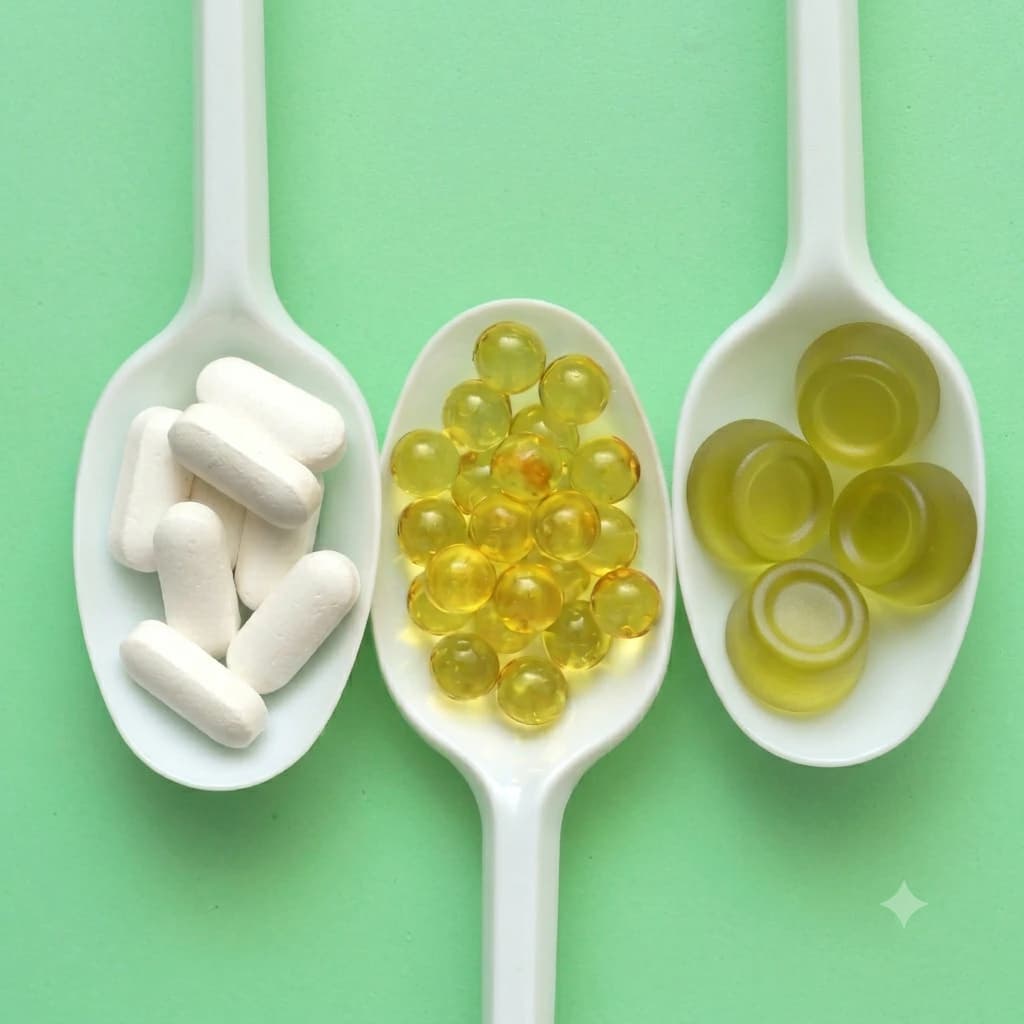
Stand in front of any supplement shelf and you'll see the same vitamin sold three different ways: a bottle of gummy vitamins next to a jar of tablets next to a strip of capsules, all claiming to deliver the same nutrient. The format isn't just packaging. It changes how fast the vitamin breaks down, how precisely it's dosed, and, honestly, whether you'll actually remember to take it tomorrow. Here's a straight comparison of all three, grounded in how each one actually behaves once it's in your body, so you can pick the format that fits your routine instead of whichever one had the nicest bottle.
A gummy is a dose of vitamins suspended in a chewable, sweetened base, usually pectin or gelatin, that you chew and swallow directly. A tablet is a compressed powder that has to disintegrate in the stomach before the nutrient can be absorbed, which is why tablets often include disintegrants and coatings to control how and where that breakdown happens. A capsule encloses the same kind of powder, or sometimes a liquid, inside a shell that dissolves relatively quickly, releasing the contents to disperse faster than a compressed tablet would. None of this changes what the vitamin itself does once it's absorbed. It changes how it gets to that point.
Once any of these three formats reaches your gut and fully breaks down, the nutrient inside absorbs at essentially the same rate, since absorption depends on the nutrient itself, not the shell or base that carried it there. Where the formats genuinely differ is in how quickly they get to that point and how reliably they hold their labelled dose over time. Capsules tend to dissolve fastest, since a thin gelatin or plant-based shell breaks down quicker than a compressed tablet has to disintegrate. Tablets are the most shelf-stable of the three, holding up well to heat and humidity, which is part of why they remain the standard for high-dose, precisely measured supplementation. Gummies sit at the other end: their chewable, moisture-containing base is chemically less stable, and independent testing has repeatedly found that some gummy products drift from their labelled potency faster than tablets or capsules do. The NIH Office of Dietary Supplements is direct about this kind of variation, noting that effectiveness, safety, and quality can differ meaningfully between supplement products regardless of format.
None of this makes one format objectively better. It means each one trades something for something else: capsules for speed, tablets for stability and precision, gummies for taste and daily consistency.
•Be honest about your track record. If tablets sit unopened in a drawer, the best-dosed tablet on the market isn't helping you.
•Check the actual nutrient amount per serving, not just the name, whichever format you choose.
•If sugar matters to you, default to tablets or capsules over gummies.
•Store any format in a cool, dry place. Heat and humidity shorten the effective life of all three, gummies most of all.
•If you take several supplements, capsules and tablets are usually easier to organise into a pill box than gummies, which need to stay in their own container.
Reset Multivitamin Gummies take the gummy format and keep it deliberately simple: eight nutrients, Vitamin B12, Folate, Vitamin C, Vitamin D, Vitamin E, Vitamin A, Zinc, and Magnesium, in a gelatin-free, gluten-free, vegetarian gummy, one a day after a meal. It's made in FSSAI, WHO-GMP, HACCP, and ISO-certified facilities, without artificial flavours or preservatives. If your priority is a format you'll actually take every day without fail, this is a reasonable pick within the trade-offs that gummies carry as a category, including the shelf-stability and sugar points above. If you specifically need iron or a higher, more precisely dosed single nutrient, a tablet or capsule is likely the better fit, and that's worth being upfront about rather than pretending one format suits everyone. As far as multivitamin gummies for adults go, it does the everyday job without overreaching into claims the format can't back up.
•All three formats absorb nutrients at essentially the same rate once fully broken down; the real differences are speed, stability, and precision.
•Capsules tend to dissolve fastest, tablets hold potency longest, and gummies win on taste and daily consistency.
•The best format is the one you'll actually take every day without fail, not necessarily the one with the highest theoretical dose.
•If sugar or precise high dosing matters, tablets or capsules are usually the better fit.
• Reset Multivitamin Gummies offer a simple, eight-nutrient daily option for adults who prioritise consistency over maximum dosing.
Are gummy vitamins as good as tablets? Similar core nutrients in a more palatable form; tablet doses can sometimes run higher.
What's the difference vs capsules? Capsules often deliver concentrated nutrients faster; gummies are easier to chew and taste better.
Which is better for adults? Depends on preference. Gummies suit pill-averse users, tablets suit those wanting precise dosing.
Do gummy vitamins contain less sugar than candy? Yes, sugar levels are controlled for daily nutritional use, not confectionery-level.
Can I switch from tablets to gummies? Yes, if the nutrient profile matches your needs. Check with a healthcare provider if unsure.
National Institutes of Health, Office of Dietary Supplements, “Dietary Supplements: What You Need to Know,” ods.od.nih.gov
Share this article:
A herbal dose of complete wellness

₹439.00
A dose of immunity and goodness with a tangy twist

₹439.00
₹419.00
dose of radiance for skin and hair

₹439.00
| Factor | Gummies | Tablets | Capsules |
|---|---|---|---|
| Dissolution speed | Chewed directly, no disintegration needed | Slower, must break down first | Faster, shell dissolves quickly |
| Dosing precision | Moderate, some nutrients hard to fit in | High, easy to standardise and split | High, especially for oil-based nutrients |
| Shelf stability | Lower, degrades faster over time | Highest, tolerates heat and humidity well | Moderate, sensitive to humidity |
| Taste and compliance | Easiest, tastes like a treat | No taste factor | Neutral, but easier to swallow than most tablets |
| Situation | Best format | Why |
|---|---|---|
| You skip pills because you forget or dislike swallowing them | Gummies | Taste and habit-forming ease beat any format you won't actually take |
| You need a precise, higher single-nutrient dose | Tablets | Easiest to standardise, split, and store long term |
| The nutrient is oil-based or needs to dissolve fast | Capsules | Shell dissolves quickly, disperses liquid or powder contents efficiently |
| You're managing sugar intake closely | Tablets or capsules | Neither typically carries added sugar the way gummies do |
| Check | Why |
|---|---|
| Actual dose per nutrient | Confirms a meaningful amount rather than a token trace |
| Certification (FSSAI, WHO-GMP, ISO, or similar) | Signals the facility follows basic manufacturing standards |
| Expiry and storage instructions | Matters most for gummies, which lose potency fastest |
| Serving size needed to hit stated doses | Some formulas need two or three units a day, changing the real cost |
| Detail | Reset Multivitamin Gummies |
|---|---|
| Key nutrients | B12, Folate, Vitamin C, D, E, A, Zinc, Magnesium |
| Dose | 1 gummy daily, after a meal |
| Dietary fit | Gelatin-free, gluten-free, 100% vegetarian |
| Certifications | FSSAI, WHO-GMP, HACCP, ISO |
| Best suited for | Daily consistency over maximum single-nutrient dose |

