
Vitals
Vitamin Gummies vs Tablets vs Capsules: Which Is Better for Adults?
2026-09-02
4 min read

2026-09-04 • 4 min read
Something that tastes like candy and claims to be good for you deserves a little suspicion, and that instinct is fair. So, are gummies good for health, or are they just a sweetened workaround that happens to have vitamins printed on the label? The honest answer sits in between. Vitamin gummies can genuinely support daily nutrition, and they also come with real trade-offs that pill-based multivitamins don't have. Neither the marketing nor the skepticism tells the full story on its own. Here's what the evidence actually says, who stands to benefit, and how to get the upside without the downsides.
A vitamin gummy is a dose of vitamins and minerals suspended in a chewable, sweetened base, usually pectin or gelatin, instead of being pressed into a tablet or packed into a capsule. The format was originally built for children who couldn't swallow pills, and it has since become the default choice for a large share of adults too, mostly because chewing something that tastes good is simply easier to do every day than swallowing something that doesn't.
The NIH Office of Dietary Supplements is direct about a point that applies to every supplement format, not just gummies: effectiveness, safety, and quality can vary meaningfully between products, and a supplement is meant to complement a healthy diet, not replace one. Independent testing of gummy vitamins has repeatedly found that some products don't contain the exact nutrient amounts listed on the label, partly because gummies are chemically less stable than pressed tablets and lose potency faster over their shelf life. On the sugar side, consumer health sources tracking gummy formulations put the typical range at 2 to 8 grams of added sugar per serving, which for a single gummy isn't dramatic, but adds up if you're also managing sugar intake elsewhere.
None of this means gummies are a bad format. It means they're a convenience trade-off: you gain consistency and ease of use, and you give up a small amount of dosing precision and shelf stability in return. For most healthy adults taking a standard daily multivitamin, that trade works out fine. It matters more for young children, for anyone managing diabetes or sugar intake closely, and for anyone who needs a specific nutrient at a precise, higher dose.
Gummies make the most sense for people who would otherwise skip their multivitamin altogether: adults who genuinely struggle to swallow pills, picky eaters, and anyone whose daily routine is inconsistent enough that a tablet sitting in a drawer never actually gets taken. They're a reasonable everyday choice for generally healthy adults looking to close ordinary nutrient gaps.
They make less sense, or need more caution, for young children around adult-strength formulas that may contain iron, since iron overdose in kids is a genuine medical emergency and gummies are the format most likely to be mistaken for candy. People managing diabetes or watching added sugar closely should also check the label carefully, and anyone with a diagnosed deficiency that needs a specific, higher, precisely dosed nutrient is usually better served by a tablet or a doctor-guided supplement.
•Check the sugar content per serving before you buy, not after.
•Keep the bottle somewhere out of reach of young children, especially any formula containing iron.
•Stick to the labelled serving size; doubling up doesn't double the benefit and can push some nutrients past safe limits.
•Rinse or brush after taking one if you're prone to cavities, since sticky, sugary residue is the main dental concern.
•Store the bottle in a cool, dry place. Heat and humidity speed up potency loss.
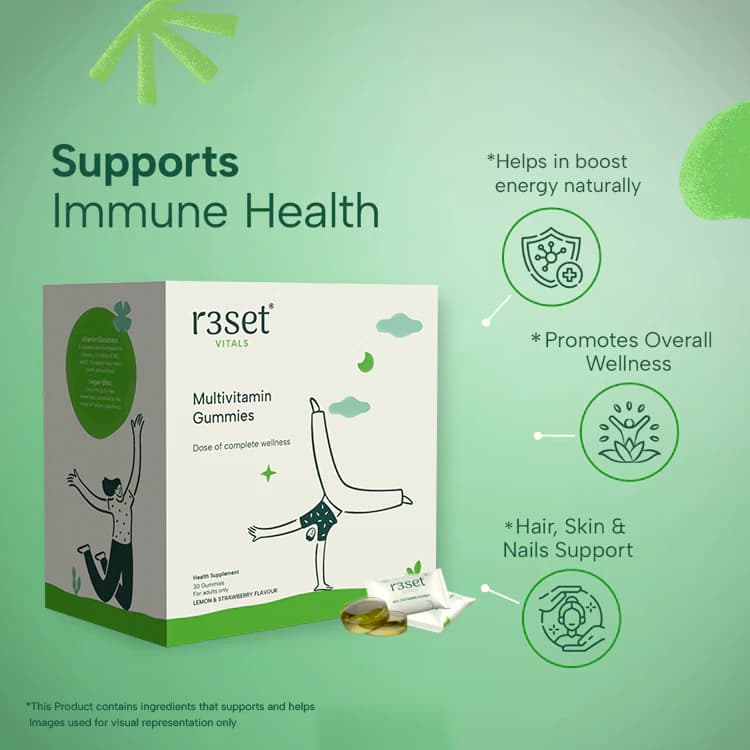
Reset Multivitamin Gummies take a reasonably conservative approach to the format: eight nutrients, Vitamin B12, Folate, Vitamin C, Vitamin D, Vitamin E, Vitamin A, Zinc, and Magnesium, in a gelatin-free, gluten-free, vegetarian gummy taken once a day after a meal. It's made in FSSAI, WHO-GMP, HACCP, and ISO-certified facilities, without artificial flavours or preservatives, and the one-a-day dose keeps sugar intake from the supplement itself modest rather than compounding across two or three gummies. It doesn't contain iron, which is worth knowing both ways: it's a lower-risk pick if there are children in the house, and it means anyone who specifically needs iron should look elsewhere or pair it with food sources. Used as directed, it's a reasonable example of multivitamin gummies for daily health done without overreach.
•Are gummies good for health? Generally yes, for healthy adults using them as a daily backstop to a reasonable diet.
•The real trade-offs are added sugar, faster potency loss, and less precise dosing compared with tablets.
•Keep any gummy vitamin, especially one containing iron, out of reach of young children.
•Tablets remain the better choice for targeted, higher-dose, medically guided supplementation.
•A gummy is only as good as its label: check actual doses, sugar content, and certification before buying.
Are vitamin gummies good for health?
Yes, they can support daily nutrition by filling common dietary gaps when used as directed.
Are gummy vitamins as effective as pills?
Similar nutrients, but may contain less of certain vitamins per dose. Check the label.
Can adults take vitamin gummies daily?
Yes. Consult a doctor if you have an existing medical condition.
Do vitamin gummies have side effects?
Excess intake or gummy sugar content may cause mild issues. Stick to the recommended dose.
Are they suitable for dietary restrictions?
Many are gluten-free, gelatin-free, or vegetarian. Check the specific label.
National Institutes of Health, Office of Dietary Supplements, “Dietary Supplements: What You Need to Know,” ods.od.nih.gov
Share this article:
A herbal dose of complete wellness

₹439.00
dose of radiance for skin and hair

₹439.00
Enhance the quality of sleep and focus with a flavourful dose

₹489.00
| Factor | The upside | The trade-off |
|---|---|---|
| Taste and compliance | Far easier to take daily; feels like less of a chore | Can blur the line between supplement and treat |
| Sugar content | Small enough not to matter for most healthy adults | A single serving often carries 2 to 8 grams of added sugar |
| Nutrient potency | Fine when taken and stored correctly | Gummies degrade faster than tablets, so labelled and actual content can drift over time |
| Dosing | Convenient, no water needed | Harder to fit certain minerals in effective doses; some nutrients are left out entirely |
| Dental impact | Minimal if you rinse or brush after | Sticky texture combined with sugar and acidity raises cavity risk if ignored |
| Child safety | Appealing for kids who refuse pills | Candy-like appearance raises real overdose risk if left within reach |
| Factor | Gummies | Tablets |
|---|---|---|
| Dosing precision | Moderate, some nutrients hard to fit at effective doses | Higher, can carry more concentrated single-nutrient doses |
| Sugar content | Typically 2 to 8 g added sugar per serving | Usually sugar-free |
| Shelf stability | Degrades faster once opened | Holds potency longer |
| Convenience | No water needed, easy to remember | Requires swallowing, sometimes skipped |
| Best for | Daily maintenance, people who struggle with pills | Targeted correction, medically guided dosing |
| Check | Why |
|---|---|
| Actual dose per nutrient, not just the name | Confirms the formula gives a meaningful amount, not a token trace |
| Added sugar per serving | Helps you judge the real trade-off against a tablet |
| Certification (FSSAI, WHO-GMP, ISO, or similar) | Signals the facility meets basic manufacturing standards |
| Gelatin-free or vegetarian status, if relevant | Matters for dietary or religious restrictions |
| Iron content | Critical to check if children could access the bottle |
| Detail | Reset Multivitamin Gummies |
|---|---|
| Key nutrients | B12, Folate, Vitamin C, D, E, A, Zinc, Magnesium |
| Dose | 1 gummy daily, after a meal |
| Dietary fit | Gelatin-free, gluten-free, 100% vegetarian |
| Certifications | FSSAI, WHO-GMP, HACCP, ISO |
| Contains iron? | No, a lower-risk choice around children, but not a fit if you specifically need iron |

