
Vitals
Vitamin Gummies vs Tablets vs Capsules: Which Is Better for Adults?
2026-09-02
4 min read

2026-09-10 • 5 min read
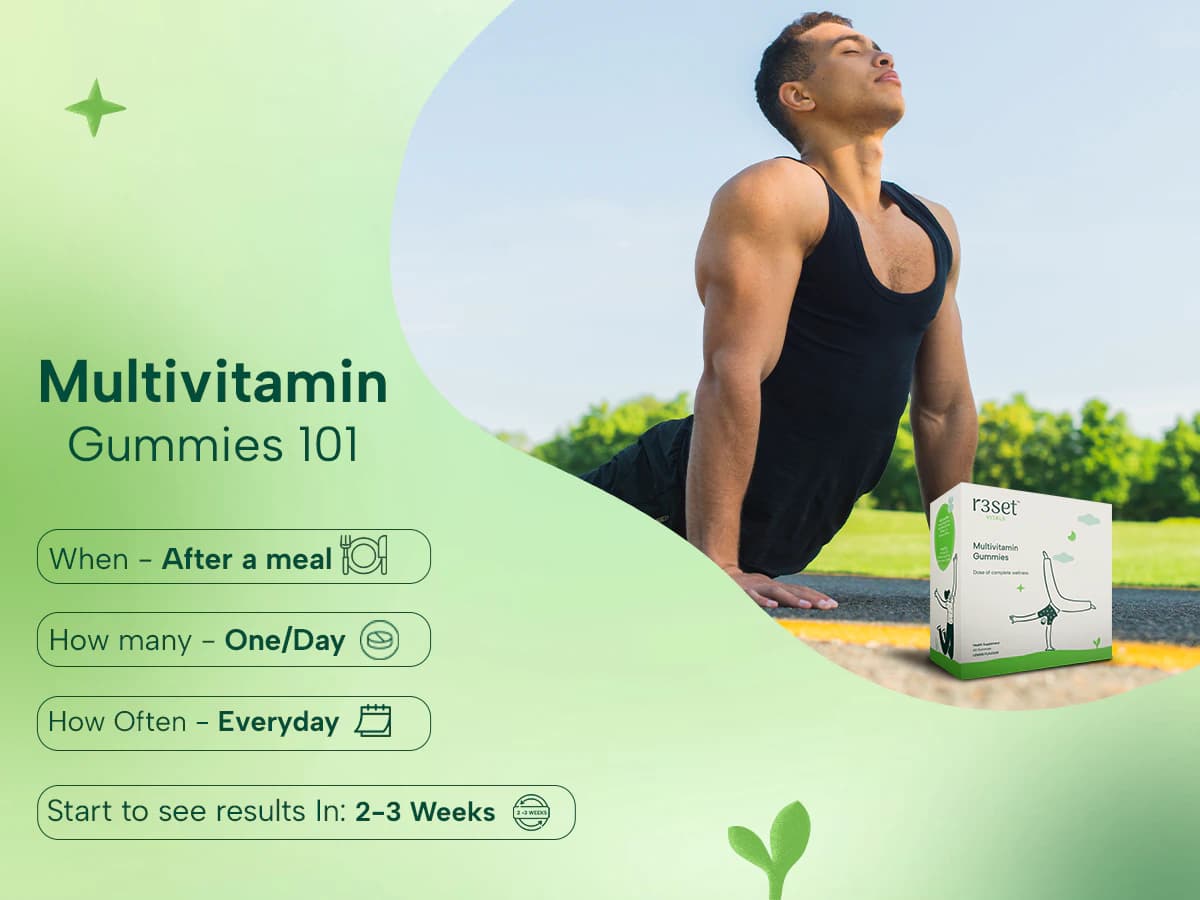
Somewhere between skipping breakfast and a gym bag that hasn't been opened in a week, most men's diets quietly fall short in the same few places: not enough sleep, not enough vegetables, and a multivitamin bottle that either doesn't exist or sits unopened. That gap is exactly why multivitamin gummies for men have become such a common search, and also why the honest question behind it, do they actually work, deserves a straight answer rather than a marketing one. Short version: yes, for what they're designed to do, and no, not for what people sometimes hope they'll do. Here's the difference, what the science backs up, and how to pick one that's actually worth taking daily.
A multivitamin gummy is, at its core, a small dose of several vitamins and minerals suspended in a chewable base instead of pressed into a tablet. The body absorbs most of these nutrients reasonably well in gummy form, though not identically to a tablet or capsule: some vitamins, particularly the fat-soluble ones like A, D, and E, are absorbed better when taken with food, which is exactly why most labels say to take them after a meal. The gummy format doesn't make a nutrient more powerful. It mostly changes how easy it is to actually take the thing every single day, which, for most men, is the part that tablets fail at.
The NIH's Office of Dietary Supplements sets the daily zinc target for adult men at 11 mg, noticeably higher than the 8 mg recommended for women, largely because zinc is involved in testosterone metabolism and general cellular repair, both of which men's bodies lean on more heavily. Magnesium needs follow a similar pattern: men aged 19 to 30 need about 400 mg a day, rising to 420 mg from age 31 onward, compared with 310 to 320 mg for women. Magnesium is also one of the nutrients most consistently under-consumed in modern diets, according to the same NIH guidance, which is part of why it shows up in nearly every men's multivitamin formula.
None of this means a deficiency is guaranteed, or that a gummy is solving a crisis. It means the baseline requirement is genuinely a bit higher for a few specific nutrients, and a diet that skips seafood, nuts, whole grains and leafy vegetables on most days is unlikely to hit it through food alone.
Here's the part most product pages skip. A daily multivitamin gummy can genuinely help close small, everyday nutrient gaps, support normal energy metabolism, and back up immune function, especially for men whose diets are inconsistent or heavy on processed food. What it will not do is build muscle on its own, dramatically raise testosterone, undo a bad diet, or replace sleep and exercise. Zinc plays a role in testosterone metabolism, but taking extra zinc when you're not actually deficient doesn't push levels higher than normal. The honest way to think about a multivitamin is as insurance, not fuel. It covers you on the days the diet doesn't, it doesn't upgrade the days the diet does.
•Look at your actual week. If seafood, nuts, and leafy greens rarely make it onto your plate, zinc and magnesium are worth prioritising.
•Check the label for a real dose, not just a name-drop of a nutrient with no quantity listed.
•Take it after a meal, since fat-soluble vitamins like A, D and E absorb better alongside food.
•Stick to the labelled serving. More gummies does not mean more benefit, and some nutrients have upper limits.
•Treat it as a daily habit, not an occasional fix. Consistency is where a multivitamin actually earns its keep.
Reset Multivitamin Gummies combine Vitamin B12, Folate, Vitamin C, Vitamin D, Vitamin E, Vitamin A, Zinc, and Magnesium in one gluten-free, gelatin-free gummy, taken once a day after a meal. It is made in FSSAI, WHO-GMP, HACCP, and ISO-certified facilities, with no artificial flavours or preservatives, and a 30-day pack costs ₹439. For men whose week doesn't leave much room for seafood, greens, and a varied diet, it's a reasonable, low-effort way to cover the everyday basics of energy, immunity, and muscle function. It is not a testosterone booster, a pre-workout, or a substitute for actually eating well, and it doesn't claim to be either. As a daily multivitamin gummies for men habit that's easy to keep, it does the job it's meant to do.
•Multivitamin gummies for men genuinely work for closing everyday nutrient gaps, not for dramatic performance or hormonal gains.
•Zinc (11 mg/day) and magnesium (400-420 mg/day) are two nutrients men need more of than women, and both are commonly under-consumed.
•Gummies win on consistency and taste; tablets sometimes allow higher single-nutrient doses when a real deficiency needs correcting.
•Take a multivitamin as daily insurance alongside a decent diet, not as a replacement for one.
•Reset Multivitamin Gummies cover eight everyday nutrients relevant to men's energy, immunity, and muscle function in one vegetarian gummy.
Do multivitamin gummies actually work for men?
Yes, they deliver essential vitamins and minerals in an easy format; absorption can vary by nutrient.
What nutrients should men look for?
Vitamin D, B12, zinc, and magnesium for energy and immune support.
Are multivitamin gummies enough for men's daily nutrition?
They fill gaps, not replace a balanced diet.
How many should men take per day?
One gummy daily after a meal, per label guidance.
National Institutes of Health, Office of Dietary Supplements, “Zinc: Fact Sheet for Consumers,” ods.od.nih.gov
National Institutes of Health, Office of Dietary Supplements, “Magnesium: Fact Sheet for Consumers,” ods.od.nih.gov
Share this article:
A herbal dose of complete wellness

₹439.00
dose of radiance for skin and hair

₹439.00
Enhance the quality of sleep and focus with a flavourful dose

₹489.00
| Nutrient | Why it matters for men | Common gap |
|---|---|---|
| Zinc | Immune function, skin health, normal testosterone metabolism | Diets low in meat, seafood or fortified cereals often fall under the 11 mg a day target |
| Magnesium | Muscle function, energy metabolism, reduction of tiredness | One of the most commonly under-consumed minerals in modern diets |
| Vitamin D | Bone health, immune support | Limited with desk-bound days and little sun exposure |
| Vitamin B12 | Energy-yielding metabolism, nerve function | Lower in vegetarian diets, common across urban India |
| Factor | Gummies | Tablets |
|---|---|---|
| Ease of daily use | High, chewable, no water needed | Depends on habit; easy to forget or skip |
| Dosing precision | Generally moderate per-nutrient doses | Can carry higher single-nutrient doses when needed |
| Taste and compliance | Flavoured, easier to stick with long term | No taste factor, purely functional |
| Added sugar | Usually contains some, for texture | Typically sugar-free |
| Best suited for | Everyday, low-effort consistency | Targeted correction under medical guidance |
| Nutrient | Role for men |
|---|---|
| Vitamin B12 | Supports normal energy-yielding metabolism and nerve function |
| Magnesium | Supports normal muscle function and helps reduce tiredness and fatigue |
| Zinc | Contributes to normal immune function and testosterone metabolism |
| Vitamin D | Supports calcium absorption and normal bone maintenance |
| Vitamin C | Supports immune function and normal collagen formation |
| Vitamin E | Helps protect cells from oxidative stress |
| Vitamin A | Contributes to the maintenance of normal skin |
| Folate | Supports cell division as part of overall nutritional intake |
| Detail | Reset Multivitamin Gummies |
|---|---|
| Key nutrients | B12, Folate, Vitamin C, D, E, A, Zinc, Magnesium |
| Dose | 1 gummy daily, after a meal |
| Dietary fit | Gelatin-free, gluten-free, suitable for vegetarians |
| Certifications | FSSAI, WHO-GMP, HACCP, ISO |
| Pack size and price | 30 gummies for ₹439 |
| Best for | Everyday nutrient gaps, not a testosterone or performance boost |

