
Multivitamin Gummies for Men — Do They Actually Work
2026-09-10
5 min read

2026-09-11 • 5 min read
Most days start with good intentions and end with whatever was fastest. Breakfast gets skipped, lunch is at your desk, and by dinner the vegetables on your plate are more of a suggestion than a plan. Add periods, stress, or just a demanding month at work, and it is easy to see why so many women end up short on a few key nutrients even while eating what looks like a reasonably healthy diet. This is where multivitamin gummies for women come in: not as a replacement for real food, but as a daily backstop. Below, what your body actually needs more of, what to check before you buy any gummy, and which one we would put our name behind.
Women lose iron every month through menstruation, need more folate than men during the reproductive years, and tend to fall short on vitamin D and calcium as they get older, particularly after menopause when bone density starts to drop faster. Layer on a demanding job, disrupted sleep, or a diet that leans heavily on packaged food, and the gap between what you eat and what your body actually needs can widen without you noticing. None of this means something is wrong. It just means the maths of a woman's body asks for a bit more attention in a few specific places.
The National Institutes of Health's Office of Dietary Supplements sets adult women's daily iron requirement at 18 mg, more than double the 8 mg recommended for men, precisely because of monthly blood loss. Folate needs sit at 400 mcg DFE a day for all adults, and the same NIH guidance is clear that women and teen girls who could become pregnant should be deliberate about getting enough, since roughly half of pregnancies are unplanned. None of this is an argument that a gummy fixes everything. A multivitamin is designed to complement a varied diet, not substitute for one, and the NIH is direct about that: supplements are useful when it genuinely isn't possible to meet a need through food alone, not a shortcut around eating well.
Where a daily gummy earns its place is consistency. A tablet that sits unopened in a drawer helps nobody. A gummy that tastes good enough to actually take every day, after a meal, without having to think about it, closes small gaps before they become bigger ones.
•Iron, if you have heavy periods or a plant-based diet: not every multivitamin gummy includes it.
•Vitamin D and B12, both commonly short in Indian diets and desk-bound routines.
•Folate, especially if pregnancy is a possibility at any point.
•Added sugar per serving. Gummies are, after all, a form of candy.
•Gelatin-free or vegetarian labelling, if that matters to you.
•A certification mark such as FSSAI, WHO-GMP, or ISO, which tells you the facility meets basic quality standards.
•Start with your actual diet. If you rarely eat leafy greens or citrus, folate and vitamin C are worth prioritising.
•Check whether you need iron specifically. If your periods are heavy or you eat little meat, look for a formula that includes it, or plan iron-rich foods separately.
•Read the serving size. One gummy a day is standard; more is not automatically better.
•Take it after a meal for better absorption of fat-soluble vitamins like A, D and E.
•Keep the bottle somewhere visible so it becomes a habit rather than a resolution.
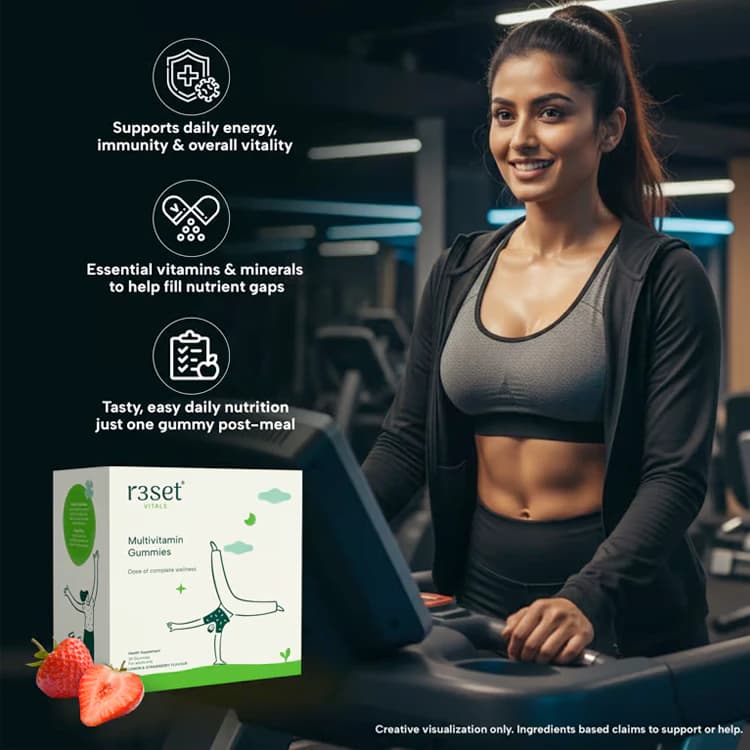
Reset Multivitamin Gummies bring together Vitamin B12, Folate, Vitamin C, Vitamin D, Vitamin E, Vitamin A, Zinc, and Magnesium in one gelatin-free, 100 percent vegetarian gummy, taken once a day after a meal. The formula is free from gluten, artificial flavours, and preservatives, and it's made in FSSAI, WHO-GMP, HACCP, and ISO-certified facilities. A 30-day pack runs at ₹439, which puts the daily cost of the habit below the price of a cup of coffee. One honest caveat: this formula does not contain iron. If heavy periods, a mostly plant-based diet, or a doctor's note point you toward needing more iron specifically, that is worth addressing separately, through food or a targeted supplement, rather than assuming any general multivitamin covers it. For everyday energy, immune support, skin health, and filling the ordinary gaps a busy week leaves behind, though, it is a genuinely useful best multivitamin gummies for women pick that we can stand behind.
•Women's nutrient needs, especially for iron and folate, genuinely differ from men's, largely due to menstruation and reproductive life stages.
•A multivitamin gummy is a daily backstop for a varied diet, not a substitute for one.
•Check the label for iron, vitamin D, B12, folate, added sugar, and a real certification mark before you buy.
•Gummies win on consistency and taste; tablets sometimes carry higher single-nutrient doses.
•Reset Multivitamin Gummies cover eight everyday nutrients in a vegetarian, gelatin-free gummy, though they don't include iron.
What should women look for in a multivitamin gummy?
Check for iron, vitamin D, B12, and folate, plus gelatin-free or vegetarian formulation.
Are multivitamin gummies as effective as tablets for women?
Gummies deliver similar nutrient support in a more palatable format; tablets sometimes carry higher single-nutrient doses.
Can multivitamin gummies help with women's hormonal health?
They help fill everyday nutritional gaps; consult a doctor for specific hormonal concerns.
How many multivitamin gummies should women take daily?
Typically one gummy a day after a meal. Follow label directions.
Are Reset Multivitamin Gummies suitable for women?
Yes, formulated with vitamins A, C, D, E, and zinc, and gelatin-free.
National Institutes of Health, Office of Dietary Supplements, “Iron: Fact Sheet for Consumers,” ods.od.nih.gov
National Institutes of Health, Office of Dietary Supplements, “Folate: Fact Sheet for Consumers,” ods.od.nih.gov
Share this article:
A herbal dose of complete wellness

₹439.00
dose of radiance for skin and hair

₹439.00
Enhance the quality of sleep and focus with a flavourful dose

₹489.00
| Nutrient | Why it matters | Common gap |
|---|---|---|
| Iron | Needed to make haemoglobin and carry oxygen around the body | Lost monthly through periods; adult women need 18 mg a day versus 8 mg for men |
| Folate | Needed for cell division and DNA synthesis | Often falls short of the 400 mcg DFE a day adults need, especially with low vegetable intake |
| Vitamin D | Supports calcium absorption and bone strength | Common shortfall with limited sun exposure or desk-bound days |
| Vitamin B12 | Needed for nerve function and energy metabolism | Lower in vegetarian and vegan diets, which are common among Indian women |
| Calcium & magnesium | Bone density, muscle and nerve function | Often under target, more so after menopause |
| Factor | Gummies | Tablets |
|---|---|---|
| Ease of daily use | High, chewable, no water needed | Moderate, some people skip pills |
| Dosing precision | Generally lower per-nutrient doses | Can carry higher single-nutrient doses |
| Taste and compliance | Flavoured, easier to stick with daily | No taste factor, purely functional |
| Additives | Often contain some sugar for texture | Usually sugar-free |
| Best suited for | Everyday maintenance and consistency | Targeted, higher-dose correction under medical guidance |
| Nutrient | Everyday role |
|---|---|
| Vitamin B12 | Supports normal energy-yielding metabolism and nerve function |
| Folate | Supports cell division and complements nutritional intake as part of a balanced diet |
| Vitamin C | Contributes to normal collagen formation and immune function |
| Vitamin D | Supports calcium absorption and maintenance of normal bones |
| Vitamin E | Helps protect cells from oxidative stress |
| Vitamin A | Contributes to the maintenance of normal skin |
| Zinc | Contributes to normal immune function and skin maintenance |
| Magnesium | Contributes to normal muscle function and energy metabolism |
| Detail | Reset Multivitamin Gummies |
|---|---|
| Key nutrients | B12, Folate, Vitamin C, D, E, A, Zinc, Magnesium |
| Dose | 1 gummy daily, after a meal |
| Dietary fit | Gelatin-free, 100% vegetarian, gluten-free |
| Certifications | FSSAI, WHO-GMP, HACCP, ISO |
| Pack size and price | 30 gummies for ₹439 |
| Contains iron? | No, pair with iron-rich foods or a separate supplement if needed |

