
Pain Relief
knee pain location chart
2026-06-25
4 min read

2026-08-25 • 4 min read
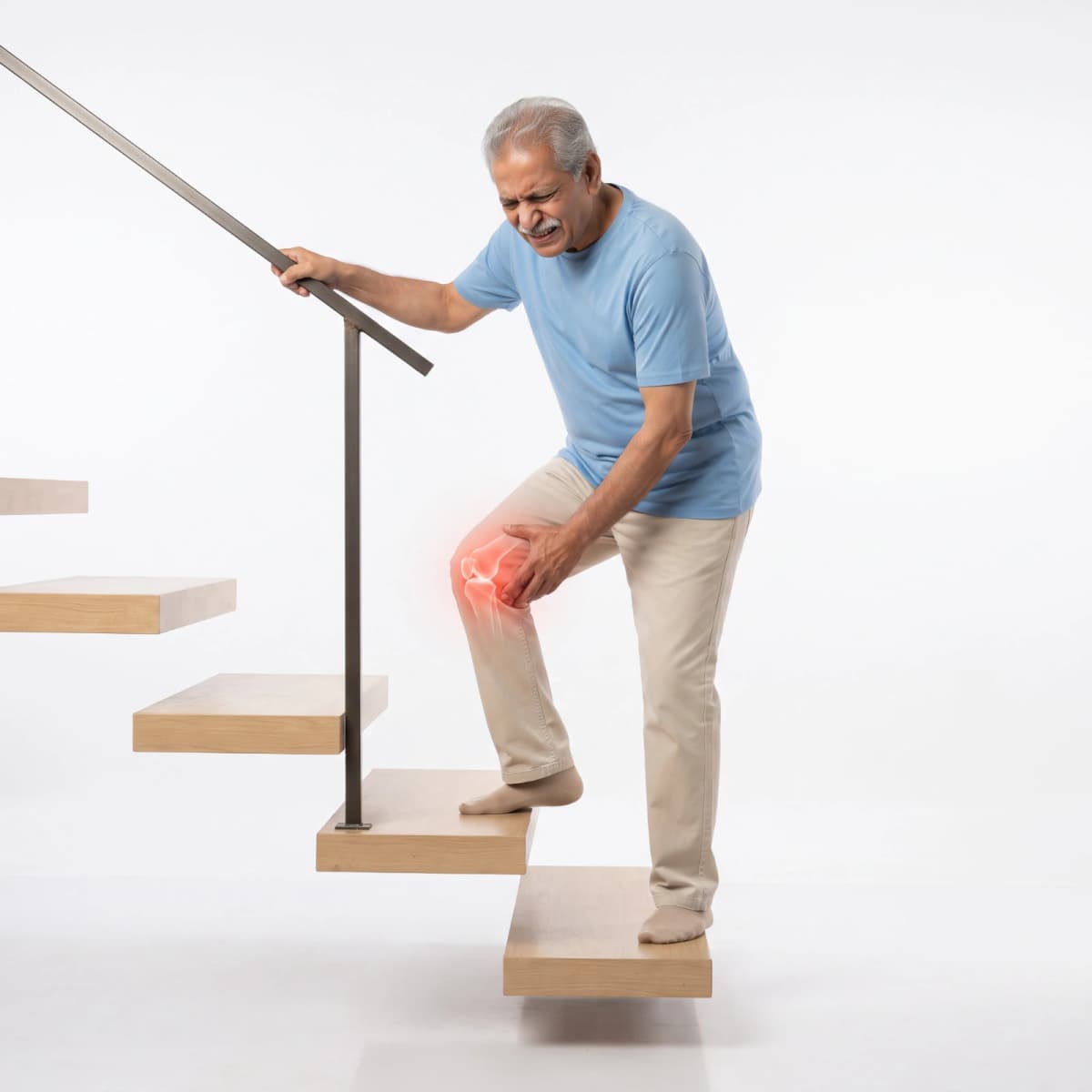
Your knees feel fine on flat ground. Then you hit a flight of stairs and there it is, the familiar ache right at the front of the knee, sometimes with a click or two on the way up. Knee pain climbing stairs is one of the most common complaints people bring to a doctor, and it rarely means the same thing for everyone. For some, it traces back to patellofemoral pain syndrome. For others, it points to early cartilage wear or quadriceps muscles that have quietly grown weak over the years. This guide walks through why knee pain going upstairs shows up the way it does, what is actually happening inside the joint, and the natural, practical steps that help you find lasting relief.
Walking on level ground barely taxes the knee. Climbing stairs is a different story entirely. Each step forces the knee to bend further and the quadriceps to contract harder to lift your full body weight onto the next stair. Research on joint mechanics has repeatedly found that the load moving through the kneecap during stair climbing can reach three to four times body weight, compared to a fraction of that during level walking. That single fact explains why a knee that feels perfectly fine on a flat sidewalk starts complaining the moment stairs enter the picture, and why the pain often shows up going down even more than going up.
Patellofemoral pain syndrome, often called runner's knee, is the single most common reason people feel pain specifically on stairs and not on flat ground. It happens when the kneecap does not glide smoothly through the groove at the end of the thigh bone. Instead of gliding, it grinds slightly, and stairs, where the knee bends deeper than in almost any other daily movement, amplify that grinding.
Early cartilage wear, the start of osteoarthritis, is another common cause, especially past the age of 40. Cartilage cushions the joint, and as it thins, bone-on-bone pressure builds during high-load movements like stair climbing long before it shows up on flat ground.
Weak quadriceps do not directly cause pain on their own, but they change how much work the joint has to absorb. When the thigh muscles are not strong enough to control the kneecap through its full range, the knee ends up taking on pressure and instability that the muscles should have handled.
Old injuries that were never fully rehabilitated, a ligament sprain or a meniscus tear from years back, can resurface as stair pain once daily wear catches up with a joint that never regained its original strength. Hormonal and structural differences also play a role in who develops this kind of pain, something we cover in more depth in our piece on what causes knee pain in females.
●Patellofemoral pain syndrome (kneecap tracking issue)
●Early cartilage wear or osteoarthritis
●Weak quadriceps and hip stabilizer muscles
●Old, incompletely healed injuries
The kneecap sits in a groove at the end of the femur and should glide smoothly up and down that groove as the knee bends. Cartilage lines both surfaces, cushioning the contact and letting the joint move without friction. When the thigh muscles are weak or unbalanced, especially the inner quadriceps that help guide the kneecap, it tends to track slightly off center. That uneven pressure wears at the cartilage faster in some spots than others, and cartilage has a limited blood supply, so it heals far more slowly than muscle or skin.
According to the National Institute of Arthritis and Musculoskeletal and Skin Diseases (NIAMS), osteoarthritis develops when the cartilage that cushions a joint breaks down over time, and if left unaddressed, this can eventually progress to bone rubbing against bone. (Source: NIAMS)
That breakdown is gradual, which is exactly why stair pain often shows up years before anyone is formally diagnosed with arthritis. The knee complains on stairs long before it complains anywhere else, simply because stairs are where the joint is asked to do the most work.
The good news is that most stair-specific knee pain responds well to consistent, low-effort changes rather than dramatic intervention.
Start by strengthening the muscles that support the knee, particularly the quadriceps and the muscles around the hip.
The Centers for Disease Control and Prevention notes that regular physical activity helps people with arthritis maintain muscle strength and joint function, and is not associated with further joint damage when done sensibly. (Source: CDC)
Pace yourself on stairs. Taking one step at a time rather than two, and using a handrail when needed, reduces the peak load moving through the kneecap on any single step.
Watch your weight. Every extra kilogram carried adds multiplied pressure to the knee joint during stair climbing, since the load scales several times over relative to body weight.
Give sore knees a break between high-load days, but avoid full inactivity. NIAMS points out that staying moderately active, rather than resting completely, tends to support joint health better over the long run. For a faster way to calm an active flare-up, our guide on the fastest way to relieve knee pain covers short-term steps you can layer on top of these habits.
Shoes matter more than most people expect. A worn-out sole or a shoe with no arch support changes how force travels up through the ankle and into the knee with every step. For stair-heavy days, look for shoes with decent cushioning at the heel, a stable sole that does not twist easily underfoot, and a heel height under about two centimeters. Very flat shoes and very high heels both change knee alignment in ways that add strain, just in different directions. If you already deal with knee pain, footwear is a bigger factor than most people realize, and it is worth adjusting before anything else.
Alongside strengthening and better movement habits, many people look for something that eases the day to day discomfort while the underlying issue improves.
Topical oils remain popular for targeted relief you can work directly into a sore knee, and we have a full breakdown of which oil works best for knee pain relief if that is your preferred format.
For days when applying an oil is not convenient, at your desk, mid-travel, or right after a workout, an oral option like Reset Instant Ease Tablets can fit into a daily routine instead. It is formulated with five Ayurvedic herbs, White Willow, Vayavidang, Ajwain, Safed Jeera, and Pippali, herbs that have traditionally been used to ease discomfort and support the body's natural recovery process. It is worth being clear about what it does and does not do: it is not a treatment for cartilage wear, and it will not reverse osteoarthritis or replace strengthening work. Think of it as one comfort-focused piece of a broader routine, sitting alongside the exercises and movement habits described above, not in place of them.
●Knee pain that shows up mainly on stairs usually points to patellofemoral pain syndrome, early cartilage wear, or weak quadriceps, sometimes all three together
●Stairs load the knee three to four times body weight, far more than walking, which is why symptoms concentrate there
●Strengthening the quadriceps and hips, pacing yourself on stairs, and choosing supportive footwear address the root causes rather than just the symptom
●Natural options like topical oils or herbal tablets, such as Reset Instant Ease Tablets, can ease day to day discomfort but work best alongside movement, not instead of it
It usually comes down to patellofemoral pain syndrome, weak quadriceps, or early cartilage wear, since stairs load the kneecap far more heavily than flat ground ever does.
It can be an early sign, especially past age 40, but it is not always. A lot of stair pain in younger, active people traces back to muscle imbalance rather than joint degeneration.
Strengthening exercises for the quadriceps and hips, maintaining a healthy weight, wearing supportive footwear, and adding natural comfort options like topical oils or herbal tablets to your daily routine.
National Institute of Arthritis and Musculoskeletal and Skin Diseases (NIAMS). Osteoarthritis.
Centers for Disease Control and Prevention (CDC). Arthritis and physical activity.
Share this article:
A 2X more powerful formula for enhanced relief.

₹799.00
₹794.00
An easy to apply potent formula with roll-on massager

₹549.00
₹449.00
An optimal choice for safe and natural pain relief.

₹349.00
₹249.00
| Activity | Load on the knee joint | What it demands from the body |
|---|---|---|
| Walking on flat ground | About 1 to 2x body weight | Basic quad and hip support |
| Climbing stairs | About 3 to 4x body weight | Strong quad contraction, stable kneecap tracking |
| Descending stairs | Similar or slightly higher | Controlled deceleration, eccentric quad control |
| Cause | What it typically feels like | Who it is common in |
|---|---|---|
| Patellofemoral pain syndrome | Ache around or under the kneecap, clicking, pain after sitting | Younger, active adults, runners |
| Early cartilage wear | Morning stiffness, dull ache that builds with activity | Adults over 40 |
| Weak quadriceps | Knee feels unstable, wobbles more going down stairs | Sedentary lifestyles, post-injury |
| Old injury | Pain flares with specific movements, occasional swelling | Anyone with a past sprain or tear |
| Exercise | How it helps | How often |
|---|---|---|
| Straight leg raises | Builds quad strength without bending the knee | 2 to 3 sets of 10 to 15, most days |
| Wall sits | Builds endurance and control in the quads | Hold 20 to 30 seconds, a few times daily |
| Low step-ups | Mimics stair mechanics under control | 2 to 3 sets of 8 to 10 per leg, few times a week |
| Glute bridges | Strengthens the hips that stabilize the knee | 2 to 3 sets of 12 to 15, most days |
| Format | Best for | Thing to keep in mind |
|---|---|---|
| Topical oil or gel | Targeted relief right where the pain is, no swallowing needed | Needs clean, dry skin and a few minutes to absorb |
| Oral tablet | Convenient when out, traveling, or mid-task | Takes a little longer to feel, follow label dosing |

