
Vitals/Immunity
What Is Knee Gap? Causes, Safety Concerns, and How to Treat It
2025-05-22
4 min

2026-06-25 • 4 min read
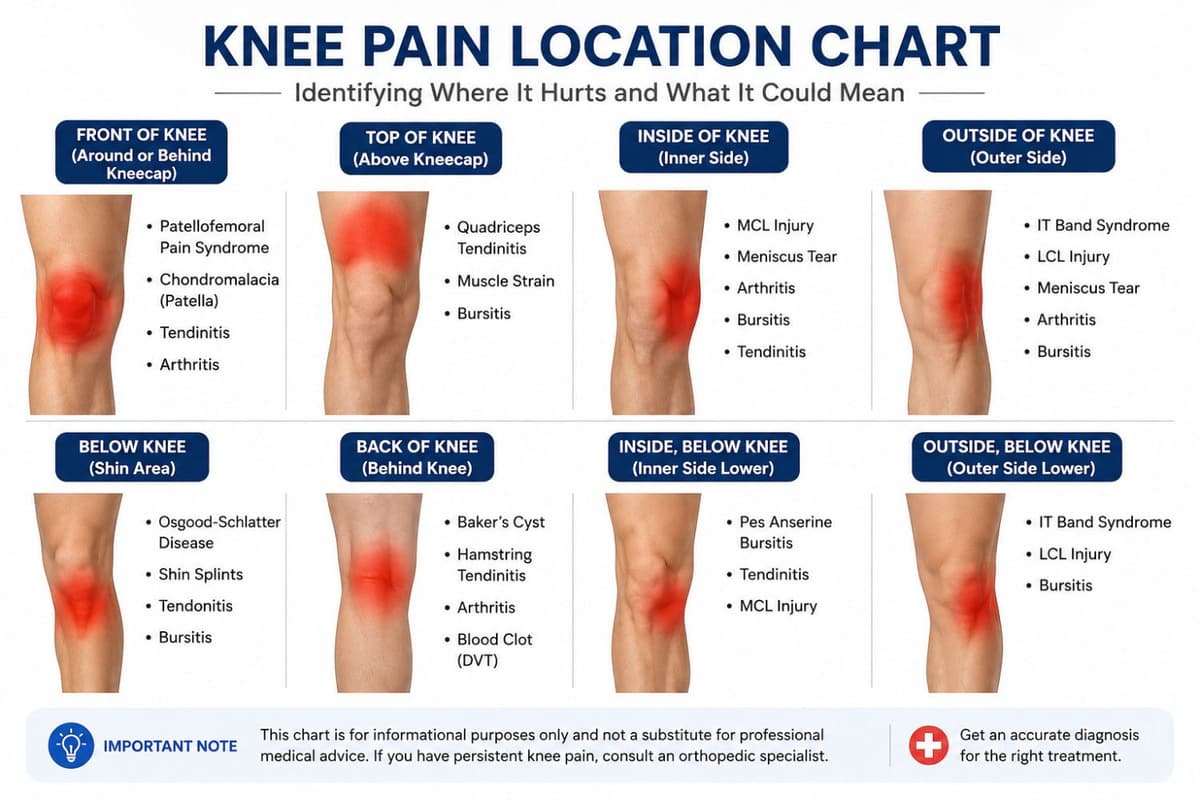
Your knee hurts, but where exactly? That one question does more work than most people realise. Pain at the front of the knee points somewhere very different from an ache behind it or a twinge along the inner edge. That is the whole idea behind a knee pain location chart. Your knee is a busy joint with a lot of moving parts, and where it hurts is usually the first real clue to what is going on underneath. Get the location right and everything after it, from the stretches you pick to the moment you decide to call a doctor, gets simpler.
At Reset, we would rather help you understand your body than hand you a one-size-fits-all fix. So this is not a scary list of worst-case diagnoses. We will map the knee zone by zone, explain the why behind each kind of pain, show you what you can do today, and point out the signs that mean it is time to get it checked. Picture the friend who limps for a week assuming it is “just age,” when the pain was sitting squarely on the outer knee and pointing at something as ordinary and fixable as a tight IT band. Knowing where to look changes what you do next.
Your knee is where three main bones meet: the femur (thighbone), the tibia (shinbone), and the patella (kneecap), with the slim fibula sitting just alongside. Between the bones are two C-shaped cartilage cushions called the menisci, plus a smooth layer of articular cartilage on the joint surfaces. Holding everything together are four main ligaments and a web of tendons, and small fluid-filled sacs called bursae cut down the friction as the joint glides.
Here is why that matters. Each of those structures lives in a specific spot. The kneecap sits at the front. The medial collateral ligament runs down the inner side, the iliotibial band down the outer. Meniscus tears tend to ache along the joint line, inner or outer. So when your knee hurts in one particular place, you are often getting a fairly direct message about which part is unhappy. That is what turns a location chart from a novelty into something you can actually use.
Use the table below as a starting map, not a diagnosis. It lines up the most common trouble spots with the conditions usually behind them and how each tends to feel. Find your zone, then read on for the why and the what-to-do.
Table 1: Knee pain by location, and what it often points to
Two zones get searched more than the rest, so they are worth a closer word. Pain at the front, right around the kneecap, is the classic “runner's knee” pattern. It flares going down stairs, standing up after a film, or squatting, and it often traces back to how the kneecap glides rather than to any single injury. Pain at the back is usually less about the joint surface and more about what sits behind it. A Baker's cyst, for instance, is a fluid pocket that creates a feeling of fullness or tightness when you bend the knee all the way.
Location tells you where. The next question is why that spot is complaining, and most knee pain falls into a handful of buckets. Overuse is the big one: repeated load from running, jumping, or a sudden jump in training irritates tendons and the tissue around the kneecap. Acute injury is the opposite story, a twist or awkward landing that tears a meniscus or strains a ligament in a single moment. Then there is wear and tear, mainly osteoarthritis, where the cartilage cushion gradually thins, which is why this kind of pain climbs with age and tends to be worse first thing in the morning.
Two more worth naming. Inflammation, whether from an injury or an inflammatory type of arthritis, brings swelling, warmth, and stiffness. And referred pain, where the ache you feel in the knee is actually coming from the hip or lower back. That last one catches people out, which is exactly why a location chart is a starting point and not the final word.
Table 2: What the feeling of the pain can tell you
Most knee pain settles with rest and simple care. The UK's NHS notes that knee pain can often be treated at home and usually starts to ease within a few days, and that you should see your GP if the pain is very bad or lasts a long time (nidirect.gov.uk). Some signs, though, are worth taking seriously rather than waiting out.
Get it looked at if you cannot put weight on the leg, if the knee looks visibly out of shape, if it locks or gives way, or if it becomes hot, red, and swollen alongside a fever, which can point to infection. Pain that drags on for weeks despite rest, or that keeps you from the things you normally do, also deserves a proper assessment. None of this is meant to alarm you. It is just the line between what a heat pack can handle and what needs an expert eye.
Table 3: Handle at home vs. see a doctor
Here is the part you can act on before anything else, and none of it is dramatic. For a fresh, sore, or slightly swollen knee, the old RICE routine still earns its place: rest it, ice it, wrap it lightly for support, and keep it raised when you can. Ice is your friend in the first day or two of swelling, while gentle heat suits stiffness that has settled in.
Movement matters more than people expect. Resting a cranky knee forever tends to make it weaker, not happier. Once the sharp phase passes, gentle strengthening for the muscles that support the joint, mainly the quads and glutes, takes load off the knee itself. Straight-leg raises, wall sits within a comfortable range, and easy cycling are kind starting points. If your outer knee is the problem, loosening a tight IT band and the hips around it often helps more than fussing over the knee directly.
A few everyday levers add up. Carrying less weight eases the load your knees absorb with every step, and supportive footwear changes how force travels up the leg. For direct, on-the-spot relief, a good topical you can rub straight into the sore area works fast and pairs well with the rest. You can browse Reset's full pain relief range if you want to see the options side by side.
Table 4: Simple relief options and when to reach for them
When the ache is the everyday kind, the sort that shows up after a workout, a long walk, or too many stairs, Reset Easy-to-Rub Emulsion is the one to keep in your bag. It is a herbal roll-on built around Nirgundi oil and seven Ayurvedic herbs, including Wintergreen, Boswellia serrata, menthol, and eucalyptus, carried deeper into the skin through a nanotech formula that the brand reports gives 45% better analgesic activity. It rolls on clean, absorbs fast, and skips the greasy film that pain oils leave behind, so you can use it at your desk or mid-commute and get on with your day. Knee soreness is one of the exact uses it is made for.
For the deeper, more stubborn stiffness, the kind that sits in an ageing or overworked knee and does not budge with the light stuff, Reset Ultra Potent Gel steps up. It is the strongest formula in the range, roughly twice the potency of a standard pain gel, with concentrated Boswellia serrata, Wintergreen, and Nirgundi delivered through the same nanotech approach so the actives reach the deeper tissue where the discomfort actually sits. Rub it into the knee and give it a couple of weeks of consistent use for the herbs to build up.
Neither one replaces medical care, and anything from the red-flag list belongs with a doctor. But for the ordinary knee ache that most of us meet sooner or later, gentle, targeted relief handles a lot of the load.
•Where your knee hurts is a genuine clue: front, back, inner, and outer pain each point to different structures and different likely causes.
•Front-of-knee pain is usually a kneecap or tendon issue, while back-of-knee pain often involves a Baker's cyst or hamstring tendon.
•How the pain feels matters too. Sharp and catching suggests something mechanical, dull and constant leans toward overuse or arthritis.
•See a doctor for a knee you cannot stand on, one that locks or gives way, or one that is hot and swollen with a fever.
•Ice, heat, strengthening the quads and glutes, sensible footwear, and targeted topical relief handle most everyday knee pain at home.
Inner, or medial, knee pain most often comes from a medial meniscus tear, an MCL sprain, pes anserine bursitis, or arthritis on the inner side of the joint. It tends to sit along the inner joint line and can flare when you twist, climb stairs, or press on the spot. If it followed a specific twist or wobble, a soft-tissue injury is the usual suspect.
Pain at the back of the knee is commonly a Baker's cyst, a fluid pocket that creates a tight, full feeling when you bend fully, or hamstring tendonitis where the tendon meets the knee. Less often it involves the PCL, the ligament deep in the back of the joint. A back-of-knee pain with calf swelling deserves prompt medical attention.
Front-of-knee pain usually points to the kneecap or its tendons: patellofemoral pain (runner's knee), patellar tendonitis just below the cap, or quadriceps tendonitis just above it. The giveaway is pain that worsens on stairs, during squats, or after sitting with the knee bent for a while.
Gentle movement is usually good for a mildly sore knee, since resting it completely tends to weaken the supporting muscles. But if you cannot bear weight, the knee is locking or giving way, or walking sharply increases the pain, stop and get it assessed rather than pushing through.
Pain on bending and squatting loads the kneecap and the tendons around it, so it commonly signals patellofemoral pain or a tendon issue. It can also come from a meniscus problem if there is clicking or catching. Easing off deep squats for a while and strengthening the quads often helps.
Treat it as serious if you cannot put weight on the leg, the knee looks deformed, it locks or buckles, or it turns hot, red, and swollen with a fever. Pain that lasts more than a few weeks or keeps getting worse despite rest is also worth a doctor's visit.
Reach for ice in the first day or two when there is swelling or a fresh flare, since it calms inflammation. Use gentle heat for stiffness that has settled in, like a knee that feels tight in the morning. Many people alternate, ice after activity and heat before it.
For everyday soreness, yes. A topical delivers herbal actives or a cooling analgesic right to the sore spot without going through your stomach. Reset's Emulsion roll-on suits everyday and post-activity aches, while the Ultra Potent Gel is built for deeper, more stubborn stiffness. Neither replaces medical care for a serious injury.
NHS (via nidirect.gov.uk), Knee pain; Hospital for Special Surgery and Mayo Clinic for knee anatomy and warning signs.
Share this article:
A 2X more powerful formula for enhanced relief.

₹799.00
₹794.00
An optimal choice for safe and natural pain relief.

₹349.00
₹249.00
An easy to apply potent formula with roll-on massager

₹549.00
₹449.00
Infused with 6 powerful essential oils

₹1,299.00
₹999.00
| Where it hurts | Common causes | How it usually feels |
|---|---|---|
| Front (around the kneecap) | Patellofemoral pain (runner's knee), kneecap tracking issues, chondromalacia | Dull ache worse on stairs, squats, or long sitting |
| Just below the kneecap | Patellar tendonitis (jumper's knee) | Tender, pinpoint pain that flares with jumping or running |
| Just above the kneecap | Quadriceps tendonitis | Ache above the cap, worse with activity |
| Inner side (medial) | Medial meniscus tear, MCL sprain, pes anserine bursitis, medial arthritis | Ache or sharpness along the inner joint line |
| Outer side (lateral) | IT band syndrome, lateral meniscus tear, LCL strain | Pain on the outside, common in runners and cyclists |
| Back of the knee | Baker's cyst, hamstring tendonitis, PCL injury | Tightness, fullness, or ache when bending fully |
| What you feel | What it may point to |
|---|---|
| Sharp, catching pain | A mechanical issue like a meniscus tear or a loose fragment |
| Dull, constant ache | Overuse or early osteoarthritis |
| Clicking, locking, or catching | Cartilage or meniscus trouble |
| Swelling and warmth | Inflammation, injury, or arthritis |
| A sense the knee may give way | Ligament involvement, such as the ACL or PCL |
| Usually fine to manage at home | Worth seeing a doctor |
|---|---|
| Mild ache that eases within a few days | Pain so severe you cannot bear weight |
| Soreness after a workout or long day | Visible deformity, locking, or the knee giving way |
| Stiffness that loosens once you move | Hot, red, swollen knee with a fever |
| Pain that responds to rest and topical relief | Pain lasting weeks or steadily getting worse |
| What to try | Why it helps | Best for |
|---|---|---|
| Ice | Calms swelling and numbs sharp pain | The first day or two after a flare |
| Gentle heat | Loosens stiff, tight tissue | Morning stiffness or lingering aches |
| Quad and glute strengthening | Shares the load the knee carries | Ongoing or recurring knee pain |
| Supportive footwear | Changes how force reaches the knee | Daily wear, especially if on your feet |
| Topical herbal relief | Targets the sore spot directly | Everyday soreness and post-activity ache |

