
Pain Relief
Knots in Shoulder and Neck: Causes, Relief & 5 Easy Stretches
2026-10-05
4 min read
2026-10-05 • 4 min read
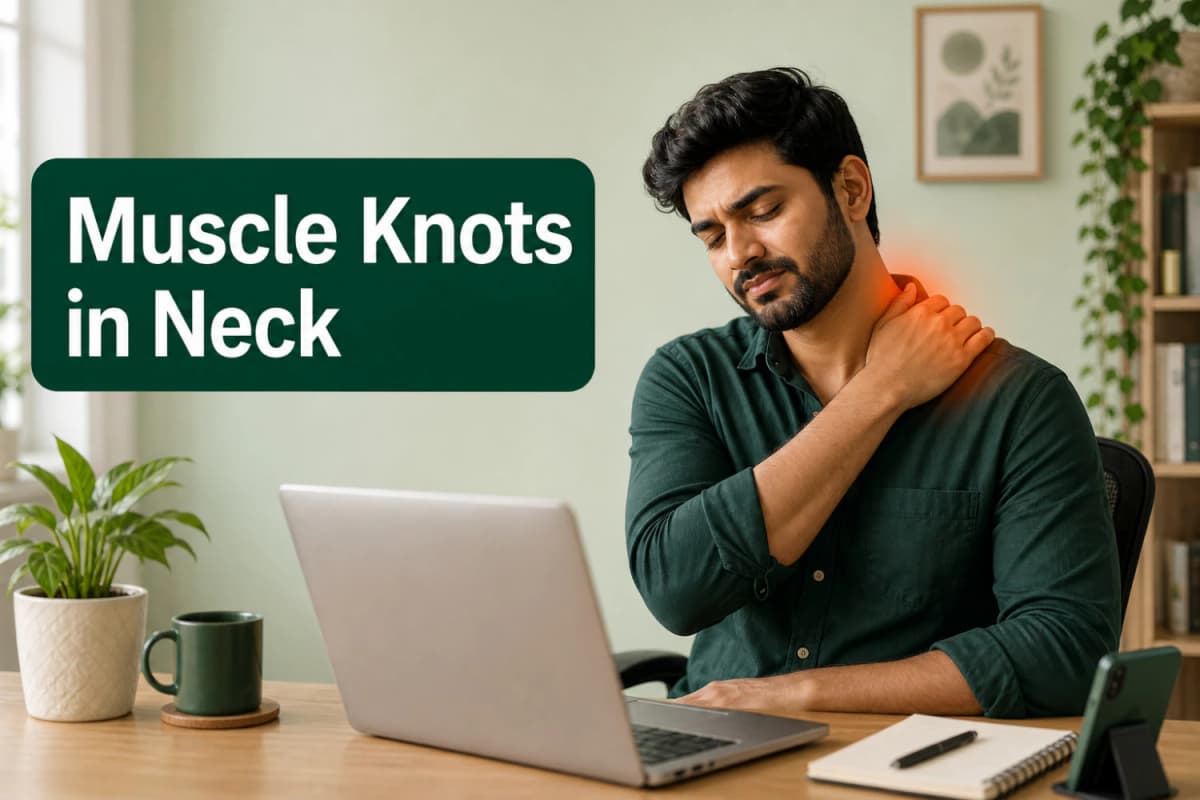
You turn your head after a long day at a desk and feel it: a small, stubborn patch of tightness near the base of your neck or across the top of your shoulder. People often call this a muscle knot. It may follow prolonged sitting, repetitive activity, an awkward sleeping position, stress, or a minor strain. This guide explains what muscle knots in the neck may be, why they form, and how to try heat or cold, gentle self-massage, movement, and simple stretches at home. It also explains when home care is not enough.
“Muscle knot” is a common, non-technical phrase. Health sources often use terms such as myofascial pain or trigger point. StatPearls describes a trigger point as a tender nodule within a taut band of skeletal muscle. It can cause pain at the spot itself or refer discomfort to a nearby area. In the neck and shoulder region, the upper trapezius, levator scapulae, and muscles around the shoulder blade are often involved.
A knot can feel like a hard or sensitive patch, a deep ache, a tight band, or stiffness when you turn your head. The sensation is real, but the label does not confirm a diagnosis. Neck pain can also come from a strain, a pinched nerve, a joint problem, or another condition, so pay attention to symptoms that do not behave like ordinary muscle tightness.
Most everyday neck tightness is linked to how the muscles are used. Holding the head in one position for a long time, such as while working at a laptop or looking down at a phone, can leave the neck and upper back muscles working without much rest. Repetitive movements, carrying loads, a sudden increase in exercise, or an awkward sleeping position can add more strain. MedlinePlus lists prolonged desk work, poor posture, uncomfortable sleep positions, and sudden or poorly controlled movement among common contributors to neck pain.
Stress can add another layer. Many people unconsciously lift their shoulders or clench their jaw when they feel pressured. Poor sleep can make the body feel more guarded and tense, while too little movement allows stiffness to build. There is no single perfect posture. The better goal is variety: change position, move often, and avoid asking one small area to hold the same load for hours.
How to Get Rid of Muscle Knots in the Neck at Home
Try the steps below only if the discomfort feels like ordinary muscle tightness and you have no warning signs. Keep movements slow and within a comfortable range. A gentle pulling sensation can be acceptable; sharp, electric, shooting, or radiating pain is a reason to stop.
Seated upper trapezius stretch for muscle knots in neck
For a newly painful area, MedlinePlus suggests ice during the first 48 to 72 hours, followed by heat. For established stiffness, many people prefer warmth from a shower, warm compress, or heating pad. Keep the pack wrapped in a cloth, use it for about 15 to 20 minutes, and never fall asleep with it in place. Do not apply heat or cold directly to skin with reduced sensation, and ask a clinician for advice if you have circulation problems.
Use your fingertips on the upper shoulder or a soft ball against the upper back and wall. Press gently for 20 to 30 seconds, then release and move around the area rather than digging into one point. The pressure should feel manageable, not like you are fighting the pain. Avoid forceful pressure on the front or side of the neck, where important nerves and blood vessels lie close to the surface. Research on manual therapies is mixed, so treat massage as a comfort technique, not a guaranteed fix.
Sit tall with both feet supported. Hold the chair with your left hand to keep the left shoulder down, then slowly tilt your right ear toward your right shoulder. Hold for 20 to 30 seconds, return to center, and repeat on the other side. You should feel a mild stretch along the side of the neck and top of the shoulder, not a sharp pull.
Turn your head about 45 degrees to the left, as if looking toward your left armpit. Gently angle your chin downward and use your left hand for only light guidance. Hold 20 to 30 seconds, then switch sides. Keep the movement small and relaxed, especially if the tender spot is close to the base of the skull.
Sit or stand with your eyes level. Draw your chin straight back, as if making a small double chin, without looking up or down. Hold for 5 to 10 seconds and repeat 5 to 10 times. The effort should feel deep and controlled, not like you are squeezing the front of your throat.
Stand in a doorway with your forearms resting on the frame and your elbows bent. Step one foot forward and lean through the doorway until you feel a mild stretch across the chest and front of the shoulders. Hold 20 to 30 seconds, breathing normally. This can be useful when rounded desk positions leave the shoulders pulled forward.
Change position at least every 30 minutes. Stand up, walk briefly, roll the shoulders, or look away from the screen. Frequent comfortable movement is usually more useful than trying to hold one rigid “correct” posture all day.
Keep the screen near eye level, support your lower back, and avoid holding the phone between your ear and shoulder. At night, choose a pillow that keeps your head aligned with the rest of your body and avoid sleeping on your stomach if it twists your neck.
Slow breathing, a short walk, and a regular wind-down routine can help if stress is making your shoulders stay lifted. Relaxation does not replace medical care, but it can make gentle movement easier.
RESET Stretch Easy Oil is a 200 ml herbal massage oil made with Chamomile flower oil, Geranium leaf oil, Rosemary leaf oil, Lemongrass oil, Olive oil, Neelgiri or Eucalyptus, Sunflower oil, and Camphor as named on the live product page. Apply a small amount to the desired area and massage gently in circular motions. Use it as an optional abhyanga-inspired comfort ritual alongside movement, not as a cure or replacement for professional care. Patch test first and avoid broken, irritated, or sensitive skin. check RESET Stretch Easy Oil
Contact a healthcare professional if your neck pain does not improve with self-care, keeps getting worse, or is stopping you from normal activities. Seek prompt medical advice for numbness, tingling, weakness, or pain that travels into an arm or hand. Pain after a fall, collision, or other injury also deserves assessment.
Get urgent help for a severe stiff neck with fever or headache, difficulty breathing or swallowing, trouble walking or balancing, loss of bladder or bowel control, new clumsiness in the hands, or symptoms that appear suddenly and severely. These signs are not typical of a simple muscle knot.
• Set a timer to move every 30 minutes.
• Keep screens near eye level and vary your position.
• Use only a comfortable range during stretches.
• Pair gentle movement with slow breathing.
• Stop if a stretch causes sharp, shooting, electric, or radiating pain.
• Do not use aggressive pressure, direct heat, or direct ice on the skin.
Can muscle knots in the neck go away on their own?
Mild muscle tightness often settles over days or weeks with time, movement, and activity changes. If it keeps returning or does not improve, seek clinical advice.
What does a muscle knot in the neck feel like?
It may feel like a tender bump, tight band, deep ache, or stiffness. Pain can sometimes be felt in a nearby area.
Is it safe to massage a knot in my neck?
Gentle massage over the upper shoulder or upper back may be comfortable for some people. Avoid forceful pressure and do not press deeply on the front or side of the neck.
Should I use heat or cold for neck muscle knots?
For a new painful episode, try wrapped ice for the first 48 to 72 hours, then heat. For established stiffness, protected warmth may feel more soothing.
Why do I keep getting knots in the same spot?
The trigger may still be present, such as prolonged sitting, repetitive use, stress, poor sleep, or an unaddressed strength or movement issue. Repeated symptoms deserve a professional assessment.
[1] MedlinePlus, Neck pain: https://medlineplus.gov/ency/article/003025.htm
[2] MedlinePlus, Neck pain or spasms, self care: https://medlineplus.gov/ency/patientinstructions/000802.htm
[3] NHS, Neck pain: https://www.nhs.uk/symptoms/neck-pain-and-stiff-neck/
[4] NLM StatPearls, Myofascial Pain Syndrome: https://www.ncbi.nlm.nih.gov/books/NBK499882/
[5] NLM StatPearls, Cervical Myofascial Pain: https://www.ncbi.nlm.nih.gov/books/NBK507825/
[6] NLM InformedHealth, Overview: Neck pain: https://www.ncbi.nlm.nih.gov/books/NBK338120/
[7] RESET, Stretch Easy Oil: https://www.reset.in/products/stretch-easy-oil
Share this article:
Infused with 6 powerful essential oils

₹1,299.00
₹999.00
A 2X more powerful formula for enhanced relief.

₹799.00
₹649.00
An easy to apply potent formula with roll-on massager

₹549.00
₹449.00


