
Pain Relief
L4-L5 Pain Symptoms: What Your Lower Back Is Actually Trying to Tell You
2026-06-10
5 min read

2026-08-19 • 4 min read
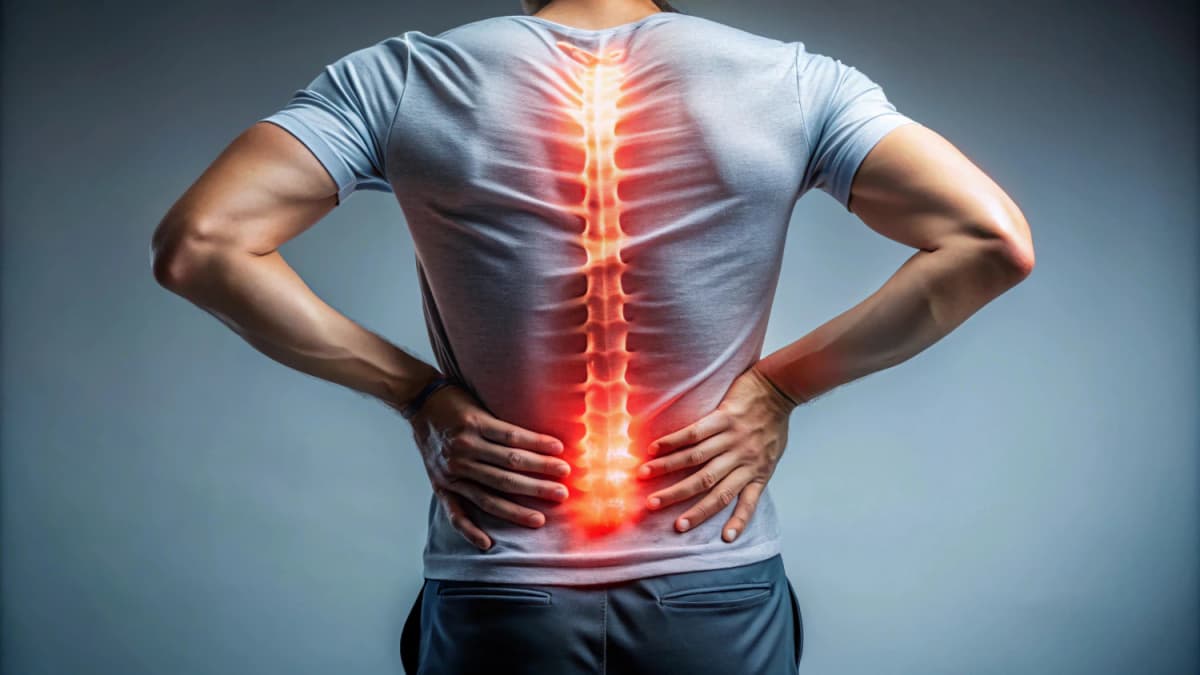
You bend down to pick up a bag, and something catches in your lower back. A few hours later the pain is running down the back of your leg. If that sounds familiar, you are probably dealing with an L5-S1 disc bulge, and one of the first things you will search for is which exercises to avoid so you do not make it worse. That instinct is correct. The L5-S1 disc bulge exercises to avoid list is one of the most searched lower back pain queries online, and for good reason: the wrong movement at the wrong time can set your L5-S1 recovery back by weeks.
The good news is that most L5-S1 disc bulges respond well to conservative care. An evidence-based review published in the International Journal of General Medicine (Schoenfeld & Weiner, 2010) found that the majority of patients with lumbar disc herniation improve without surgery when given the right combination of rest, physical therapy, and lower back disc exercise precautions. The key is knowing what to do and, just as importantly, what not to do.
L5-S1 is the lumbosacral junction: the point where the last vertebra of your lumbar spine (L5) meets the first segment of your sacrum (S1). This joint bears more weight than any other spinal segment because it sits at the bottom of the mobile spine, where all the load from your upper body converges before transferring to your pelvis.
Between L5 and S1 sits an intervertebral disc, a tough, fibrous ring (the annulus fibrosus) filled with a gel-like center (the nucleus pulposus). When that outer ring weakens or tears, the inner material pushes outward. If it pushes without fully breaking through, that is a disc bulge. If it breaks through, that is a herniation. Either way, the bulging material can press on the S1 nerve root, which runs right behind the disc, causing pain that shoots down the buttock, back of the thigh, calf, and sometimes into the outer foot. That radiating pain is sciatica.
The Cleveland Clinic notes that herniated discs most commonly occur at L4-L5 and L5-S1, because these segments handle the most mechanical stress during bending, lifting, and twisting. Understanding this anatomy matters for exercise decisions because any movement that increases compression, flexion, or rotational force on that already-damaged disc can push the bulge further into the nerve. For a deeper look at recovery timelines, see our post on L5-S1 disc bulge recovery time (reset.in/blog/l5-s1-disc-bulge-recovery-time).
Disc bulge vs. herniated disc: what's the difference
The general rule is simple: avoid anything that loads your lower spine in flexion (bending forward), combines flexion with rotation (bending and twisting at the same time), or creates high compressive impact on the lumbar discs. Here is why specific exercises are problematic.
Heavy deadlifts and barbell squats put enormous compressive force on the L5-S1 disc, especially when form breaks down under fatigue. Even with good technique, the loads involved can push a bulging disc further into the spinal canal.
Sit-ups and crunches force repeated spinal flexion. Each rep curls your lumbar spine forward, which is exactly the movement pattern that increases pressure on the posterior wall of the disc, the side that is already bulging toward the nerve. The same logic applies to leg raises while lying flat, which load the lower back through hip flexor pull.
Standing toe touches and forward bends are a problem because the weight of your entire upper body hangs from the lumbar spine while it is in its most vulnerable, fully flexed position. The NINDS Low Back Pain Fact Sheet lists forward bending as a common aggravating movement for disc-related pain.
Russian twists and seated rotations combine flexion with rotation, which is the single most damaging movement pattern for a disc bulge. Think of it like wringing out a wet towel: the disc gets squeezed and twisted simultaneously.
High-impact activities like running, jumping, and plyometrics send jarring forces through the spine with every foot strike. During the acute phase of an L5-S1 disc bulge, those repeated impacts can significantly irritate the nerve root. For more on how long sciatica symptoms from a disc issue typically last, see our post on how long does sciatica pain last (reset.in/blog/how-long-does-sciatica-pain-last).
Recovery is not about doing nothing. Total bed rest for more than a day or two actually slows healing. The goal is controlled, low-load movement that keeps blood flowing to the disc area, maintains muscle activation, and avoids the dangerous movement patterns listed above.
Gentle walking. Twenty to thirty minutes of flat-surface walking is one of the best things you can do. It keeps your spine in a neutral position, promotes circulation to the lower back, and gently activates the stabilizing muscles without compressive load.
Pelvic tilts. Lie on your back with knees bent. Gently flatten your lower back against the floor by tightening your abdominals, hold for 5 seconds, then release. This is a safe, low-level core activation that does not involve spinal flexion.
Prone press-ups (McKenzie extension). Lie face down, place your hands under your shoulders, and gently press your upper body up while keeping your hips on the floor. This encourages the disc material to shift away from the nerve, toward the center of the disc. Many physiotherapists use this as a first-line exercise for posterior disc bulges.
Bird-dog. On hands and knees, extend your right arm forward and your left leg back, hold for 5 to 10 seconds, then switch. This builds core stability and spinal endurance with minimal disc loading. It is one of the McGill Big Three exercises recommended by spine biomechanist Dr. Stuart McGill.
Modified curl-up (McGill curl-up). Lie on your back with one knee bent and the other straight. Place your hands under the small of your back to preserve the natural lumbar curve. Lift your head and shoulders slightly off the floor without flexing the lower back. This trains the abdominals while keeping the spine in a safe, neutral position.
The NIH-funded SPORT trial (Spine Patient Outcomes Research Trial) showed significant improvement in patients with lumbar disc herniation who received conservative management including guided physical therapy. The key word is guided: work with a physiotherapist who can tailor these exercises to your specific bulge location and symptom pattern.
People often use "sciatica" and "disc bulge" interchangeably, but they are not the same thing. Sciatica is a symptom: pain that radiates along the sciatic nerve, usually down one leg. A disc bulge at L5-S1 is one of the most common causes of sciatica, but it is not the only one. Piriformis syndrome, spinal stenosis, and spondylolisthesis can all produce similar radiating leg pain.
When sciatica comes from an L5-S1 disc bulge specifically, the pain tends to follow the S1 nerve root distribution: the back of the thigh, the calf, and sometimes the outer edge or sole of the foot. You might also notice weakness when pushing off with your foot (like pressing a gas pedal) or a diminished ankle reflex. These are clues that the S1 nerve root is involved.
The exercise precautions in this post apply specifically to disc-related sciatica. If your sciatica comes from a different cause, the exercise recommendations may be different, which is another reason to get a proper diagnosis before building a rehab program. For Ayurvedic approaches to sciatica management, see our post on sciatica treatment in Ayurveda (reset.in/blog/sciatica-treatment-in-ayurveda-exercises-and-what-actually-works).
Most L5-S1 disc bulges do not need surgery. The evidence-based review by Schoenfeld and Weiner (2010), published in the International Journal of General Medicine, concluded that while surgery can provide faster relief, most patients improve with continued conservative management over 6 to 12 weeks.
Surgery typically becomes necessary in three situations. First, cauda equina syndrome: if the disc compresses the bundle of nerves at the base of the spinal cord, causing bladder or bowel dysfunction, that is a medical emergency requiring immediate surgery. Second, progressive neurological deficit: if you are losing motor function in your foot or leg (like foot drop) and it is getting worse despite conservative care. Third, persistent, disabling pain that has not responded to at least 6 weeks of proper conservative treatment.
It is also worth knowing that disc bulges can shrink on their own over time. MRI studies published in PubMed have documented that herniated disc material decreases in size in roughly 60 to 65 percent of patients treated conservatively over 6 to 12 months. Larger herniations actually tend to resorb more completely than smaller ones.
Exercise is only one part of L5-S1 recovery. What you do for the other 23 hours of the day matters just as much.
Sleeping position makes a big difference. If you sleep on your side, place a pillow between your knees to keep your pelvis level. If you sleep on your back, put a pillow under your knees to reduce the pull on your lumbar spine. Stomach sleeping puts the lower back into extension and is generally the hardest position to manage during disc recovery.
Sitting is often the most painful position with an L5-S1 disc bulge because it flexes the lumbar spine and increases disc pressure. Keep sitting sessions under 20 to 30 minutes, use a lumbar support cushion or rolled towel behind your lower back, and stand up to walk briefly before sitting again.
Hydration supports disc health directly. Your intervertebral discs absorb water overnight and lose it under the compressive load of the day. Staying well-hydrated helps them maintain height and shock-absorbing capacity.
During the weeks of conservative care, daily discomfort can wear you down. Conventional painkillers help, but long-term use of NSAIDs comes with well-known gastric side effects. RESET Instant Ease Tablets (reset.in/products/tablet) offer a plant-based alternative made with White Willow (which contains salicin, the natural compound that inspired aspirin), Vayavidang, Ajwain, Safed Jeera, and Pippali. The herbal formulation is designed to support everyday pain management without the acidity that comes with regular NSAID use.
These tablets are not a substitute for physiotherapy or medical treatment. But as one piece of a broader recovery routine, they can help take the edge off daily discomfort, which makes it easier to stay consistent with your exercises and avoid the temptation to push too hard too soon.
An L5-S1 disc bulge is painful and disruptive, but it is also one of the most treatable spinal conditions when you get the exercise balance right. Avoid anything that loads your lower spine in flexion or combines bending with twisting. Stick to gentle, physiotherapy-approved movements like walking, pelvic tilts, prone press-ups, and the McGill Big Three. Give conservative care an honest 6 to 12 weeks before considering other options. And support your recovery with good sleep posture, limited sitting, hydration, and herbal pain support like RESET Instant Ease Tablets.
Which exercises should I avoid with an L5-S1 disc bulge?
Avoid heavy deadlifts, sit-ups, crunches, toe touches, Russian twists, and high-impact activities like running and jumping. These all load the lumbar spine in ways that can push the disc bulge further into the nerve root.
What exercises are safe?
Gentle walking, pelvic tilts, prone press-ups (McKenzie extensions), bird-dog, and McGill curl-ups are all considered safe for most L5-S1 disc bulges. Work with a physiotherapist to confirm which ones are right for your specific situation.
How long does L5-S1 disc bulge recovery take?
Typically 4 to 8 weeks with consistent conservative care for a straightforward bulge. More severe cases or full herniations may take 12 weeks or longer. The SPORT trial and other NIH-funded research supports conservative management as the first-line approach.
Can an L5-S1 disc bulge heal without surgery?
Yes, in most cases. Published MRI studies show that herniated disc material shrinks on its own in roughly 60 to 65 percent of patients over 6 to 12 months. Surgery is reserved for cases with emergency symptoms (cauda equina syndrome), progressive nerve damage, or failure of conservative treatment beyond 6 weeks.
What is the best sleeping position for an L5-S1 disc bulge?
Side sleeping with a pillow between the knees, or back sleeping with a pillow under the knees. Both positions reduce pressure on the L5-S1 disc and keep the spine closer to its natural alignment. Avoid stomach sleeping, which forces the lower back into extension.
1. Schoenfeld, A.J. & Weiner, B.K. (2010). Treatment of lumbar disc herniation: Evidence-based practice. International Journal of General Medicine, 3, 209-214. PMC2915533.
2. National Institute of Neurological Disorders and Stroke (NINDS). Low Back Pain Fact Sheet. National Institutes of Health.
3. Cleveland Clinic. Herniated Disk. my.clevelandclinic.org/health/diseases/12768-herniated-disk
4. Mayo Clinic. Back Pain: Symptoms and Causes. mayoclinic.org/diseases-conditions/back-pain/symptoms-causes/syc-20369906
5. Weinstein, J.N. et al. Surgical vs nonoperative treatment for lumbar disk herniation: The Spine Patient Outcomes Research Trial (SPORT). JAMA, 296(20), 2441-2450.
6. Altun, I. & Yuksel, K.Z. (2017). Lumbar herniated disc: spontaneous regression. Korean Journal of Pain, 30(1), 44-50. PMC5256262.
Share this article:
A 2X more powerful formula for enhanced relief.

₹799.00
₹629.00
An optimal choice for safe and natural pain relief.

₹349.00
₹229.00
An easy to apply potent formula with roll-on massager

₹549.00
₹449.00
| Factor | Disc bulge | Herniated disc |
|---|---|---|
| What happens | Outer disc wall pushes outward but stays intact | Outer wall tears; inner gel leaks out |
| Severity | Generally milder | Can be more severe, especially with large fragments |
| Nerve involvement | May or may not compress a nerve | More likely to compress or irritate a nerve root |
| Typical recovery | 4 to 8 weeks with conservative care | 6 to 12 weeks; some cases need surgical evaluation |
| Exercise | Movement type | Risk to L5-S1 |
|---|---|---|
| Heavy deadlifts | Spinal compression + flexion | Massive compressive load on the damaged disc |
| Sit-ups / crunches | Repeated lumbar flexion | Pushes disc material toward the nerve with each rep |
| Toe touches / forward bends | Loaded spinal flexion | Full body weight hanging from a flexed lower back |
| Russian twists | Flexion + rotation | Wringing force on the disc, the worst combination |
| Leg presses (heavy) | Compressive loading | Rounds lower back under load when knees come too close to chest |
| Running / jumping | High-impact repetition | Jarring forces aggravate an inflamed nerve root |
| Exercise | Target area | How to do it | Frequency |
|---|---|---|---|
| Gentle walking | General circulation, spinal stability | 20-30 min on flat ground, comfortable pace | Daily |
| Pelvic tilts | Deep core activation | Flatten lower back to floor, hold 5 sec, 10 reps | 2 to 3 times daily |
| Prone press-ups | Lumbar extension, disc repositioning | Press up from prone, hips stay down, hold 5 sec | Every 2 hours, 10 reps |
| Bird-dog | Core stability, spinal endurance | Opposite arm and leg, hold 5-10 sec, 5 per side | Once or twice daily |
| McGill curl-up | Abdominals (spine-safe) | Slight head/shoulder lift, hands under lower back | Once daily, 3 sets of 8 |
| Factor | Conservative care | Surgical intervention |
|---|---|---|
| When to consider | First-line for most disc bulges | After 6+ weeks of failed conservative care, or emergency symptoms |
| Typical timeline | 4 to 12 weeks | Recovery from surgery: 4 to 6 weeks, full rehab: 3 to 6 months |
| Success rate | ~80% improve without surgery (NINDS) | ~85-90% report improvement post-discectomy |
| Risks | Slow progress, requires patience | Infection, nerve damage, re-herniation (2-25% recurrence rate) |

