
Pain Relief
Neck Pain Under Ear: Causes, Symptoms & the Fastest Relief Methods That Work
2026-03-26
5 min
2026-10-01 • 4 min read
You know the spot. It sits right where your neck meets your shoulder, it feels like a small stone under the skin, and it gets louder the longer you stare at a screen. Knots in the shoulder and neck are some of the most common aches people carry around every day.
The good news is that most of them respond well to simple habits you can start today. This guide explains what a knot actually is, why it forms, and five easy stretches you can do at your desk or at home in under ten minutes.
Things You Should Know
• A muscle knot is a tight, tender band of muscle, often in the upper trapezius, that can send pain into your head, neck, or shoulder.
• Long hours of desk posture, stress, and repetitive arm work are the most common triggers.
Gentle daily stretching, warmth, and regular movement breaks help most people feel looser over time.
Doctors call them myofascial trigger points. A reference from the National Institutes of Health (NIH) describes them as focal knots inside a taut band of muscle, an idea first described by physician Janet Travell in 1942. Press on one and it usually feels sore right there. It can also send pain somewhere else, which is called referred pain.
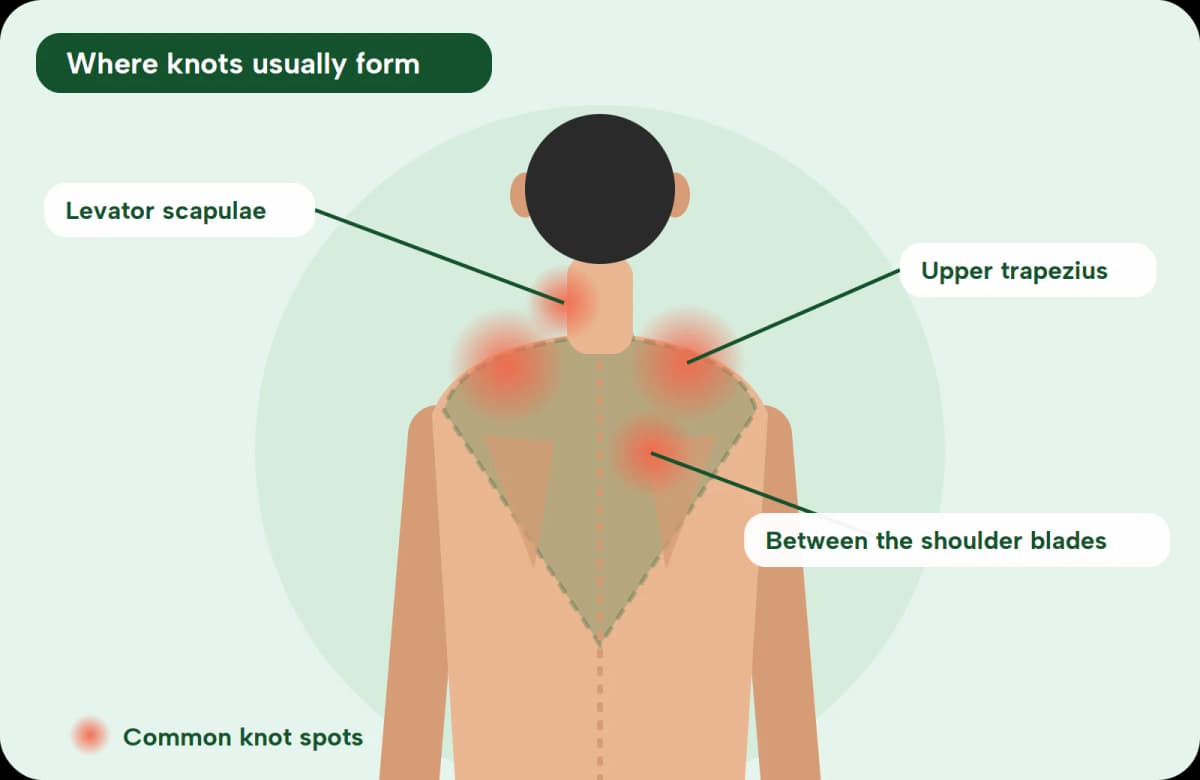
In the neck, the muscles most often involved include the trapezius, levator scapulae, and rhomboids, according to the NIH. When the trapezius is involved, the ache can show up as tension headaches or pain that spreads into the neck, shoulders, and upper arms. That is why a knot near your shoulder blade can make your whole head feel heavy.
There is rarely one single cause. The NIH notes that overuse, stress, and posture habits can all lead to muscle pain in the neck, in situations that range from a car accident to painting a ceiling to working at a poorly set up desk all day. The NHS lists sitting at a desk for long periods with poor posture, and sleeping with the neck locked in an awkward position, among the most common causes of neck pain.
Daily life adds its own layer. When your head drifts forward toward a laptop or phone, the muscles at the back of your neck have to work harder to hold it up. Stress plays a quieter role. Many of us lift our shoulders toward our ears without noticing, and holding that position for hours keeps the upper trapezius switched on. Carrying a heavy bag on one shoulder, cradling a phone between your ear and shoulder, and long stretches without moving all add to the load. Experts at the Johns Hopkins Arthritis Center point out that people can feel knots from muscle tightness caused by injury, strain, or too little exercise.
Move slowly, breathe out as you ease into each position, and stop at a gentle pull, never pain. Unless a step says otherwise, hold each stretch for 20 to 30 seconds and repeat two or three times on each side. A few minutes once or twice a day does more than one long session on the weekend.
1 Do the upper trapezius stretch.
Sit tall and hold the edge of your chair with your left hand. Tilt your right ear toward your right shoulder, then rest your right hand on the left side of your head and let the weight of your arm add a little more stretch. Don't pull. You should feel a long, easy stretch along the left side of your neck, right where many knots live. Switch sides.
2 Try the levator scapulae stretch.
This one targets the muscle that runs from the side of your neck down to the top of your shoulder blade. Sit tall, hold the chair with your left hand, and turn your head about 45 degrees to the right. Then lower your nose toward your right armpit. Rest your right hand on the back of your head without pressing. The stretch should land along the back and side of the left side of your neck.
3 Practice chin tucks.
Chin tucks work against the forward head posture that screen time encourages. Sit or stand with a tall spine and look straight ahead. Glide your head straight back, as if your chin were sliding along a shelf, until you feel a stretch at the base of your skull. Keep your eyes level so you don't tip up or down. Hold for 3 to 5 seconds, relax, and repeat 10 times.
4 Open up with a doorway chest stretch.
Tight chest muscles pull your shoulders forward, which leaves the upper back overstretched and overworked. Stand in a doorway and place your forearms on each side of the frame, elbows bent at about shoulder height. Step one foot forward and lean in slowly until you feel an opening across your chest and the front of your shoulders. Keep your belly gently firm so your lower back doesn't arch.
5 Finish with thread the needle.
Come onto your hands and knees on a mat, with hands under shoulders and knees under hips. Lift your right arm and slide it under your body toward the left, palm facing up, until your right shoulder and the side of your head rest on the mat. Your left hand stays planted for support. Breathe into the space between your shoulder blades, then slowly unwind and switch sides.
1 Use gentle heat or cold.
Warmth can help tight muscles let go. For neck pain, the NHS suggests a hot water bottle wrapped in a tea towel for 20 minutes, two to three times a day. A cold pack wrapped in a towel is another option if that feels better to you.
2 Roll it out with a tennis ball.
Place a tennis ball between your upper back and a wall, right on the tender spot. Bend and straighten your knees slowly to roll it around, and pause for a few breaths on any area that feels tight. Aim for firm pressure that feels relieving, not sharp.
3 Fix your desk setup.
Raise your screen so the top sits near eye level, keep your elbows close to your body, and let the chair support your back. The NHS advises against keeping your neck in the same position for a long time, so set a reminder to stand up and move regularly, even for a minute or two.
4 Check your pillow and sleep position.
The NHS recommends a firm mattress, a low and firm pillow, and keeping your head level with the rest of your body while you sleep. Sleeping on your front keeps the neck twisted for hours, so try your back or side instead.
5 Adding Reset Stretch Easy Oil
Oil gives your fingers glide, so the pressure feels smoother and more like a proper massage. Reset Stretch Easy Oil is a 200 ml herbal massage oil made with chamomile, geranium, lemongrass, rosemary, eucalyptus, camphor, olive oil and sunflower oil. The product page describes it as helping to ease everyday stiffness and support muscle relaxation. It does not claim to remove knots, and it should not be treated as a replacement for medical care.
To use it, take a small amount in your palm and massage the area in gentle circular motions until absorbed. The product page says it can be used up to three times a day, including before or after stretching. If your skin is sensitive, do a small patch test first, and keep the oil away from your eyes and any broken skin.
Most knots ease with time and self care. The NHS advises seeing a doctor if neck pain or stiffness doesn't go away after a few weeks, if painkillers haven't helped, if you are worried about the pain, or if you have other symptoms such as pins and needles or a cold arm. Get checked sooner if the pain follows a fall or accident, or comes with fever, a severe headache, weakness in your arms or hands, or changes in your balance or walking.
•Stretch when you are warm, such as after a shower or a short walk.
•Breathe out slowly as you move into each stretch.
•Never bounce. Hold each position steadily.
•A few minutes every day does more than one long session a week.
•Stop any stretch that causes sharp, shooting, or spreading pain, numbness, or tingling.
•Patch test any new topical, and keep it away from your eyes, cuts, and broken skin.
Knots aren't bubbles, so they don't pop. What you feel is a tight area slowly easing with pressure, stretching, and warmth. Pressing too hard can leave the spot more sore the next day, so go gently.
It varies from person to person. An NIH reference notes that short-term muscle pain of this kind often settles on its own or with simple care, while chronic cases lasting six months or longer can take more time and may need professional support.
It can play a part. The NIH lists stress alongside overuse and posture as factors that can lead to muscle pain in the neck. Slow breathing, a short walk, or a two-minute stretch break can help your shoulders drop back down.
Both are options. The NHS suggests either heat or cold packs for neck pain. Many people find warmth more soothing for tight, knotted muscles, while cold may feel better right after a strain.
It can contribute. A pillow that is too high or too flat can keep your neck bent all night. The NHS recommends a low, firm pillow so your head stays level with your body.
1. NHS. Neck pain. https://www.nhs.uk/conditions/neck-pain/
2. National Library of Medicine, NIH (StatPearls). Cervical Myofascial Pain. https://www.ncbi.nlm.nih.gov/books/NBK507825/
3. National Library of Medicine, NIH (StatPearls). Trigger Point Injection. https://www.ncbi.nlm.nih.gov/books/NBK542196/
4. National Library of Medicine, NIH (StatPearls). Myofascial Pain Syndrome. https://www.ncbi.nlm.nih.gov/books/NBK499882/
5. Johns Hopkins Arthritis Center. Fibromyalgia and knots. https://www.hopkinsarthritis.org/ask-the-expert/fibromyalgia-and-knots/
NHS Wales, Move Better Gwent. Neck pain. https://movebettergwent.nhs.wales/?p=7681
Share this article:
Infused with 6 powerful essential oils

₹1,299.00
₹999.00
A 2X more powerful formula for enhanced relief.

₹799.00
₹649.00
An easy to apply potent formula with roll-on massager

₹549.00
₹449.00

Back view of the upper body showing common knot spots in the upper trapezius, levator scapulae, and between the shoulder blades

Side view of a person hunched over a laptop with the head pushed forward and strain at the base of the neck

Seated person tilting the head toward one shoulder with a hand resting on the head, stretching the opposite upper trapezius

Seated person turning the head and lowering the nose toward the armpit, with a hand resting on the back of the head

Side view of a seated person gliding the head straight back into a chin tuck, with a dotted outline showing the forward starting position

Side view of a person in a doorway with a forearm on the frame, stepping forward to stretch the chest and front of the shoulder

Person on hands and knees sliding one arm under the body with the shoulder and head resting on a mat

Person standing with the back against a wall and a tennis ball placed on a tight spot near the shoulder blade

Side view of a person sitting upright at a desk with the screen raised to eye level and the back supported

