
Pain Relief
Shoulder Pain: Causes, Symptoms and the Fastest Relief Methods
2026-08-03
4 min read

2026-08-05 • 4 min read
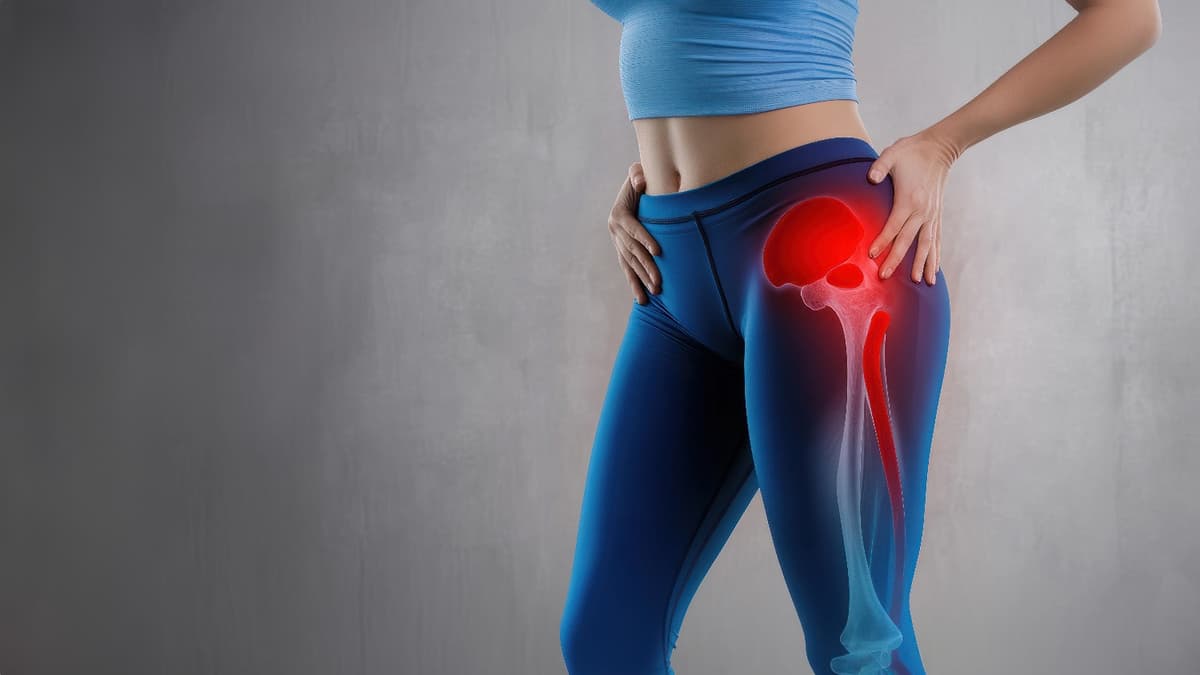
It shows up when you climb the stairs, when you stand after a long sit, or when you settle onto your side at night and the outside of your hip lights up. Pain in the hip joint is one of those problems that quietly rearranges your day, and it is far more common than most people realise, especially past 40. The tricky part is that “hip pain” is a catch-all term. It could be trochanteric bursitis on the outer hip, arthritis deep in the joint, or pain referred from your lower back that is only pretending to be a hip problem.
This guide helps you make sense of it. We will start with a hip pain location diagram, described in plain words, so you can match where it hurts to the likely cause. Then we move through the common culprits, the science of why hips ache, and the natural, practical steps you can take today to move more freely again.
Where your hip hurts is the single best first clue to what is going on, because different structures live in different zones.
Pain at the front or in the groin usually points inward, to the hip joint itself. That is the classic pattern for hip osteoarthritis or a labral issue, and it often arrives with stiffness and a shrinking range of movement. Pain on the outer side, over the bony point of the hip and down the upper thigh, is the signature of trochanteric bursitis, now more often called greater trochanteric pain syndrome. It is the kind that flares when you lie on that side. Pain at the back of the hip or deep in the buttock frequently is not a hip problem at all; it can be referred from the lower back or the sacroiliac joint, sometimes with a burning or pins-and-needles quality running down the leg.
Use the guide below as an at-a-glance map, then read on for the detail.
A handful of conditions account for most hip pain.
Trochanteric bursitis, or GTPS, is inflammation and irritation of the tissues over the bony point on the outside of the hip, including a fluid-filled cushion called a bursa and the nearby gluteal tendons. NHS inform notes it is most common in women between 40 and 60, though it can affect anyone, and it is a leading reason for that stubborn outer-hip ache.
Hip osteoarthritis is wear of the smooth cartilage inside the ball-and-socket joint. As the cushion thins, the bones grate, and you feel deep groin or front-of-hip pain with morning stiffness that eases once you get moving.
Gluteal tendinopathy overlaps heavily with GTPS: the tendons of the buttock muscles that anchor to the hip get overloaded and sore, often after a sudden jump in walking or running.
Referred pain from the lower back is the great impostor. A problem in the spine can send pain into the hip and thigh while your back itself feels perfectly fine.
Hip impingement, where the bones of the joint pinch during deep movement, tends to strike younger, active people and shows up as a catch in the groin.
Because bursitis and arthritis can both make a hip hurt, they get confused constantly, so much so that bursitis is sometimes nicknamed the great mimicker. The distinction is worth making, because the fixes differ.
The cleanest tell is location and trigger. Bursitis pain sits on the outside of the hip, is tender to the touch right on the bony point, and spikes when you lie on that side. Arthritis pain sits deeper, in the groin or front, brings stiffness and a shrinking range of motion, and tends to be worst first thing in the morning or after heavy use. Bursitis often follows a spell of overload, like ramping up your daily step count; arthritis builds slowly over years.
Hip and back pain travel together more than people expect, and it goes both ways. A worn or inflamed hip changes how you stand and walk, which loads the lower back and sets off pain there. Equally, a spinal problem can refer pain down into the hip and thigh even when your back feels normal, which is why NHS inform points out that some hip pain is actually a back problem, often described as sharp, hot, or tingling in the leg.
The practical upshot: if your hip pain comes with pins and needles down the leg, or it shifts around between hip, buttock, and back, the spine is worth investigating too. If your trouble is actually higher up, Reset's guides on shoulder pain and rotator cuff injury walk through the same detective work for the upper body.
Strip these conditions back and two mechanisms explain most hip pain: inflammation and wear. In bursitis and tendinopathy, overload irritates the bursa and tendons, and the body answers with the swelling and chemical signals that make the area throb. In osteoarthritis, the loss of cartilage removes the joint's shock absorber, and the low-grade inflammation that follows keeps it sore. Either way, pain makes you move less, the muscles around the hip weaken, and a weaker hip is loaded more awkwardly, which feeds the cycle. It is the same capsule-and-bursa inflammation story we unpack in our frozen shoulder guides on what causes a frozen shoulder and how to ease one faster, just playing out in a different joint.
Calming that inflammation is where certain herbs have a real evidence base. Boswellia serrata acts directly on inflammatory enzymes. A 2020 systematic review and meta-analysis in BMC Complementary Medicine and Therapies, held in the US National Institutes of Health library, pooled seven trials and found it reduced pain and stiffness in osteoarthritis. It will not regrow cartilage, but for the inflammatory ache layered on top, the direction of the evidence is solid.
Most hip pain, the NHS notes, eases within about six weeks with sensible self-care. Here is what earns its place in those weeks.
●Keep moving, within reason. A hip that seizes up hurts more. Avoid the movements that sharply aggravate it, but stay gently active; walking on the flat often beats sitting still.
●Use ice for a flare. The NHS suggests an ice pack wrapped in a towel on the sore area for up to 20 minutes every two to three hours, never straight on the skin. Switch to heat for stiff, chronic aching.
●Mind your footwear. Comfortable, shock-absorbing shoes with a soft sole take load off an irritated hip, and they are one of the NHS's own suggestions.
●Ease the night-time load. Sleeping with a pillow between your knees keeps the hip better aligned and takes pressure off the painful side.
●Take pressure off the joint. If you are carrying extra weight, even a modest reduction meaningfully lowers the load going through the hip with every step.
●Rebuild with gentle mobility work. Once the sharp pain settles, the exercises below restore movement and steady the muscles that support the joint.
●Reach for targeted topical relief. A deep-acting gel worked into the outer hip gives you comfort to move and do your exercises without another oral dose. The NHS itself lists ibuprofen gel among reasonable options, and a herbal alternative works on the same targeted principle.
Start gently and stop short of sharp pain; build up slowly over a few weeks.
When hip pain sits deep and a light gel just cools the surface, a stronger topical earns its place. Reset's Ultra Potent Gel is the most concentrated formula in the range, and it specifically covers discomfort that radiates from the lower back down through the hip and leg, which is exactly the pattern many hip sufferers describe. It carries seven Ayurvedic actives at double strength: Wintergreen, a natural source of the deep-muscle analgesic methyl salicylate, alongside Boswellia serrata and Nirgundi for inflammation, plus menthol, camphor, eucalyptus, and celery seed.
The delivery does the heavy lifting. Nanotechnology breaks the actives into ultra-fine particles that get past the skin surface into the deeper tissue where hip discomfort lives, reaching 54 percent better analgesic activity than a conventional topical. It is a fast-absorbing, non-sticky 100g gel. Work a thin layer into the outer hip on clean, dry skin two or three times a day, ideally before your mobility exercises. The gel handles the pain; the movement does the rest.
Most hip pain settles at home, but some signs need prompt attention. Get urgent help if you cannot put any weight through the leg, if the hip is hot, swollen, and you feel feverish, or if the pain followed a significant fall or blow within the last few days. And if your hip pain has not improved after around six weeks of sensible self-care, or it is steadily getting worse, see a GP or a physiotherapist to pin down the cause.
In women, particularly between 40 and 60, trochanteric bursitis (greater trochanteric pain syndrome) is a very common cause of outer-hip pain. Hip osteoarthritis, gluteal tendinopathy, referred lower-back pain, and pregnancy-related pelvic changes can all contribute as well.
Walking loads the hip joint and the tendons and bursa on its outer side, so pain on walking often points to bursitis or hip osteoarthritis. Worn footwear, a sudden jump in distance, and weak supporting muscles can all make it worse.
Yes. Hip pain can radiate to or from the lower back, and the two often occur together. A spinal problem can refer pain into the hip and thigh, and an unhappy hip can change your gait and strain the back.
Relative rest, gentle stretching and mobility work, ice for flares and heat for stiffness, a pillow between the knees at night, and Ayurvedic pain-relief oils or gels for targeted comfort. Most hip pain eases within about six weeks of consistent self-care.
●Where the pain sits is your first clue: the outer hip suggests trochanteric bursitis, the groin suggests the hip joint itself, and the back of the hip is often referred from the spine.
●Bursitis and hip arthritis are easy to confuse; tenderness on the bony point and pain lying on that side point to bursitis.
●Pain in the hip joint and lower-back pain frequently travel together, so it is worth considering both.
●Most hip pain settles within about six weeks with movement, ice, sensible footwear, and targeted pain relief.
●Boswellia serrata, concentrated in Reset's Ultra Potent Gel, has real evidence for easing the inflammation behind hip pain.
NHS. Hip pain in adults. https://www.nhs.uk/symptoms/hip-pain/
NHS inform. Greater trochanteric pain syndrome. https://www.nhsinform.scot/illnesses-and-conditions/muscle-bone-and-joints/leg-and-foot-problems-and-conditions/greater-trochanteric-pain-syndrome/
NHS inform. Hip problems. https://www.nhsinform.scot/illnesses-and-conditions/muscle-bone-and-joints/leg-and-foot-problems-and-conditions/hip-problems
Yu G, et al. Effectiveness of Boswellia for osteoarthritis: a systematic review and meta-analysis. BMC Complement Med Ther, 2020. https://pmc.ncbi.nlm.nih.gov/articles/PMC7368679
This article is for general information and is not a substitute for professional medical advice. If you are concerned about your symptoms, please consult a qualified healthcare provider.
Share this article:
A 2X more powerful formula for enhanced relief.

₹799.00
₹794.00
An easy to apply potent formula with roll-on massager

₹549.00
₹449.00
RESET Recovery Relief Combo is made for days when your body feels sore, stiff, or tired after long work hours, travel, workouts, or daily strain. The Soothing Gel helps comfort the affected area with gentle topical support, while the Pain Relief Tablets support relief from within. Together, they help support muscle recovery, body ache relief, back discomfort, joint stiffness, and everyday body pain. A simple recovery-focused combo for home, office, gym, travel, and daily use.

₹698.00
₹499.00
| Where it hurts | Common cause | Typical feel |
|---|---|---|
| Front or groin | Hip osteoarthritis, labral or joint issue | Deep ache, stiffness, reduced range |
| Outer side of hip and upper thigh | Trochanteric bursitis (GTPS) | Sharp then achy, worse lying on it |
| Back of hip or buttock | Referred from lower back or SI joint | Burning, pins and needles down the leg |
| Groin with a catching sensation | Hip impingement | A pinch on deep bending or squatting |
| Feature | Trochanteric bursitis (GTPS) | Hip osteoarthritis |
|---|---|---|
| Where it hurts | Outer hip and upper thigh | Groin and front of the hip |
| Tender to touch? | Yes, on the bony point | Not usually |
| Worse when | Lying on that side, climbing stairs | Mornings, and after heavy use |
| Stiffness / lost range | Mild | Marked and progressive |
| Typical onset | After a spell of overload | Slowly, over years |
| Mobility move | How to do it | What it helps |
|---|---|---|
| Standing hip abduction | Hold a chair, lift one leg out to the side, lower slowly | Strengthens the outer-hip muscles |
| Glute bridge | Lie on your back, knees bent, lift the hips, hold briefly | Steadies the hip and lower back |
| Knee-to-chest stretch | Lie down, draw one knee gently toward the chest | Eases stiffness at the front of the hip |
| Clamshell | Lie on your side, knees bent, open the top knee | Wakes up the gluteal stabilisers |
| Key herb | What it contributes |
|---|---|
| Wintergreen | Natural methyl salicylate for deep muscle analgesia |
| Boswellia serrata | Targets inflammatory enzymes; studied for joint pain and stiffness |
| Nirgundi (Vitex negundo) | Traditional analgesic with anti-inflammatory action |
| Menthol & camphor | Cooling counterirritants that dial down the pain signal |
| Eucalyptus & celery seed | Warming, soothing support for stiff muscle |

