
Pain Relief
Upper Back Pain Causes
2026-06-25
5 min read

2026-06-29 • 5 min read
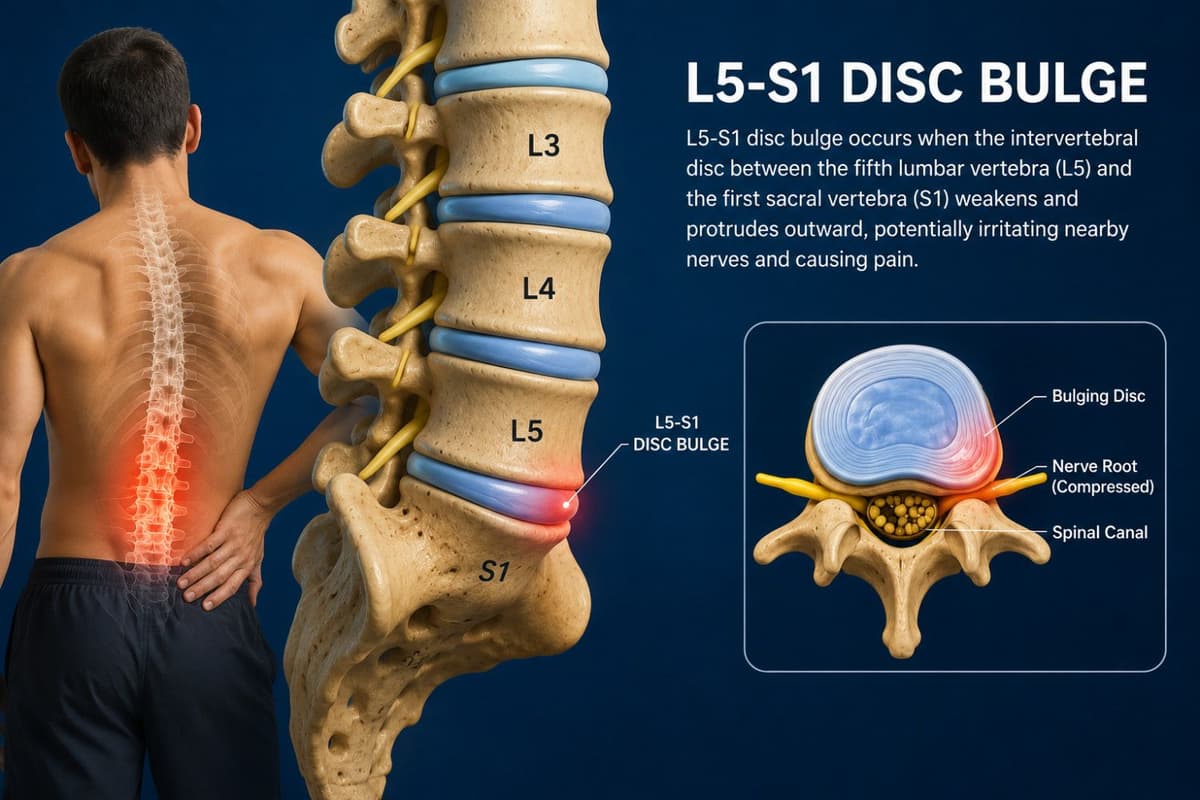
If you've just been told you have an L5-S1 disc bulge, the question on your mind is probably simple: how long is this going to last? L5-S1 disc bulge recovery time isn't a single number you can circle on a calendar — it's a range shaped by how your body responds, how you move during the process, and how consistently you support that healing. Most people search for a fixed timeline because uncertainty is uncomfortable, but what actually helps is understanding the real stages of healing, what your body is doing at each one, and what you can control along the way. At Reset, recovery isn't about waiting passively — it's about giving your body every advantage while it does the work.
A disc bulge and a herniated disc are often used interchangeably, but they aren't identical. With a bulge, the outer wall of the disc weakens and protrudes without tearing. A herniation goes a step further — the inner gel-like core pushes through a tear in that outer wall, which tends to irritate nearby nerves more directly. At the L5-S1 level, the lowest joint in your spine, either version is common, since this segment carries a disproportionate share of your body's daily movement and load. In general, a straightforward bulge tends to settle faster than a herniation with clear nerve involvement, but the difference in timeline is usually measured in weeks, not months — both conditions follow a similar underlying healing process.
Table 1: Recovery Stage vs. Typical Timeframe
According to MedlinePlus, a service of the National Library of Medicine at the National Institutes of Health, most people with a herniated disk improve with nonsurgical treatment, though it may take several months to a year or more before they return to their usual activities without pain or strain.¹ That timeline reflects what's actually happening internally: the disc itself rarely "un-bulges" back to its original shape. Instead, inflammation around the disc gradually decreases, irritated nerve roots stop firing pain signals as intensely, and the surrounding muscles adapt to support the area differently. Recovery, in other words, is less about restoring the disc to a prior state and more about your body building a new, stable equilibrium around it.
Two people with an almost identical L5-S1 disc bulge on an MRI can have very different recovery timelines, and the difference usually comes down to a handful of controllable factors. Age, overall fitness, and how quickly you seek proper guidance all play a role, but so do the daily choices made throughout the healing window.
Table 2: Factors That Help Healing vs. Factors That Delay It
None of these factors work in isolation, and that's precisely why two people with the same MRI report can have such different experiences. Someone who combines gentle movement with good sleep and a healthy weight is stacking several small advantages at once, while a single setback — a smoking habit, a return to heavy lifting too early — can quietly undo weeks of progress. Recovery responds to patterns, not one-off efforts.
The "How" — What You Can Do During Recovery
In the first two weeks, the instinct to stay completely still is understandable, but it often works against you. Short, frequent walks keep blood flow moving through the area without adding strain, while complete bed rest beyond a day or two can actually weaken the muscles meant to support your spine during healing. Avoid prolonged sitting, heavy lifting, and any twisting motion under load. Alternating heat and cold in this window helps manage both muscle spasm and inflammation, and a targeted topical applied directly to the lower back can ease surface-level discomfort while your body works through the deeper healing process.
Sleep position matters more than people expect during this stage too. Lying on your back with a pillow under your knees, or on your side with a pillow between them, keeps your spine in a neutral position overnight instead of adding rotational strain while you're least able to correct it.
As pain settles, the focus shifts from protecting the area to rebuilding it. Our lower back pain relief exercises guide walks through movements appropriate for this stage, and our how to improve posture piece covers the daily adjustments that keep pressure off a healing disc. If you're tracking your progress, our article on signs a herniated disc is healing outlines the milestones worth watching for.
L5-S1 sits right alongside L4-L5, so it helps to understand how the two compare — our guide to L4-L5 pain symptoms breaks down that neighboring level, while our broader pieces on lower back pain causes and what causes back pain connect the wider picture. And if discomfort shows up elsewhere along your spine during recovery, our guides to right side back pain and upper back pain causes are worth bookmarking too.
It's worth being clear about what a topical application can and can't do here: nothing applied to the skin changes how quickly a disc heals internally. What it can do is ease the everyday muscle tension and surface discomfort that build up around a healing disc, making it easier to stay consistent with the movement and posture work that actually drives recovery. RESET's Ultra Potent Gel — a concentrated blend of Wintergreen, Menthol, Neelgiri, Nirgundi, Camphor, Boswellia Serrata, and Ajmoda, delivered through advanced nanotechnology — is suited to the deep, stubborn tension that often surrounds a healing disc. The RESET Emulsion roll-on carries the same seven Ayurvedic herbs in a lighter, faster-absorbing format for everyday comfort between exercises or during a long day at a desk.
Table 3: Choosing Between Reset Ultra Potent Gel and Emulsion
Most L5-S1 disc bulges heal with the conservative approach outlined here. But a small number of cases involve a rare, serious complication called cauda equina syndrome, where the disc compresses a bundle of nerves at the base of the spine. This is a medical emergency, not something to monitor at home. Seek immediate emergency care if you experience new numbness in the groin or inner thighs (sometimes described as "saddle" numbness), loss of bladder or bowel control, or rapidly worsening weakness in one or both legs. These symptoms require same-day evaluation, since delayed treatment is linked to a higher risk of lasting nerve damage.
Table 4: Home Care Timeline vs. Reset Products vs. Emergency Care
●L5-S1 disc bulge recovery time typically spans 6 to 12 weeks for functional improvement, though full tissue remodeling can take several months to a year.
●The disc doesn't return to its exact original shape — recovery is about reduced inflammation, calmer nerves, and your body building a new stable pattern around the area.
●Early, gentle movement generally supports healing better than prolonged bed rest; heavy lifting, twisting, and smoking all slow it down.
●Reset's Ultra Potent Gel and Emulsion can ease everyday muscle tension and discomfort during recovery, though they don't change how quickly the disc itself heals.
●Saddle numbness, bladder or bowel changes, or rapidly worsening leg weakness are emergency symptoms — don't wait to see if they pass.
Most people see meaningful functional improvement within 6 to 12 weeks of conservative care, though complete tissue remodeling can take several months to a year. Individual timelines vary based on severity, age, and consistency of care.
Many bulging discs improve significantly without surgery, as inflammation subsides and surrounding muscles adapt. The disc rarely returns to its exact prior shape, but most people regain full function and become pain-free.
Consistency matters more than any single fix — early gentle movement, avoiding prolonged bed rest and heavy lifting, following a structured exercise plan, and maintaining a healthy weight all support faster, more durable recovery.
Yes, for most people. Short, frequent walks encourage blood flow and gentle movement without the strain of higher-impact activity, though it's worth checking with your doctor if walking increases leg pain or numbness.
Sudden numbness in the groin or inner thighs, loss of bladder or bowel control, or rapidly worsening leg weakness are emergency signs that need same-day medical care, not a wait-and-see approach.
¹ MedlinePlus, National Library of Medicine, National Institutes of Health. "Herniated Disk." medlineplus.gov/ency/article/000442.htm
This article is for informational purposes and does not replace professional medical advice or diagnosis. Reset products are intended for comfort and support during recovery, not as a treatment for underlying disc conditions. If you experience emergency warning signs described above, seek immediate medical care.
Share this article:
| Recovery Stage | Typical Timeframe |
|---|---|
| Acute inflammation | First few days to 2 weeks |
| Repair and nerve calming | 2 to 6 weeks |
| Functional return | 6 to 12 weeks |
| Full tissue remodeling | 3 months to a year or more |
An easy to apply potent formula with roll-on massager

₹549.00
₹449.00
A 2X more powerful formula for enhanced relief.

₹799.00
₹649.00
An optimal choice for safe and natural pain relief.

₹349.00
₹249.00
Rejuvenating blend of herbal ingredients for your liver detox.

₹559.00
₹449.00
| Helps Healing | Delays Healing |
|---|---|
| Early, gentle movement | Prolonged bed rest |
| Core and posture strengthening | Repeated heavy lifting or twisting |
| Maintaining a healthy weight | Smoking, which reduces disc blood supply |
| Following a structured therapy plan | Returning to strain too soon |
| Consistent sleep and stress management | Ignoring early warning symptoms |
| Situation | Better Fit |
|---|---|
| Deep tension around the lower back during recovery | Ultra Potent Gel |
| Light, frequent comfort between therapy sessions | Emulsion roll-on |
| Post-exercise soreness as you rebuild strength | Ultra Potent Gel |
| Quick application before a desk-bound day | Emulsion roll-on |
| Ongoing daily comfort alongside a recovery plan | Emulsion roll-on |
| Situation | Best Next Step |
|---|---|
| Mild ache, improving week over week | Continue gentle movement, heat/cold, Reset topical |
| Pain plateaued past 6 weeks | Follow up with your doctor or physical therapist |
| Persistent leg pain, tingling, or weakness | Medical evaluation, possibly imaging |
| Saddle numbness, bladder/bowel changes, rapid leg weakness | Emergency care immediately |

