
Pain Relief
Signs a Herniated Disc Is Healing
2026-06-17
5 min read

2026-06-10 • 5 min read
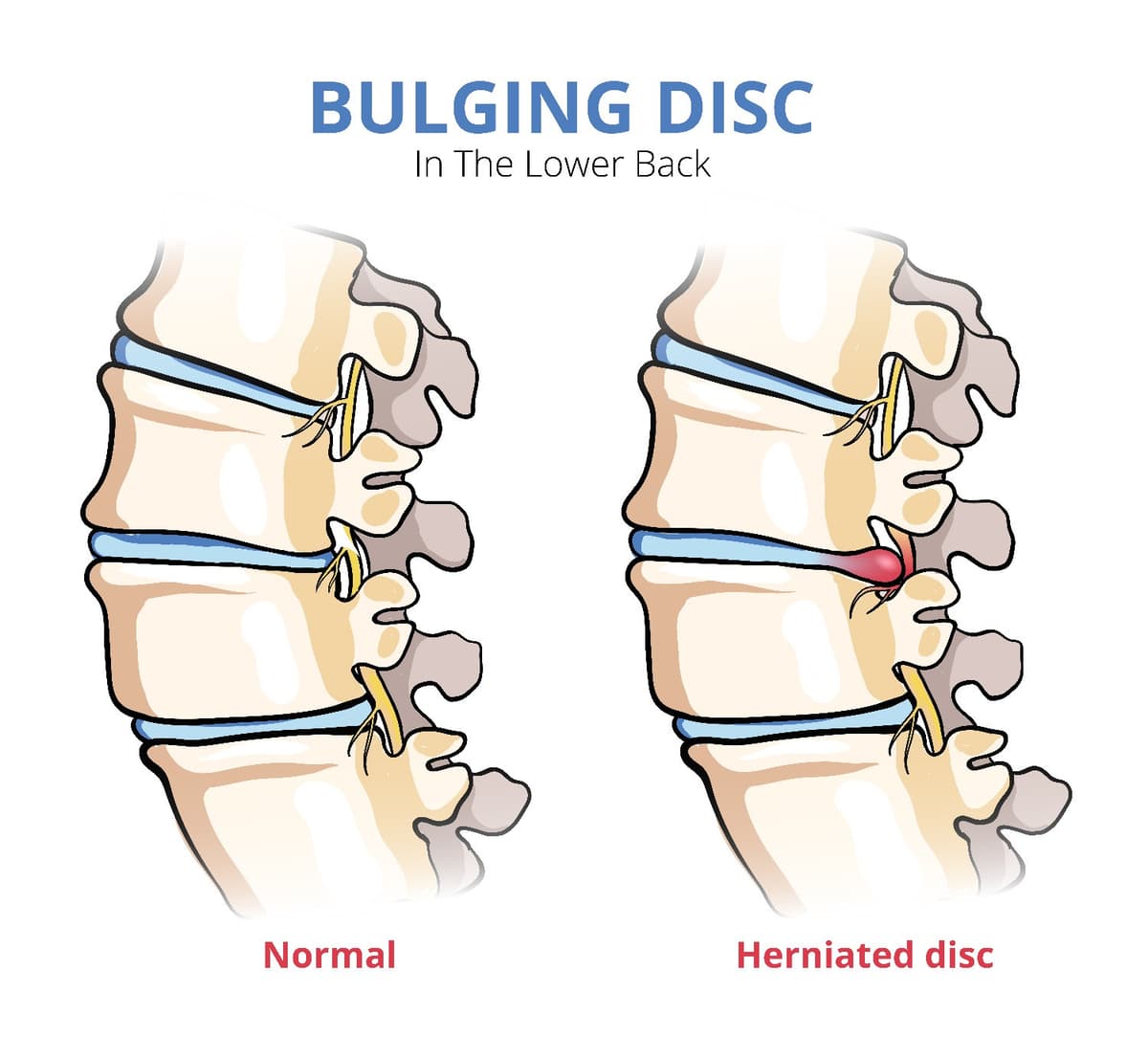
A diffuse disc bulge rarely announces itself politely. For most people it starts quietly: a dull ache after a long drive, a morning stiffness that no longer loosens the way it used to. Then you reach for something on the floor and a hot line of pain runs down one leg. If a scan has confirmed a slip disc, or a doctor has used the words disc bulge, the question that follows is almost always the same one. Will I need surgery?
The honest answer is reassuring: most people never do. Effective disc bulge treatment is far less dramatic than the worst-case stories suggest, and it sits on a spectrum that runs from gentle daily movement at one end to surgery at the other. The overwhelming majority of recoveries happen near the gentle end. This guide walks you through every rung of that ladder, explains what is actually going wrong inside your spine, and gives you something you can act on today.
Your spine is a stack of bones called vertebrae, and between each pair sits a small disc that works like a shock absorber. Every disc has a firm, fibrous outer ring and a soft, jelly-like center. When the outer ring weakens with age or strain, that soft center can press outward and push the wall of the disc past its normal edge. The outward push is the bulge.
A disc bulge and a herniation are not the same thing, even though the words get used loosely. In a bulge, the outer ring stays intact and the disc simply protrudes. In a herniation, the inner material breaks through a tear in that ring. Both fall under the everyday label of slip disc, which is where a lot of the confusion begins. If you want the fuller picture of what sets these problems off in the first place, our guide on what causes back pain breaks down the common triggers.
You may have seen the phrase diffuse disc bulge on an MRI report and felt your stomach drop. It sounds serious. Usually it is not. Diffuse simply means the disc is bulging broadly and fairly evenly around its rim, rather than poking out at one sharp point. This pattern is most often a sign of ordinary, age-related wear, and it frequently causes no symptoms at all. A focal protrusion, by contrast, is a more localized bulge pushing in one direction, which is likelier to crowd a single nerve.
Here is the part that surprises people. The bulge is rarely the direct source of the pain. According to the UK’s National Health Service (NHS)[1], many people have slipped or bulging discs and never feel a thing, and scans routinely pick up disc changes in people with no back pain whatsoever. The discomfort tends to arrive only when displaced disc material presses on a nearby nerve root, or when the surrounding tissue becomes inflamed. That distinction matters, because it explains why calming inflammation and easing nerve irritation, not “pushing the disc back in,” is what actually drives recovery. Nothing literally slips back into place. The body settles the problem down.
If there is one message worth holding onto, it is this. The vast majority of disc bulges improve without surgery, and often without any procedure at all. The NHS advises that the best thing most people can do is keep moving and stay gently active, using simple pain relief to make that movement possible. Bed rest, once standard advice, is now known to slow recovery and stiffen the back further.
Over a few weeks, the body gradually reabsorbs the displaced material and the inflammation around the nerve settles. For most people the pain curve bends steadily downward. The table below shows the pattern recovery usually follows, though everyone’s timeline is a little different.
Doctors usually think about disc bulge treatment as a ladder. You start on the lowest, gentlest rung, and you climb higher only if your symptoms refuse to settle. Most people get everything they need from the first rung.
Conservative care: movement, physiotherapy, and symptom relief. This is the foundation, and for roughly nine in ten people it is the whole staircase. A physiotherapist is your most valuable ally. Rather than handing you a generic exercise sheet, a good one assesses your posture, your flexibility, and exactly how your nerve is being irritated, then builds a plan around your specific disc level. Approaches like the McKenzie Method use carefully chosen positions to take pressure off the nerve. Alongside this, your doctor may suggest anti-inflammatory pain relief such as ibuprofen, taken regularly rather than only when pain spikes, and occasionally a short course of muscle relaxants.
Staying active is the goal, but that is hard when every movement aches. This is where good topical relief earns its place. It will not heal the disc, and no honest product should claim it does, but easing the surface muscle tension and stiffness that build up around an irritated spine can be the difference between moving and seizing up. Reset’s Emulsion roll-on was made for these everyday moments: a clean, fast-absorbing blend of seven Ayurvedic herbs, carried deeper into the tissue by nanotechnology, that you can roll onto a stiff lower back before a morning walk without mess or a heavy medicinal smell. For the deeper, more stubborn soreness that lighter products do not touch, Ultra Potent Gel runs the same herbal formula at double the concentration. Both rely on ingredients with a long history in muscular pain relief: Wintergreen, whose natural methyl salicylate acts as an analgesic; cooling Menthol; and Boswellia serrata, Nirgundi, Camphor, Eucalyptus and Ajmoda, valued in Ayurveda for soothing inflammation. Treat them as the tool that keeps you comfortable enough to do the movement that truly heals you.
Interventional options: a stronger nudge when pain won’t settle. If weeks of conservative care have not been enough, the next rung offers more targeted help without major surgery. An epidural steroid injection places a powerful anti-inflammatory right around the compressed nerve, often buying a window of relief that lets you finally engage with physiotherapy. Some clinics also offer non-surgical spinal decompression, a form of gentle, controlled traction designed to reduce pressure on the affected disc across a series of sessions.
Surgery: the last resort, and rarely the destination. Surgery enters the conversation for only a small minority. It becomes a genuine option when pain stays severe and disabling after a fair trial of conservative care, usually six to twelve weeks, or when there are signs of progressive nerve damage such as worsening weakness in a limb. The most common procedure is a microdiscectomy, in which a surgeon removes just the fragment of disc pressing on the nerve. Spinal fusion, which joins vertebrae to stabilize the spine, is reserved for specific cases of instability. Worth knowing: the NHS notes that over the long run, surgery and conservative treatment tend to reach similar outcomes, though surgery can bring faster relief in the right candidate. It is a tool for specific situations, not a default.
You do not have to wait for an appointment to start helping yourself. A handful of sensible habits, kept up consistently, do more than any single dramatic intervention.
•Keep moving, gently. A daily walk, easy swimming, or beginner-friendly yoga keeps the back mobile and nourishes the discs. Choose whatever does not sharpen your pain.
•Respect how you sit and lift. Set up your chair and screen so you are not hunched for hours, and when you pick things up, hinge at the hips and keep the load close to your body instead of rounding your back.
•Warm up the area before you move. A little heat followed by a topical such as Ultra Potent Gel or the Emulsion roll-on can loosen a stiff lower back enough to make your walk or stretches comfortable.
•Sleep in a position that unloads the spine. Many people find relief lying on their side with a pillow between the knees, or on their back with a pillow under the knees.
•Be patient with the timeline. Progress is rarely a straight line, and a flare-up after a good day does not mean you have undone your recovery.
One important exception. While most disc problems are not dangerous, a rare condition called cauda equina syndrome is a medical emergency. Go to an emergency department straight away if you develop any of these: new difficulty controlling your bladder or bowels, numbness around the genitals, inner thighs or back passage, or rapidly worsening weakness in both legs. These signs point to serious nerve compression that needs urgent care. They are uncommon, but they are not something to wait out.
At Reset, we see a disc bulge not as a sentence but as a signal: an invitation to move better, recover smarter, and treat your body as a system rather than a set of separate parts. Lasting relief rarely comes from one product or one procedure. It comes from the steady combination of the right movement, enough patience, and small daily choices that lower the load on your spine. Topical relief is one supportive piece of that picture, the piece that keeps you comfortable enough to stay in motion while your body does the deeper work of healing. Effective disc bulge treatment, in the end, is less about a single fix and more about giving your spine the conditions it needs to settle, strengthen, and carry you forward.
•A slip disc or disc bulge is common, and most cases improve without surgery, often within about six weeks.
•The pain usually comes from nerve irritation and inflammation, not the bulge itself, which is why staying active and calming inflammation drive recovery.
•Treatment is a ladder: gentle movement and physiotherapy first, injections or decompression if needed, surgery only for a small minority.
•Topical relief such as Reset’s Emulsion and Ultra Potent Gel can ease the muscular pain and stiffness around the spine to help you keep moving; it supports comfort and does not replace medical care.
•Learn the red flags. Loss of bladder or bowel control, or numbness in the saddle area, needs emergency attention.
What is a disc bulge?
A disc bulge happens when one of the cushioning discs in your spine pushes outward beyond its normal boundary. The soft inner core presses against the firm outer ring and stretches it, so the disc protrudes. As long as the outer ring stays intact, it is called a bulge; if the inner material breaks through, it becomes a herniation. Many bulges, especially the diffuse, age-related kind, cause no symptoms at all.
How to heal a bulging disc naturally?
Natural healing is really about creating the right conditions and then letting your body do its job. Stay gently active with walking, swimming or yoga; work with a physiotherapist on targeted, posture-focused exercises; manage your weight to reduce load on the spine; and avoid smoking, which starves discs of oxygen. Using heat and a herbal topical to ease stiffness can make that daily movement far more comfortable. Most bulges settle with this kind of consistent, conservative care.
How long does a bulging disc take to heal?
For most people, the worst pain eases within the first few weeks. Roughly half improve within around ten days, about three in four within four weeks, and close to nine in ten within six weeks. The disc material itself is often reabsorbed over a similar window. If significant pain is still limiting you beyond about twelve weeks, that is the point to revisit your doctor about stepping up treatment.
How to cure a disc bulge naturally?
It is more accurate to talk about resolving a disc bulge than curing it on demand, because there is no instant fix. The encouraging reality is that the body resolves most bulges on its own when you support it: consistent gentle movement, physiotherapy, a healthy weight, good posture, and patience. Topical relief and heat help you stay active through the process. Surgery is rarely needed. If your symptoms are severe, worsening, or accompanied by any red-flag signs, see a doctor rather than relying on home care alone.
Source: Medical information in this article draws on guidance from the UK’s National Health Service (NHS), Slipped disc. This article is for general education and is not a substitute for professional medical advice; always consult a qualified clinician about your own condition.
Share this article:
A 2X more powerful formula for enhanced relief.

₹799.00
₹649.00
Uniquely formulated gel with wintergreen oil containing natural methyl salicylate.

₹349.00
₹299.00
Rejuvenating blend of herbal ingredients for your liver detox.

₹559.00
₹449.00
An easy to apply potent formula with roll-on massager

₹549.00
₹449.00
| Term | What’s happening | Typical impact |
|---|---|---|
| Bulging disc | The outer ring stays intact while the disc pushes outward, often broadly | Mild; frequently causes no symptoms |
| Disc protrusion | A more localized outward push in one direction, ring still intact | Mild to moderate |
| Herniated / prolapsed disc | The soft inner core breaks through a tear in the outer ring | Moderate to severe |
| “Slip disc” | An everyday umbrella term, not a precise medical diagnosis | Varies widely |
| Timeframe | What recovery usually looks like |
|---|---|
| First 10 days | Pain is often at its most intense, yet around half of people are already starting to improve |
| Weeks 2 to 4 | Inflammation settles and movement returns; roughly three in four feel noticeably better |
| By about 6 weeks | Close to nine in ten people have recovered or are nearly there |
| Beyond 12 weeks | Only a small minority still have limiting pain; this is the point to discuss stepping up treatment |
| Option | What it does | Best suited for | Typical recovery |
|---|---|---|---|
| Movement & physiotherapy | Strengthens supporting muscles and restores safe movement | Nearly everyone; the first-line approach | Several weeks |
| Topical & oral pain relief | Eases pain and stiffness so you can stay active | Symptom comfort alongside physio | Used as needed |
| Epidural steroid injection | Calms inflammation directly around the nerve | Nerve pain not settling with conservative care | Days to weeks of relief |
| Spinal decompression | Gentle traction to reduce pressure on the disc | Moderate cases avoiding surgery | Across several sessions |
| Microdiscectomy / surgery | Removes the fragment pressing on the nerve | Severe, progressive or emergency cases | Weeks to a few months |
| Helps your recovery | Sets you back |
|---|---|
| Gentle daily walking and easy movement | Long stretches of bed rest |
| Hip-hinge lifting with the load held close | Bending and twisting with a rounded back |
| Heat and topical relief before activity | Pushing through sharp, radiating pain |
| Guided core and posture work with a physio | Random, unguided exercises from the internet |
| Consistent sleep and stress management | Smoking, which lowers the oxygen supply to your discs |

