
Wellness
Read more
2026-02-27
5 min

2026-08-19 • 4 min read
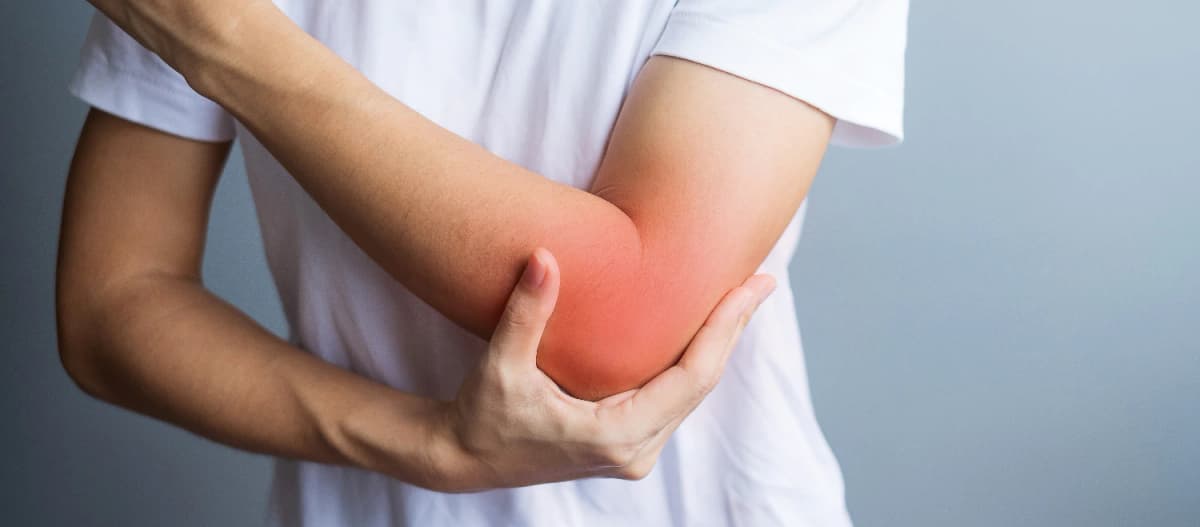
Most people who get tennis elbow have never touched a racket. Lateral epicondylitis, as doctors call it, is a repetitive strain injury that hits painters, plumbers, cooks, and anyone who spends eight hours a day gripping a mouse. About 1 to 3 percent of adults deal with it every year, with the peak at ages 30 to 50. If your outer elbow aches during something as basic as lifting a coffee cup, you're in the right place. The tennis elbow causes behind your pain are probably more mundane than you think, and elbow pain treatment at home can go a long way before you need a clinic visit.
Here's what's actually going on inside your arm, who's most at risk, and what tennis elbow relief looks like when you want something that works with your body.
On the outer bump of your upper arm bone (the lateral epicondyle), several forearm muscles attach via tendons. The main one involved in tennis elbow is the extensor carpi radialis brevis, or ECRB. It stabilizes your wrist when your elbow is straight.
Repeat the same gripping or wrist-extending motion enough times, and small tears develop in the ECRB tendon right where it anchors to that bony bump. According to StatPearls (a peer-reviewed resource through the National Library of Medicine), the damage is more degeneration than classic inflammation. The NHS describes it similarly: overuse causes tiny tears near the lateral epicondyle, leading to pain on the outside of the elbow.
That distinction matters. "Tendinitis" implies something you can ice away. But by the time most people seek help, the tissue has entered tendinosis, where the tendon is breaking down at a cellular level. Rest alone won't fix that.
Less than 5 percent of cases come from tennis. The condition is far more common in people whose daily routines involve repetitive arm movements they barely register.
Office workers are a big one. If your wrist sits flat on a desk while you click and scroll for hours, that constant low-grade extension loads the same tendons a backhand would. Painters get it from brush strokes. Plumbers from turning wrenches. Cooks from chopping and gripping hot pans.
The Royal Berkshire NHS Foundation Trust notes that the condition most frequently affects adults between 40 and 50, and is more common in women. Up to 4 in 10 people develop it at some point, according to NHS Lothian. And in 2026, the padel and pickleball boom has driven a noticeable uptick in elbow injuries among recreational players who jumped in without conditioning their forearms first.
Tennis elbow usually builds gradually. The earliest sign is a dull ache on the outer elbow after a long day. Over time, it sharpens. You notice it gripping a pen, opening a jar, or turning a door handle. Some people feel the pain travel down their forearm. Morning stiffness is common, and so is a weakened grip that makes you drop things.
There's a quick self-check called the "coffee cup test": lift a full mug with your arm extended. If that sends a bolt of pain through the outer elbow, lateral epicondylitis is a likely culprit. The NHS advises seeing a GP if the pain doesn't improve after a few days of rest.
You rest for a week, the pain fades, you go back to normal, and it flares right back up. That's the frustrating part.
Tendons don't heal like skin. They have limited blood supply, so repair is slow. When micro-tears accumulate faster than the body can fix them, the tissue degenerates instead of regenerating. You end up with disorganized collagen and weakened structure.
The good news, per the Royal Berkshire NHS Trust: this is a self-limiting condition. Nobody has it forever. Around 80 to 90 percent of people recover without surgery, and most are better within a year. But "waiting it out" without changing anything is the slowest path. The key is to actively support healing. If you've been dealing with post-workout soreness elsewhere too, the lesson is the same: recovery isn't passive.
Most cases respond well to consistent home strategies. No prescription needed.
Ice in the acute phase. During the first 48 to 72 hours of a flare-up, apply a cold pack wrapped in a towel to the outer elbow for 15 to 20 minutes, several times a day.
Heat after the acute phase. Once the sharpest pain subsides, warm compresses improve blood flow and help with stiffness.
Eccentric stretching. This is where real recovery happens. Eccentric exercises load the tendon in a lengthening position, which stimulates proper collagen alignment. A simple one: hold your arm straight out, let your wrist drop downward, then use your other hand to press gently into a deeper stretch. Hold 15 to 20 seconds, repeat two to three times daily. Wringing out a towel with both hands also builds forearm strength without overloading the tendon.
Anti-inflammatory diet. Omega-3 fatty acids (fish, flaxseed, walnuts), turmeric, and ginger all have documented anti-inflammatory properties. They won't cure tennis elbow alone, but they support the healing environment.
If your tennis elbow came from desk work, no amount of stretching will fix things while the setup that caused it stays the same.
Keep your wrists neutral when typing, not resting flat on the desk or angled upward. Elbows should sit close to your body at roughly 90 degrees. A vertical mouse can reduce the twisting motion that loads the forearm extensors. And take micro-breaks: every 30 to 45 minutes, put the mouse down, open and close your fists, rotate your wrists gently. Thirty seconds, real difference over an eight-hour day.
Topical treatments work well here because the affected tendon sits close to the skin surface. You don't need deep systemic absorption; you need active compounds reaching the tissue just below the outer elbow.
Several plant-based ingredients have a long track record in Ayurvedic medicine for this kind of localized pain. Wintergreen contains methyl salicylate, a natural analgesic related to aspirin. Menthol provides cooling that interrupts pain signals. Boswellia serrata has been used for centuries for joint inflammation. Camphor improves local circulation. Eucalyptus and Nirgundi (Vitex negundo) both have traditional anti-inflammatory applications, and Celery seed (Ajmoda) is an Ayurvedic staple for joint stiffness.
If you want all of these in one formulation, Reset Ultra Potent Gel combines Wintergreen, Boswellia Serrata, Nirgundi, Menthol, Eucalyptus, Camphor, and Celery Seed at double concentration, delivered through nanotechnology for better absorption into deeper tissue. It's built for stubborn musculoskeletal pain, which is exactly what tennis elbow tends to be. Apply two to three times a day on clean, dry skin over the outer elbow.
Home care handles most cases, but see a doctor if pain persists beyond a few weeks despite rest and home treatment, if you notice numbness or tingling in your hand (which could indicate nerve involvement), or if grip weakness is making daily tasks unsafe.
Worth knowing: tennis elbow and carpal tunnel syndrome are often confused since both worsen with repetitive work. Tennis elbow produces outer elbow pain from tendon damage. Carpal tunnel produces wrist and hand numbness from nerve compression. Different conditions, different treatment paths.
Tennis elbow sounds minor until you have it. The pain can interfere with work, sleep, and basic daily tasks. But most cases resolve without surgery when you address the root cause: repetitive overload on an under-supported tendon. Rest during flare-ups, consistent eccentric exercises, ergonomic adjustments, and targeted topical relief (herbal gels with Wintergreen and Boswellia, for instance) give the tendon what it needs. Don't wait until the pain is severe to act.
Do I need to play tennis to get tennis elbow?
No. It commonly affects painters, plumbers, cooks, musicians, and desk workers. Any repetitive gripping or wrist extension can cause it.
How is tennis elbow different from carpal tunnel?
Tennis elbow causes outer elbow pain from tendon damage. Carpal tunnel causes wrist and hand numbness from nerve compression. Separate conditions entirely.
What helps tennis elbow at home?
Rest, ice during flare-ups, gentle eccentric stretching, and topical anti-inflammatory gels (with ingredients like Wintergreen, Menthol, or Boswellia). Ergonomic desk adjustments matter too.
How long does tennis elbow take to heal?
Mild cases often improve within 6 to 12 weeks. Stubborn cases can take up to a year. The NHS notes around 90 percent of people recover within 12 months.
Can tennis elbow come back after it heals?
Yes, especially if you return to the same activities without changing technique or workstation setup. Ongoing forearm strengthening reduces recurrence risk.
Is tennis elbow the same as golfer's elbow?
No. Tennis elbow affects the outer elbow (lateral epicondylitis). Golfer's elbow affects the inner elbow (medial epicondylitis). Different tendon groups, different movement triggers.
1. StatPearls, "Lateral Epicondylitis," National Library of Medicine/NCBI Bookshelf. Authors: Benjamin K. Buchanan, Matthew A. Varacallo. Last updated August 4, 2023. https://www.ncbi.nlm.nih.gov/books/NBK431092/
2. NHS UK, "Tennis Elbow." https://www.nhs.uk/conditions/tennis-elbow/
3. Cleveland Clinic, "Tennis Elbow (Lateral Epicondylitis)." Last updated August 9, 2026. https://my.clevelandclinic.org/health/diseases/7049-tennis-elbow-lateral-epicondylitis
4. Royal Berkshire NHS Foundation Trust, "Tennis Elbow or Lateral Epicondylitis," January 2025. https://royalberkshire.nhs.uk/media/ivkg5bwv/tennis-elbow-or-lateral-epicondylitis_jan25.pdf
5. NHS Lothian, "Information about Tennis Elbow." https://services.nhslothian.scot/wp-content/uploads/sites/63/2022/09/NHS-Lothian-Tennis-Elbow-Advice-and-Information.pdf
Share this article:
An easy to apply potent formula with roll-on massager

₹549.00
₹449.00
A 2X more powerful formula for enhanced relief.

₹799.00
₹629.00
Uniquely formulated gel with wintergreen oil containing natural methyl salicylate.

₹349.00
₹299.00
| Feature | Tennis elbow | Golfer's elbow |
|---|---|---|
| Pain location | Outer elbow (lateral side) | Inner elbow (medial side) |
| Medical name | Lateral epicondylitis | Medial epicondylitis |
| Main tendon affected | Extensor carpi radialis brevis | Common flexor tendon |
| Common triggers | Wrist extension, gripping | Wrist flexion, throwing motions |
| Activity | Repetitive motion involved |
|---|---|
| Typing and mouse work | Wrist extension, repetitive clicking |
| Painting and plastering | Brush strokes, rolling |
| Cooking | Chopping, stirring, gripping pans |
| Racket sports | Backhand strokes, tight grip |
| Plumbing and carpentry | Wrench turning, hammering |
| Method | How it helps | When to use |
|---|---|---|
| Ice therapy | Reduces swelling and pain | First 48 to 72 hours |
| Heat therapy | Improves blood flow | After acute phase |
| Eccentric stretches | Rebuilds tendon structure | Daily, once pain is manageable |
| Topical herbal gel | Localized pain relief | Two to three times daily |
| Forearm brace | Offloads the tendon | During repetitive tasks |
| Ingredient | Traditional use | Relevance to tennis elbow |
|---|---|---|
| Wintergreen (methyl salicylate) | Natural analgesic | Pain at the tendon site |
| Boswellia serrata | Anti-inflammatory | Tendon inflammation |
| Menthol | Cooling sensation | Immediate pain interruption |
| Nirgundi (Vitex negundo) | Joint and muscle pain | Elbow soreness |
| Camphor | Warming, circulation | Blood flow to the injury |
| Eucalyptus | Anti-inflammatory | Localized swelling |
| Celery seed (Ajmoda) | Joint care | Elbow stiffness |

