
Wellness
Read more
2026-04-15
4 min

2026-08-04 • 4 min read
You reach up to grab something off a high shelf, and a sharp catch stops your arm halfway. Or you wake at 2am because rolling onto that shoulder hurts. A rotator cuff injury announces itself in small, frustrating ways like these, and it leaves most people with the same three questions: is this serious, how do I check it, and how long until my shoulder feels normal again.
This guide answers all three. We will walk through a simple rotator cuff injury test you can try at home, spell out realistic rotator cuff pain recovery time for everything from mild tendinitis to a full tear, and lay out rotator cuff tear treatment that does not begin with surgery. The aim is not to alarm you. Most cuff problems settle with the right care and a bit of patience, and understanding what you are actually dealing with is the first real step toward fixing it.
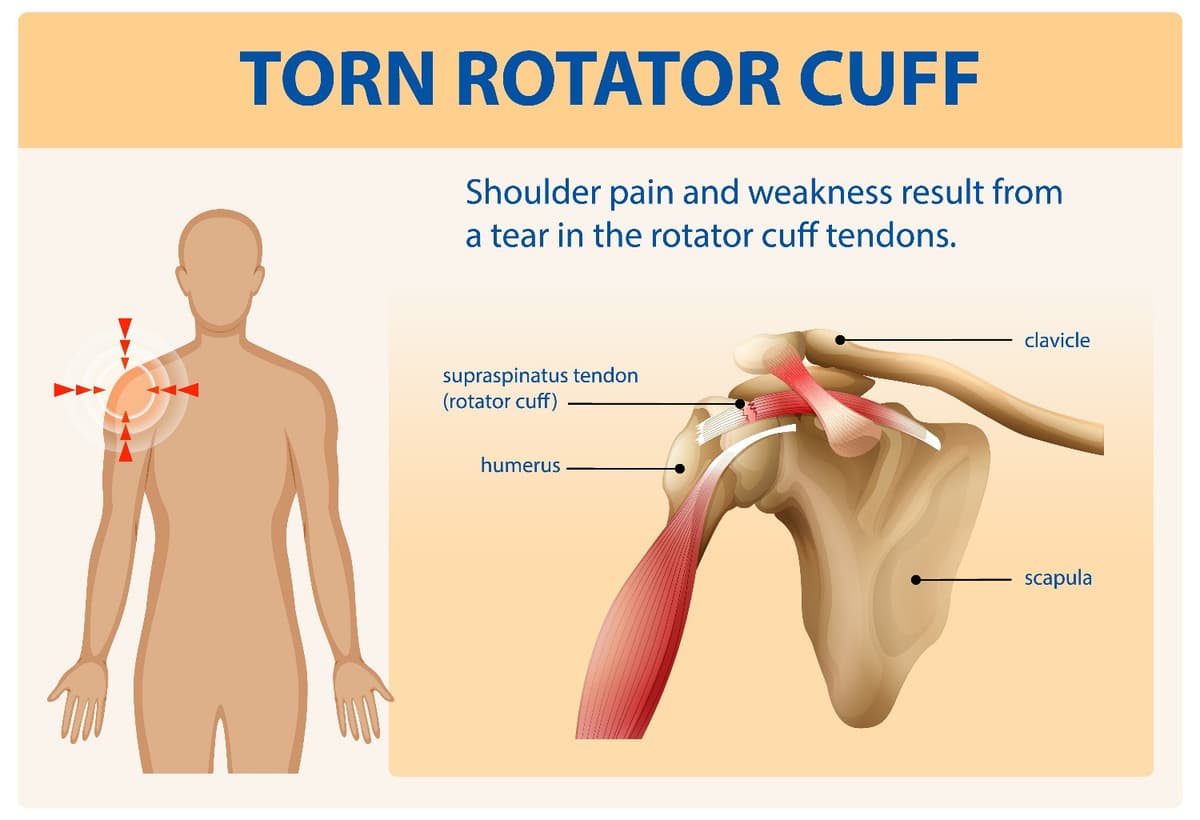
Your rotator cuff is a team of four small muscles that wrap the top of your arm bone and hold it centred in the shoulder socket. The one on top, the supraspinatus, does most of the heavy lifting, which is why it gets injured first. Together they let you raise, rotate, and steady your arm. They also sit in a tight space under a bony arch, and that tight space is exactly why they get pinched and irritated.
Injuries land in two broad camps. There are the sudden ones: a heavy lift with sloppy form at the gym, a fall onto an outstretched arm, a wrenching throw or swing. Then there is the slow kind, where years of overhead work or sport gradually fray the tendon until it frays through. Age matters more than most people expect. Figures compiled in the US National Institutes of Health's StatPearls resource show cuff involvement climbing from under 10 percent in the teens and twenties to more than 60 percent by age 80, whether or not it ever causes symptoms.
Painters, swimmers, cricketers, and anyone whose day involves reaching above shoulder height carry the highest everyday risk. The common thread is load through a raised arm, repeated often enough that the tendon cannot keep up with its own repairs.
The single most useful thing to sort out early is whether you have an irritated tendon or a torn one, because the two behave very differently and need different plans.
Rotator cuff tendinitis (also called tendinopathy) is inflammation and wear in the tendon with no break in it. It aches, it grumbles with overhead movement, and it usually responds well to rest and rehab. A tear is a different animal. A partial tear frays part of the tendon's thickness; a full-thickness tear goes all the way through, and the NHS is candid that once a cuff tendon tears fully, the tendon itself does not knit back together on its own. That sounds bleak, but it is not the whole story. Physiotherapy can train the surrounding muscles, especially the large deltoid, to take over much of the work and restore useful movement, often without surgery.
Classic rotator cuff symptoms are pain over the outer upper arm rather than the very top of the shoulder, pain that bites when you lift or reach, weakness in the arm, and that unmistakable ache that wakes you when you sleep on it.
You can gather clues at home, though none of these replaces a proper exam. The best known is the empty can test, or Jobe test: raise your arm out in front at about shoulder height, angle it slightly outward, then turn your thumb down as if emptying a can, and have someone press gently down while you resist. Pain or giving way suggests the supraspinatus is involved. The drop arm test is another: lift the arm out to the side and lower it slowly. If it drops suddenly or you cannot control the way down, that points toward a larger tear. A painful arc, where the ache shows up midway through raising the arm and eases near the top, hints at impingement.
Worth being honest here: NIH's StatPearls notes these physical tests are not individually very reliable, which is why clinicians combine several and turn to ultrasound or MRI when the picture is unclear. Treat a positive result as a reason to get checked, not a diagnosis.
These are clues to bring to a clinician, not a substitute for a proper assessment.
If a rotator cuff seems to drag on for months, the anatomy is partly to blame. The cuff tendons have a relatively poor blood supply near the point where they attach, and blood is what carries the repair crew. Less flow means slower healing. Add the familiar vicious circle, where pain makes you guard and stop moving, the shoulder stiffens and weakens, and that weakness loads the tendon even more, and you can see why “just rest it” rarely fixes things on its own.
Calming the inflammation gives the tendon room to recover, and that is where a couple of well-studied herbs come in. Boswellia serrata acts on the enzymes that drive inflammation. A 2020 systematic review and meta-analysis in BMC Complementary Medicine and Therapies, held in the NIH library, pooled seven trials and found it eased pain and stiffness in people with osteoarthritis. Nirgundi (Vitex negundo) shows a similar anti-inflammatory effect, with an NIH-hosted study finding a standardised extract reduced swelling to a degree comparable with a common anti-inflammatory drug. Neither will reattach a torn tendon, but for the inflammation and soreness around it, the evidence is genuine.
Recovery time is the question everyone wants answered, and the honest reply is that it depends heavily on what you have done to the tendon. Mild irritation can clear in a few weeks; a tear needing surgery is a months-long project. The ranges below are realistic starting points, though age, general health, and how consistently you rehab all shift the timeline. If stubborn stiffness is your bigger problem, our guides on what causes a frozen shoulder and how to ease a frozen shoulder faster are worth a read alongside this one.
Most rotator cuff problems, especially tendinitis and many partial tears, improve without an operation. Here is what actually moves the needle in the first weeks.
●Rest it relatively, not completely. Stop the movements that sharply aggravate it, particularly loaded overhead work, but keep the shoulder gently mobile. A shoulder that stops moving stiffens quickly.
●Ice early, heat later. The NHS suggests an ice pack wrapped in a cloth for about 15 minutes to calm a freshly irritated shoulder, then heat once you are into the stiff, achy phase.
●Take simple pain relief sensibly. Over-the-counter paracetamol or ibuprofen can settle pain enough to let you move and rehab, and the NHS lists both as reasonable starting options. A pharmacist can advise on what suits you.
●Rebuild strength deliberately. Once sharp pain eases, gentle strengthening is the heart of recovery. Pendulum swings to loosen the joint, then light external rotations with a band and your elbow tucked in, and shoulder-blade squeezes to steady the base. Progress slowly, and stop short of sharp pain.
●Fix your sleep setup. Sleep on the unaffected side or your back, hug a pillow to support the sore arm, and avoid lying directly on the bad shoulder. Better nights genuinely speed recovery.
●Use targeted topical relief. A deep-acting gel worked into the area gives you enough comfort to move and rehab without another oral dose, which helps before physio or bed.
Give it a fair run. Consistency across six to eight weeks beats intensity for a few days.
When cuff pain sits deep and a light cooling gel just skates over the surface, a stronger topical earns its place. Reset's Ultra Potent Gel is the most concentrated formula in the range, built for exactly this kind of stubborn, deep-seated soreness. It carries the same Ayurvedic actives at double strength, Wintergreen among them, which is a natural source of methyl salicylate, the classic deep-muscle analgesic. Alongside it sit Boswellia serrata and Nirgundi for inflammation, plus menthol, camphor, eucalyptus, and celery seed.
The delivery is the clever part. Nanotechnology breaks the herbal actives into ultra-fine particles that get past the skin surface and into the deeper tissue where cuff discomfort actually lives. That is how the gel reaches 54 percent better analgesic activity than a conventional topical, and roughly twice the strength of a standard pain gel. It is a fast-absorbing, non-sticky 100g gel. Spread a thin layer over the shoulder on clean, dry skin, work it in, and use it two or three times a day, ideally before your rehab exercises or bed. The gel manages the pain; the exercises do the healing.
Some situations need more than home care. See a doctor promptly if your shoulder gave way after a clear injury and you cannot lift the arm, if there is sudden weakness, or if pain and lost movement are not improving after a few weeks of sensible rehab. Surgery is usually reserved for full tears from an acute injury, often in younger and more active people, or for tears that stay painful and disabling despite a proper course of physiotherapy. Even then, the rehab afterwards does much of the real work.
It depends on severity. A mild strain or tendinitis can settle in a few weeks, a partial tear managed with physiotherapy may take a few months, and a surgically repaired tear typically needs 6 to 12 months for full recovery.
Sleep on the unaffected side or on your back, and support the sore arm with a pillow so it is not pulled backward or pressed down. Avoid lying directly on the injured shoulder, which is a common cause of night pain.
The usual signs are persistent lateral shoulder pain, weakness, and trouble lifting the arm overhead, often with pain at night. Home checks like the empty-can and drop-arm tests add clues, but only a clinician with an ultrasound or MRI can confirm a tear.
Mild tears and tendinitis often improve with relative rest, a structured physiotherapy programme, ice and heat, and topical pain relief. Herbs such as Boswellia and Nirgundi can help manage the inflammation while you rehab, though a full tear will not knit back together without help.
Often, yes. Mild tendinitis and many partial tears respond well to rest, physiotherapy, and topical pain relief, and even some full tears are managed successfully by strengthening the muscles around the joint.
●A rotator cuff injury runs from mild tendinitis to a full-thickness tear, and telling them apart shapes everything that follows.
●A simple rotator cuff injury test at home, like the empty can or drop arm, gives useful clues, but imaging is what confirms a tear.
●Rotator cuff pain recovery time ranges from a few weeks for a strain to 6 to 12 months after surgical repair.
●Most rotator cuff tear treatment starts without surgery: relative rest, physiotherapy, pain management, and patience.
●Boswellia and Nirgundi, concentrated in Reset's Ultra Potent Gel, help manage the inflammation while rehab does the healing.
NHS. Shoulder exercises and advice for rotator cuff tear. https://www.kingstonandrichmond.nhs.uk/patients-and-families/patient-leaflets/shoulder-exercises-rotator-cuff-tear
NIH StatPearls. Rotator Cuff Injury. https://www.ncbi.nlm.nih.gov/books/NBK547664/
Yu G, et al. Effectiveness of Boswellia for osteoarthritis: a systematic review and meta-analysis. BMC Complement Med Ther, 2020. https://pmc.ncbi.nlm.nih.gov/articles/PMC7368679
Antioxidant and Anti-inflammatory Activity of Vitex negundo. NIH PubMed Central. https://www.ncbi.nlm.nih.gov/pmc/articles/PMC3040892/
This article is for general information and is not a substitute for professional medical advice. If you are concerned about your symptoms, please consult a qualified healthcare provider.
Share this article:
An easy to apply potent formula with roll-on massager

₹549.00
₹449.00
A 2X more powerful formula for enhanced relief.

₹799.00
₹794.00
Infused with 6 powerful essential oils

₹1,299.00
₹999.00
| Feature | Tendinitis | Partial tear | Full-thickness tear |
|---|---|---|---|
| What it is | Inflamed, worn tendon, still intact | Some fibres torn, tendon partly intact | Tendon torn all the way through |
| Typical pain | Ache with overhead use | Sharper, weakness creeping in | Pain plus marked weakness |
| Can you lift the arm? | Yes, with discomfort | Usually, but weaker | Often can't lift it unaided |
| Heals on its own? | Often, with rest and rehab | Sometimes, with rehab | Won't reunite; needs rehab or surgery |
| At-home check | How to do it | A positive result hints at |
|---|---|---|
| Empty can (Jobe) | Arm forward at shoulder height, thumb down, resist a gentle downward push | Supraspinatus tendon involvement |
| Drop arm | Raise the arm out to the side, then lower it slowly | A possible larger tear if it drops |
| Painful arc | Slowly raise the arm out to the side | Impingement or cuff irritation mid-range |
| Night pain | Notice pain when lying on that side | Common with both tendinitis and tears |
| Type of injury | Main approach | Rough recovery time |
|---|---|---|
| Mild tendinitis or strain | Relative rest, ice, gentle rehab | A few weeks |
| Moderate tendinitis / partial tear | Physiotherapy and pain management | Several weeks to a few months |
| Full tear, managed without surgery | Physio to build compensating muscles | About 3 to 6 months to settle |
| Surgical repair | Sling, then staged physiotherapy | 6 to 12 months for full recovery |
| Key herb | What it contributes |
|---|---|
| Wintergreen | Natural methyl salicylate for deep muscle analgesia |
| Boswellia serrata | Targets inflammatory enzymes; studied for joint pain and stiffness |
| Nirgundi (Vitex negundo) | Traditional analgesic with anti-inflammatory action |
| Menthol & camphor | Cooling counterirritants that dial down the pain signal |
| Eucalyptus & celery seed | Warming, soothing support for stiff muscle |

