
Rope Climbing: The Ultimate Guide to Technique, Muscles Worked & Benefits
2025-11-27 • 5 min
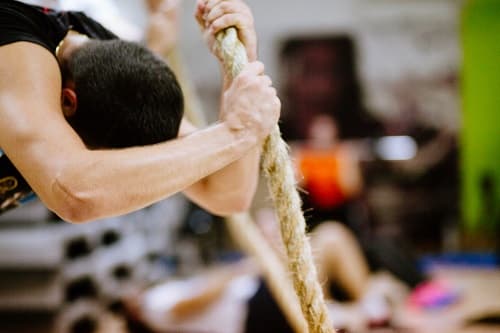
Rope climbing looks simple: grab the rope, pull yourself up, touch the top.
Then you actually try it—and realize this “simple” rope climbing exercise is a full-body fight.
This guide will walk you through everything: what rope climbing is, what muscles rope climbing works, how to climb a rope step by step, the main rope climb techniques, the best climbing rope exercises to prepare, and how to use rope climbs in obstacle races and training plans.
If you read this carefully and practice consistently, gym rope climbing will stop being the scary station in the corner and turn into one of your strongest skills.
What Is Rope Climbing?
Rope climbing is a bodyweight strength exercise where you pull yourself up a vertical rope using your hands, arms, upper body, and often your legs. In most gyms you’ll see:
A thick climbing rope (usually 1.5–2 inches diameter)
Height between 12–20 feet
A crash mat or padded flooring underneath
In the past, rope climbing was a competitive sport and a standard test in schools and the military. Today, it shows up in:
Functional fitness and CrossFit workouts
Obstacle course races
Military and police fitness assessments
Gymnastics and grip-strength training
What makes rope climbing special is how much strength, coordination, and control it demands. A single rope climb is a serious rope climbing exercise that can challenge even experienced lifters who are strong with barbells but don’t do much bodyweight work.
When people say “gym rope climbing,” they usually mean climbing a hanging rope indoors using one of the leg locks (J-hook or S-wrap) or free climbing with just the arms.
Why Is Gym Rope Climbing So Challenging?
If you’ve ever thought, “I’m strong, why can’t I do rope climbs?” you’re not alone. Gym rope climbing feels brutal at first for a few reasons.
1. You’re Lifting Your Entire Body
Unlike a machine exercise where the weight is adjustable, a rope climb always uses 100% of your bodyweight. If you weigh 80 kg, every pull is 80 kg. No warm-up set with 30 kg, no easy mode.
2. Grip Is the Limiting Factor
Rope climbing muscles used in the forearms and hands fatigue very quickly. The rope is thick and unstable, and your fingers have to squeeze hard. If your grip isn’t ready, it doesn’t matter how strong your back is—your hands let go first.
3. Technique Matters More Than People Think
You can be strong and still fail if your rope climb technique is poor. Using a proper leg lock (J-hook or S-wrap) turns a scary arm-only pull into a controlled rope climbing exercise where your legs do half the work.
Most beginners simply jump and tug with the arms—this burns them out in seconds.
4. Fear of Height and Falling
You’re off the ground, the rope moves, your hands burn, and the mat suddenly looks very far away.
That small fear spike makes you tense up, hold your breath, and rush the climb, which makes rope climbing harder and less efficient.
So if gym rope climbing feels like a different universe compared to regular pulling exercises, that’s normal. The good news: once you build specific rope climbing training, everything else in your upper-body strength game gets easier.
Which Muscles Do You Train with Rope Climbing?
Let’s answer the big question: what muscles does rope climbing work?
Rope climb muscles worked go way beyond just “arms.”
Upper Body
Forearms & Grip – The heroes of every rope climb. Every second on the rope is heavy isometric grip work. These rope climbing muscles are usually the first to fail.
Biceps – Bend the elbows and pull your chest toward your hands. Rope climbing muscles used in the biceps work even harder than in chin-ups because the rope is unstable.
Lats (Latissimus dorsi) – The big back muscles that pull your upper arms down and back. They’re the main drivers of the pull.
Upper Back (Rhomboids, Traps, Rear Delts) – Stabilize the shoulders so you can pull safely and strongly.
Shoulders – Control the arm position and help with the pull.
Core
Rope climbing is a core workout in disguise.
Rectus abdominis (six-pack area) – Keeps your body from swinging and helps with the “knees up” motion when you re-lock your feet.
Obliques & Deep Core – Stabilize your torso, especially when you twist slightly during the J-hook or S-wrap.
Hip flexors – Lift the knees so you can bring your feet higher on the rope.
Lower Body
Yes, rope climb muscles worked in the lower body are huge when you use leg technique.
Quads & Glutes – Extend the knees and hips when you “stand” on the rope.
Calves & Tibialis – Help grip the rope and create friction in the rope climbing technique.
So rope climbing is basically a whole-body pull plus a standing leg press. That’s why the rope climbing benefits include strength, power, conditioning, and massive grip improvements all at once.
Exercises to Make Gym Rope Climbing Easier
If you can’t yet perform full rope climbs, don’t worry. The smartest way to approach rope climbing training is to build strength with targeted rope climbing exercises on the ground or low height.
1. Pull-Ups
Pull-ups are the closest cousin of rope climbing.
How to train them
Aim for 3–5 sets of 3–8 reps, 2–3 times per week.
Use assistance bands or an assisted pull-up machine if needed.
Alternate grips: overhand, neutral, and even towel pull-ups to mimic the rope climbing grip.
Why they help
Pull-ups train the main rope climbing muscles worked in the back, shoulders, and arms, and they teach you to move your body as one unit.
If you can do 8–10 solid pull-ups, gym rope climbing becomes far more realistic.
2. Dead Hangs
Dead hangs are simple but brutal: grab the bar and hang.
How to do it
Hang from a pull-up bar with straight arms.
Start with 10–20 seconds, build up to 40–60 seconds.
Mix in towel hangs or hangs using a short climbing rope if your gym has one.
Why they help
Dead hangs are a direct grip version of the rope climb exercise. They condition your forearms and hand strength so you can stay on the rope longer. Stronger grip = more time to use your rope climb technique rather than panicking.
3. Strengthen Your Grip
Beyond dead hangs, you want dedicated grip work:
Farmer’s carries – Walk holding heavy dumbbells or kettlebells.
Plate pinches – Pinch weight plates together and hold.
Thick bar or fat-grip pulls – Any pulling done with a thicker handle mimics the rope.
Working these 2–3 times a week makes every rope climbing exercise easier. The rope climbing muscles used in your hands and forearms adapt fast to this stress.
4. Core Training
Remember: you need to lift your knees and keep your body tight during rope climbs.
Useful core exercises:
Hanging knee raises or leg raises
Hollow body holds
Planks and side planks
Ab wheel rollouts
Program: 3–4 exercises, 2–3 sets each, 3–4 times per week.
Stronger core = smoother leg re-locks and better control between pulls.
5. Push-Ups & Bicep Curls
Rope climbing is mainly a pulling movement, but balanced strength matters.
Push-ups keep your shoulders healthy and balance all that pulling.
Bicep curls attack one of the key rope climbing muscles used in the climb, especially for beginners who rely heavily on arm strength.
Push-ups: 3–4 sets of 10–20 reps.
Curls: 3 sets of 8–12 reps, once or twice per week.
These basic strength moves support your rope climbing training so your joints stay happy and progress keeps going.
Gym Rope Climb Techniques
Now let’s get into the actual rope climb techniques you’ll use. This is where most people either unlock rope climbing or get stuck forever.
1. The J-Hook – The Classic
The J-hook is the classic gym rope climbing technique. It gives you a strong “step” on the rope without completely wrapping both legs.
Step-by-step J-hook rope climb technique
Jump and grab the rope with both hands, arms slightly bent.
Lift your knees so the rope hangs on the inside of your dominant leg.
Place the rope under that foot, so it rests along the arch.
Bring the other foot on top, pinching the rope between your shoes—this creates the “J” shape.
Stand up tall on the rope by straightening your legs. At the same time, slide your hands up.
Once standing tall, re-bend the knees, re-lock the rope higher, and repeat.
Why the J-hook works
You use your legs like a squat or step-up to drive most of the climb.
Your arms mainly hold your position, not lift your entire body every time.
You can rest briefly in the “standing” position if you get tired.
For most people learning how to climb a rope, mastering the J-hook is the first big win.
2. The S-Wrap – For More Grip
The S-wrap (sometimes called the Spanish wrap) gives even more friction and control. It’s a little slower but great for beginners or very tall ropes.
How to do the S-wrap
Start like before: grab the rope and bring your knees up.
Wrap the rope around the outside of your leg, then under the foot and back over the top—so the rope “S” shapes around the calf and foot.
Pinch with the other foot on top to lock it in.
Stand up, slide the hands higher, repeat.
Because the rope wraps around the leg, you get tons of friction. This rope climbing technique lets you almost “sit” on the rope if needed.
Pros
Very secure; great when you’re nervous or learning.
Useful in obstacle races when the rope is wet or muddy.
Cons
Slower than the J-hook.
The rope climbing muscles in your calves and shins take some abuse—long socks help.
3. Free Climbing – For the Advanced
Free climbing is rope climbing without using the legs. Only your arms and upper body pull you up.
This is a high-level rope climbers exercise and you should only attempt it if:
You’re very comfortable with J-hook or S-wrap rope climbs
You can do 10–15 strict pull-ups
Your grip endurance is strong
Basic approach
Start seated on the floor or hanging from the rope.
Keep your legs slightly in front to counterbalance.
Use powerful arm pulls and tight core tension.
Limit swinging; think of “short but strong” pulls rather than flailing.
Free climbing is fantastic for advanced rope climbing training and for athletes who want to dominate obstacle races, but it’s not mandatory for most people. If your goal is general fitness, stick with leg-assisted rope climbs and you’ll still get all the rope climbing benefits.
Rope Climbing During Obstacle Runs
If you do Spartan races, Hyrox, or similar events, you’ll almost always face a rope climb obstacle.
Here’s how to make sure your rope climbing exercise on race day is clean and fast.
1. Expect a Wet or Muddy Rope
Outdoor ropes are often damp, dirty, or slick. This changes the game.
Favor the S-wrap for more friction.
Use your legs aggressively—don’t rely on grip alone.
Dry your hands if possible before the obstacle, but don’t depend on it.
2. Control Your Breathing
Most people arrive at the rope gasping from the previous station.
Slow to a quick walk as you approach.
Take 3–4 controlled breaths before jumping on the rope.
Use the first few pulls to find your rhythm rather than rushing.
3. Know the Standard
Some races require you to touch a bell at the top with your hand, some with any body part. Understand the rule so you don’t repeat extra rope climbs or get penalties.
4. Practice Transitions
In training, simulate race conditions:
Sprint 200–400 m or hit a rower/bike for 1–2 minutes
Immediately do 1–3 rope climb exercises
Rest, then repeat
This teaches your body to handle rope climbing muscles worked under fatigue, which is exactly what an obstacle course demands.
Rope Climbing Benefits You Shouldn’t Ignore
Why bother with rope climbing when pull-ups and lat pulldowns already exist? Because rope climbing benefits go way beyond “another back exercise.”
1. Insane Grip Strength
Few exercises build grip like repeated rope climbs. The thick surface and continuous tension make your forearms adapt fast. This carries over to:
Deadlifts
Barbell rows
Grappling, martial arts, rock climbing
Everyday tasks like carrying heavy bags
2. Full-Body Strength and Coordination
Rope climbing muscles used come from almost every major region: upper body, core, and lower body. It teaches you to move as one unit, not as separate parts.
3. Conditioning Without Boredom
Short rope climbing workouts are brutally effective conditioning sessions:
5–10 rope climbs mixed with runs, burpees, or kettlebell swings can crush you in minutes.
You get both strength and cardio effects without long, boring treadmill sessions.
4. Mental Toughness & Confidence
Let’s be honest: the first time you touch the top of the rope, the feeling is huge. Rope climbing training builds confidence in your own bodyweight strength and gets rid of that nagging fear of heights and falling.
Sample Rope Climbing Training Plan (4 Weeks)
Here’s a simple structure to turn theory into action. This plan assumes you’re a beginner or early-intermediate with basic gym experience.
Week 1–2: Build the Foundation
2–3 sessions per week
Pull-ups or Assisted Pull-ups
4 sets of 5–8 reps
Dead Hangs
3 sets of 20–40 seconds
Core Circuit
Hanging knee raises – 3 × 10
Plank – 3 × 30–40 seconds
Low Rope Drills
Practice J-hook or S-wrap on a rope that you can reach from the ground.
Just lock, stand, and step down. 8–10 reps each session.
You’re building the rope climbing muscles worked in pulling and grip while learning the footwork.
Week 3–4: Start Real Rope Climbs
2–3 sessions per week
Climbing Rope Exercises
3–6 total rope climbs per session.
Use J-hook or S-wrap.
Rest fully between attempts so each climb is clean.
Assistance Work
Pull-ups – 3 sets of 5–8
Farmer’s carries – 3 × 20–30 m
Core training – same as above
Conditioning Option (Once per Week)
5 rounds:
1–2 rope climbs
10 push-ups
200 m run
Rest 60–90 seconds
By the end of these four weeks of rope climbing training, most people can perform multiple controlled rope climbs in a workout.
Common Mistakes in Rope Climbing (and How to Fix Them)
1. Trying to Muscle It With Arms Only
This is the classic beginner error.
Fix: Drill the J-hook or S-wrap until it feels automatic. Every rep should start with locking the feet and “standing up” on the rope.
2. Looking Straight Down
Staring at the floor makes you feel higher and more scared.
Fix: Keep your eyes slightly forward or up. Trust the mat and your technique.
3. Rushing the Descent
Many injuries happen on the way down, not up.
Fix: Descend hand-over-hand with controlled slides, keeping some friction with the feet. Don’t just “drop” and catch yourself at the last second.
4. Ignoring Skin & Equipment
Rope burns and torn calluses are real.
Use long socks or shin guards for S-wrap rope climbs.
Keep calluses filed and hands moisturized (but dry during training).
Chalk helps, especially for sweaty hands.
How to Climb a Rope if You’re a Complete Beginner
If the rope terrifies you right now, here’s a realistic roadmap.
Step 1: Build Base Strength
Focus on pull-ups (assisted if needed), rows, dead hangs, and basic core work for 4–6 weeks.
Step 2: Learn the Foot Lock on the Ground
Spend entire sessions doing nothing but J-hook and S-wrap practice low to the floor.
Step 3: Partial Rope Climbs
Climb just 1–2 pulls up, then come back down.
Gradually increase distance as your rope climbing muscles worked get stronger.
Step 4: Full Rope Climbs
Set a realistic goal like 1–3 full rope climbs per workout.
Add more only when technique stays clean.
Step 5: Progress Rope Climbing Exercises
Add timed sets (max rope climbs in 5 minutes).
Experiment with free climbing once you’re strong and confident.
FAQ: Quick Answers About Rope Climbing
Is rope climbing bad for shoulders or elbows?
Not if you build up gradually and use good form. Combine your rope climbing training with push-ups and mobility work to balance the joints.
Can I use rope climbs instead of pull-ups?
You can, but it’s smart to keep both. Pull-ups give very measured progression, while rope climbing exercises bring instability and grip challenge.
How often should I do rope climbs?
For most people, 2–3 sessions per week is perfect. That’s enough to build strength without frying your grip.
How long until I see progress?
With consistent climbing rope exercises and supportive strength work, you can often go from zero to your first full rope climb in 4–8 weeks.
Bringing It All Together
Rope climbing isn’t just an old-school gym stunt. Done properly, it’s one of the most powerful bodyweight movements you can add to your training:
It hits almost every major muscle group—especially the rope climbing muscles in your back, arms, grip, and core.
It teaches coordination and technique through the J-hook, S-wrap, and advanced free climbing.
It prepares you for obstacle races, tactical tests, and real-world challenges where pulling your own bodyweight matters.
Use the exercises in this guide—pull-ups, dead hangs, grip work, core training, push-ups, curls—and combine them with smart rope climbing training. Practice the rope climb technique slowly and consistently, and treat every climb as skill work, not chaos.
Do that, and “how to climb a rope” stops being a question. It becomes something you’re simply good at—one confident rope climb at a time.
Share this article: