
Vitals/Immunity
Pain Relief Sprays vs Gels vs Creams: Which Is Right for You?
2025-06-27
4 min

2026-09-21 • 5 min read
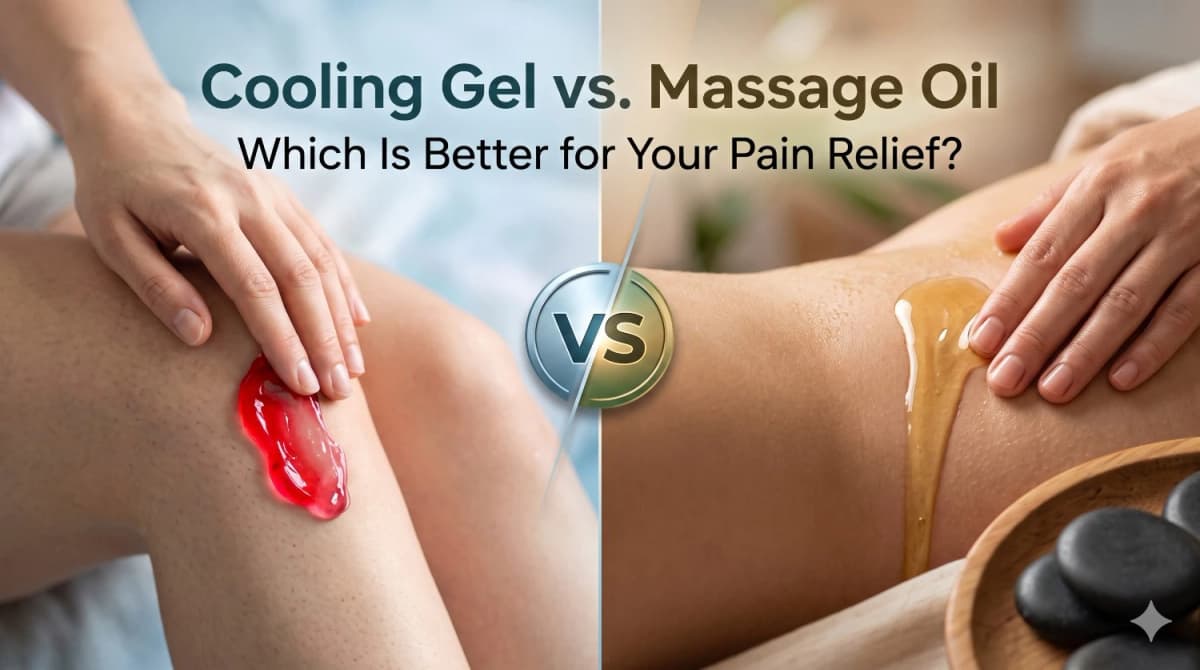
You are standing in front of two products. One says gel. The other says oil. Both promise relief for that stubborn ache in your knee, that stiffness in your lower back, or that post-workout soreness that followed you home from the gym. So which one do you actually reach for? The answer depends on the kind of pain you have, when you need relief, and how you plan to use the product. This guide breaks down the real differences between pain gels and pain oils, walks you through seven everyday scenarios, and helps you pick the right format for your body.
* Gels absorb faster and feel lighter, making them a good fit for daytime use and quick post-workout comfort.
* Oil-based formats stay on the skin longer, which can support deeper, massage-based relief for stubborn stiffness.
* Your best pick depends on the type of pain, timing, and personal preference, not on one format being universally better.
Topical pain products work by delivering active ingredients through the skin to the tissues underneath. The two most common formats are gels and oils, and they differ mainly in their base and how they interact with your skin.
A pain gel uses a water-based or aqueous carrier. When you spread it on, the water evaporates quickly, leaving the active ingredients on and in the skin without a greasy residue. A Cochrane overview of topical analgesics (Derry et al., 2017) found that formulation matters significantly: in acute musculoskeletal pain, gels generally showed better efficacy numbers than creams or plasters. The researchers noted a strong indication that for acute pain conditions, gels tend to be superior to creams.
A pain oil, on the other hand, uses a lipid-based carrier. Oil sits on the skin surface longer, which can be an advantage when paired with massage. The NCBI Bookshelf (NIH) explains that moderately lipophilic compounds pass through the stratum corneum, the skin's outer barrier, more readily than purely water-soluble ones. This means oil-based products can maintain prolonged contact with the skin, allowing ingredients more time to absorb. Emulsion formats, like roll-ons, split the difference: they combine oil and water phases for a less greasy feel while retaining some of that sustained-contact benefit.
Absorption speed is the most obvious difference. Gels dry within seconds because their water-based carrier evaporates on contact. You can apply a gel at your desk and get back to typing without worrying about slippery fingers. Oils absorb more slowly, and that slower pace is actually useful when you want to massage a stiff joint or sore muscle for several minutes.
Texture and feel differ too. Gels leave a clean, non-sticky finish. Oils can feel richer and more lubricating, which some people prefer for large-area massages (think lower back or thighs), while others find it too greasy for daytime use. Emulsions sit in the middle: lighter than traditional oils, heavier than gels.
Timing matters. A peer-reviewed overview in the Korean Journal of Anesthesiology (Choi et al., 2020) notes that topical drugs exert their action at the application site by penetrating the skin via passive diffusion. A faster-absorbing gel gets ingredients to work sooner, which is why gels suit acute moments like post-workout soreness or a sudden stiff neck. Oils, with their longer skin contact time, pair better with evening routines when you have time for a slow massage and are not worried about residue on your clothes.
Skin tolerance is worth considering. Cleveland Clinic notes that some topical products contain menthol or capsaicin that can cause warming or cooling sensations. Gels are typically lighter formulations that may be better tolerated by sensitive skin on a first try. Regardless of format, a patch test on a small area is always a smart first step.
There is no single right answer to the gel-versus-oil question. The best format depends on the situation. Here are seven common scenarios and a straightforward recommendation for each.
1. Reach for gel after a workout. Your muscles are warm, you are sweating, and you want something that absorbs fast without mixing with perspiration. A gel dries in seconds, leaves no greasy film, and will not transfer onto your gym clothes or equipment. Apply it right after your cool-down stretch, focusing on whichever muscle group you worked hardest. The NHS recommends gentle movement rather than complete rest after exercise-related soreness, so a quick-absorbing gel fits the keep-moving approach.
2. Use an oil or emulsion for chronic joint stiffness. Stiff knees, achy fingers, or a shoulder that creaks every morning: these conditions benefit from a slow, hands-on massage. An oil or emulsion roll-on stays on the skin long enough for you to work it into the area around the joint. The rubbing itself also helps. A review on the NCBI Bookshelf (NIH) acknowledges that rubbing a painful area often provides relief, partly through stimulating local blood flow and partly through the soothing ritual of massage.
3. Pick gel for desk-work neck and shoulder tension. You are in the middle of a workday and your trapezius muscles are screaming. A gel lets you apply and go: no oily hands on your keyboard, no scent cloud in a shared office. Dab a small amount across the back of your neck and upper shoulders, spread evenly, and let it absorb while you continue working. The NHS advises taking regular breaks from screen work to move and stretch, so pair the gel with a quick shoulder roll every 30 minutes.
4. Choose an oil or emulsion before bed for lower back pain. Nighttime is the ideal window for a massage-based application. You are not worried about staining work clothes, and you have time to let someone work the product into your lower back for several minutes. An oil or emulsion format supports this kind of sustained, hands-on routine. Apply along both sides of the spine and across the sacral area, using gentle circular motions.
a day 1 and day 2 timeline
5. Combine both for a weekend sports sprain. The NHS recommends rest, ice, and gentle movement in the first 48 hours after a sprain. A cooling gel complements this approach on day one: it absorbs fast, feels cool, and does not interfere with a compression bandage. On day two and beyond, once the initial swelling has settled, switch to an oil or emulsion and gently massage the area to support the recovery routine.
6. Pack a gel or roll-on for travel. Nobody wants to wrestle with a leaky oil bottle in a cramped airline seat or a train compartment. A gel tube or a roll-on emulsion is compact, mess-free, and easy to use one-handed. Apply to your wrists, neck, or lower back whenever stiffness sets in during a long journey. The roll-on format is especially convenient because it controls the amount you dispense.
7. Start with gel if you have sensitive skin. If you have not used a topical pain product before, a gel is usually a gentler first step. Its lighter formulation tends to sit better on reactive skin. Cleveland Clinic recommends never combining a topical pain product with a heating pad, as heat can speed absorption to unsafe levels. Whichever format you choose, always do a patch test: apply a small amount to your inner forearm, wait 24 hours, and check for redness or irritation before using it on a larger area.
1. Pair topical relief with gentle movement. The NHS recommends keeping joints and muscles moving rather than staying completely still for most types of musculoskeletal pain. A short walk, a few stretches, or a range-of-motion routine often helps more than bed rest.
2. Use warmth for chronic stiffness, cold for fresh injuries. A warm water soak or a warm towel can ease morning joint stiffness, while an ice pack wrapped in a cloth works better for a new sprain or swelling. The NHS advises ice for the first 48 hours after an acute injury.
3. If you prefer a fast-absorbing gel: RESET Ultra Potent Gel (reset.in/products/ultra-potent-gel) is the strongest formulation in the RESET range, with herbs at double concentration. It contains Wintergreen, Boswellia serrata, Nirgundi, Menthol (Mentha piperata), Eucalyptus (Neelgiri), Camphor, and Ajmoda (Celery Seed), delivered through nanotechnology for deeper absorption. The gel is fast-absorbing and non-sticky. Apply directly to the affected area on clean, dry skin, 2 to 3 times daily. Avoid cuts, wounds, rashes, and sensitive areas. Patch test first.
4. If you prefer a mess-free oil format: RESET Pain Relief Roll-On Emulsion (reset.in/products/emulsion) uses the same 7 Ayurvedic herbs in a non-greasy emulsion roll-on. The roll-on format gives you control over how much you apply and works well with gentle massage. Roll onto the affected area and massage in circular motions until absorbed. Use on clean, dry skin. Avoid broken skin, wounds, and eyes. Patch test first.
Both products are comfort and support tools designed to work alongside stretches, rest, and professional advice. They are not cures or replacements for medical treatment.
Topical products can help with everyday aches, but some situations call for professional attention. See a doctor if your pain has lasted more than two weeks without improvement despite rest and home care. The NHS recommends seeking medical advice if pain is stopping you from doing normal activities or keeps coming back.
Get urgent care if you notice severe swelling, redness, or warmth in a joint (possible infection); progressive numbness or weakness in a limb; or any sign of an allergic reaction to a topical product, such as blistering, intense itching, or a spreading rash. If you experience chest tightness or breathing difficulty alongside body pain, call emergency services immediately.
This article is for informational purposes only and does not replace professional medical advice, diagnosis, or treatment. Always consult a qualified healthcare provider for personal medical questions.
* Clean and dry the skin before applying any topical product for better absorption.
* Never combine a topical pain product with a heating pad; Cleveland Clinic warns this can speed absorption to unsafe levels.
* You can use gel during the day and an oil or emulsion at night. They complement each other.
* Store tubes and bottles in a cool, dry place, away from direct sunlight.
* Do not apply any topical pain product on broken skin, open wounds, rashes, or near the eyes.
* If you experience burning, blistering, or a severe skin reaction, wash the area immediately and see a doctor.
Q: Which works faster, pain gel or pain oil?
A: Gels absorb faster because their water-based carrier evaporates quickly, delivering ingredients to the skin sooner. Oils take longer to absorb but can provide more sustained comfort, especially when paired with massage.
Q: Can I use pain gel and oil together?
A: Yes. Many people use gel for quick daytime relief and switch to an oil or emulsion for a deeper massage at night. Just avoid layering one directly on top of the other at the same time.
Q: Which is better for sensitive skin?
A: Gel is usually milder and better tolerated. Regardless of format, always do a patch test on a small area of skin and wait 24 hours before applying to a larger area.
Q: Are Ayurvedic oils more effective than gels for pain?
A: Ayurvedic oils often combine multiple herbs for longer-lasting comfort, while gels act faster for shorter-term relief. Effectiveness depends on the formulation, not just the format.
Q: Which should I choose for muscle soreness after a workout?
A: A cooling gel right after exercise, since it absorbs fast and will not stain your workout clothes. An oil or emulsion massage the next day can help support recovery.
1. Derry S, et al. Topical analgesics for acute and chronic pain in adults (Cochrane Overview). https://pmc.ncbi.nlm.nih.gov/articles/PMC6481750/
2. NCBI Bookshelf (NIH). Science of Compounded Topical Pain Creams. https://www.ncbi.nlm.nih.gov/books/NBK560337/
3. NCBI Bookshelf (NIH). Role of Topical Pain Creams in Pain Management. https://www.ncbi.nlm.nih.gov/books/NBK560353/
4. Cleveland Clinic. Topical Pain Relief: What Is It and How Does It Work. https://health.clevelandclinic.org/topical-pain-relief-what-is-it-and-how-does-it-work
5. Choi EJ, et al. Topical agents: a thoughtful choice for multimodal analgesia. Korean J Anesthesiol. https://doi.org/10.4097/kja.20357
6. Peppin JF, et al. Skin Matters: Topical Treatments for Chronic Pain, Part One. https://pmc.ncbi.nlm.nih.gov/articles/PMC4470967/
7. NHS. Pain in the palm of the hand (topical care advice). https://www.nhs.uk/symptoms/hand-pain/pain-in-the-palm-of-the-hand/
Share this article:

A 2X more powerful formula for enhanced relief.

₹799.00
₹649.00
An easy to apply potent formula with roll-on massager

₹549.00
₹449.00


