
Marine Collagen: Real Benefits for Skin, Hair & Joints
2026-03-21 • 5 min read
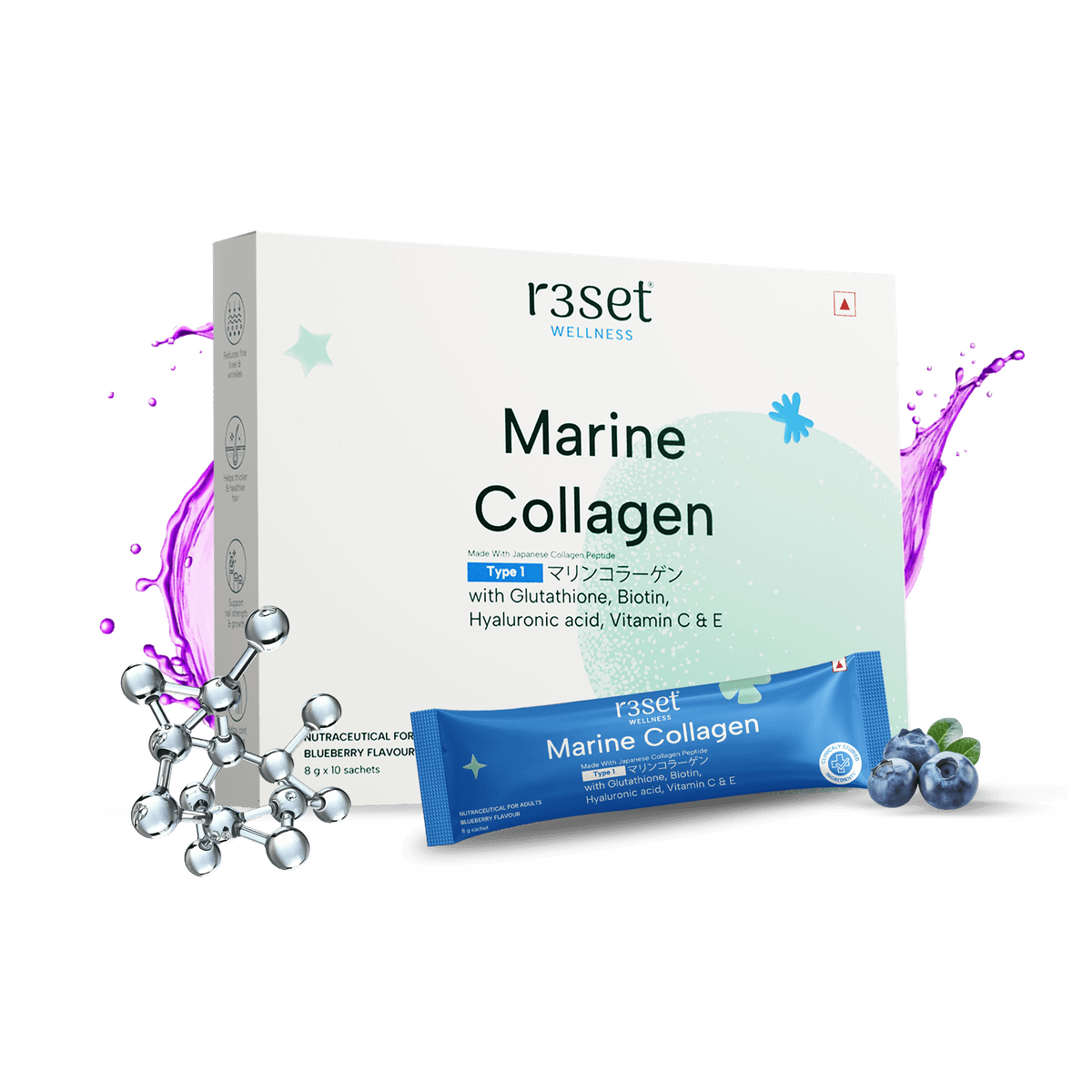
Marine collagen — hydrolysed type I collagen peptides derived from fish skin and scales — is the most bioavailable form of collagen available. It restores the extracellular matrix by supplying glycine, proline, and hydroxyproline directly to fibroblasts, stimulating endogenous collagen synthesis and reducing enzymatic collagen degradation driven by MMP activity.
Clinical studies show measurable improvements in skin elasticity, joint pain, and hair strength within 8–12 weeks of consistent daily use of 5–10g of hydrolysed marine collagen powder. Reset Marine Collagen Peptides are cold-water soluble, deeply bioavailable, and completely unflavoured — designed for seamless daily supplementation.
What Is Marine Collagen and Why Is It Different?
Marine collagen is hydrolysed type I collagen extracted from fish skin, scales, and bones — the same structural protein that forms the scaffold of your skin, bones, tendons, and hair follicles. Hydrolysis breaks the native collagen triple helix into smaller peptide chains (typically 2–10 kDa), dramatically increasing absorption rate compared to intact collagen from other sources.
What distinguishes marine collagen from bovine or porcine alternatives is bioavailability. Fish collagen peptides carry a lower molecular weight than land-animal sources, which directly correlates with faster intestinal absorption — studies show marine collagen peptides are absorbed up to one-and-a-half times more efficiently, reaching target tissues at meaningfully higher concentrations. This is a structural advantage, not a marketing claim.
Marine collagen is also the cleanest source — virtually allergen-free, sustainably produced from fish-processing by-products, and free from BSE risk. Reset Marine Collagen Peptides are sourced from deep-sea fish skin, cold-processed to preserve peptide integrity, and completely free from additives — making them one of the most bioavailable supplemental collagen options on the market.
The Science: How Marine Collagen Works at the Cellular Level
Marine collagen operates through three interconnected biological mechanisms. Each explains a different category of benefit — skin, joint, or hair.
The Three Pathways
Fibroblast Stimulation (Endogenous Collagen Synthesis): Hydrolysed marine collagen peptides — particularly prolyl-hydroxyproline (Pro-Hyp) and hydroxyprolyl-glycine (Hyp-Gly) dipeptides — are absorbed intact and detected by fibroblast receptors in the dermis. This signals cells to upregulate type I and type III collagen synthesis, communicating that the extracellular matrix needs rebuilding. The result is not just collagen replacement — it is stimulation of the body's own production machinery.
MMP Inhibition (Collagen Degradation Blockade): Matrix metalloproteinases (MMPs) are enzymes that degrade existing collagen — their activity is accelerated by UV exposure, inflammation, cortisol, and ageing. Marine collagen peptides suppress MMP-1 and MMP-3 expression, slowing the breakdown of existing collagen in skin and joints. This dual action — build more, break down less — explains why clinical results compound over time with consistent use.
NF-κB Suppression and Joint Anti-Inflammation: In joint tissue, marine collagen peptides reduce pro-inflammatory cytokine production via NF-κB pathway modulation. This calms the chronic low-grade inflammation in cartilage that drives osteoarthritic pain and collagen erosion — making supplementation effective for both cosmetic and orthopaedic outcomes simultaneously.
Why Does Collagen Decline? Root Causes of Collagen Loss
Collagen loss is not simply a consequence of ageing — it is an accelerated process driven by multiple lifestyle and environmental factors that compound over time:
Age: Collagen production declines by approximately one percent per year after twenty-five, accelerating sharply after forty
UV radiation: Activates MMPs in the dermis — sun exposure is the single largest preventable cause of collagen degradation
Chronic inflammation: NF-κB-driven cytokines directly suppress fibroblast collagen output and activate MMPs simultaneously
High sugar intake: Glycation cross-links collagen fibres, making them stiff and brittle rather than supple and elastic
Nutritional deficiencies: Vitamin C is a required cofactor for proline hydroxylation — without it, collagen cannot be properly synthesised even if peptide precursors are abundant
Chronic stress: Elevated cortisol suppresses fibroblast activity and accelerates overall collagen turnover
Key Bioactive Peptides in Marine Collagen
Categorised Actives: What's Working and How
Group 1 — Primary Actives
Hydrolysed marine collagen peptides (type I) are the core active — Pro-Hyp and Hyp-Gly dipeptides that survive digestion intact and trigger the body's own repair cascade at the fibroblast level. Reset Marine Collagen Peptides deliver a clinically relevant 5g serving per dose, sourced exclusively from deep-sea fish skin for maximum purity and peptide density.
Group 2 — Analgesic and Anti-Inflammatory Agents
Type II undenatured collagen — in joint-specific formulations — works through oral tolerance, training the immune system to stop attacking cartilage tissue. Combined with marine collagen's NF-κB suppression, this provides meaningful joint pain relief without pharmaceutical anti-inflammatories or their associated side effects.
Group 3 — Carrier and Nutritive Co-factors
Vitamin C is non-negotiable as a collagen co-factor — required for enzymatic hydroxylation of proline and lysine that makes collagen fibres stable. Hyaluronic acid, often paired with marine collagen, acts as a humectant in the dermis — retaining water in the extracellular matrix and amplifying the volumising effect of new collagen. Zinc supports MMP regulation and fibroblast proliferation.
Group 4 — Supportive and Neuro-Supportive Herbs
Shatavari (Asparagus racemosus) modulates oestrogen receptors, maintaining the hormonal environment that supports skin collagen density — particularly relevant during perimenopause when oestrogen-driven collagen loss accelerates sharply. Ashwagandha (Withania somnifera) reduces cortisol chronically, protecting fibroblast output from stress-driven suppression. Amla (Phyllanthus emblica) provides the highest natural concentration of vitamin C — a direct collagen synthesis enabler.
6. Marine Collagen vs. Bovine vs. Synthetic — The Evidence Table
How Do I Take Marine Collagen Powder for Maximum Results?
How you consume marine collagen matters as much as how much you take. Follow this five-step protocol for optimal absorption and clinical outcomes:
Choose the right form: Hydrolysed marine collagen powder dissolves completely in liquid and offers superior bioavailability over capsules or tablets. Reset Marine Collagen Peptides are cold-water soluble and unflavoured — mix into water, juice, smoothies, or coffee without altering taste or texture.
Time it strategically: Take on an empty stomach first thing in the morning — absorption peaks when the gut is not competing with other proteins. Alternatively, take last thing at night to align with the body's regenerative window during deep sleep.
Add vitamin C: Mix with fresh citrus juice or a vitamin C supplement. Without adequate vitamin C, the proline and lysine in marine collagen cannot be hydroxylated — a chemical step required to form stable, functional collagen fibres.
Stay consistent with dosage: Five grams daily is effective for maintenance and skin improvement. Ten grams daily is the clinical dose for joint pain and significant hair thinning. Consistency across ninety days — not the quantity per dose — determines your outcome.
Pair with topical support: Marine collagen works from the inside out. Complement your daily supplement with a quality topical oil at the skin surface for synergistic extracellular matrix support — inside-out care always outperforms either approach alone.
Usage Frequency Guide by Health Goal
Symptom-to-Peptide Matrix: Targeting the Right Concern
How Does Marine Collagen Improve Skin and Hair Health?
Skin improvement from marine collagen is measurable — not anecdotal. A 2019 double-blind placebo-controlled trial found that participants taking 2.5–5g of fish collagen peptides daily for eight weeks showed a twenty-eight percent improvement in skin hydration, thirteen percent improvement in elasticity, and visible reduction in periorbital wrinkle depth. The mechanism is direct: Pro-Hyp peptides stimulate dermal fibroblasts to produce new type I and type III collagen, thickening the dermis and restoring its moisture-retention capacity.
For hair, the connection is equally biological. Hair follicles are surrounded by a collagen-rich dermal sheath — when this scaffold degrades, follicles miniaturise and shed prematurely. Marine collagen supplies lysine and proline that are incorporated into follicle keratin, improving strand tensile strength, reducing breakage, and extending the anagen (growth) phase. Results are typically visible at the hairline and in the texture of new growth between ten and sixteen weeks of consistent supplementation.
What Are the Key Benefits of Marine Collagen?
Marine collagen delivers benefits across five biological systems — each backed by a distinct mechanism:
Skin: Improved elasticity, reduced wrinkle depth, increased dermal hydration, and faster wound healing via fibroblast stimulation and MMP inhibition
Hair: Stronger strands, reduced breakage, and improved follicle density through lysine and proline supply to the follicle keratin machinery
Joints: Reduced pain, improved mobility, and cartilage protection through glycine supply and NF-κB anti-inflammatory action
Gut: Glutamine and glycine in marine collagen support the integrity of the intestinal mucosal lining — relevant for leaky gut and inflammatory bowel conditions
Bone: Marine collagen provides the organic matrix scaffold on which calcium and phosphorus mineralise — supporting bone density alongside calcium and vitamin D
Reset Marine Collagen Peptides are formulated to deliver all five benefits in a single daily dose — no fillers, no flavouring, no compromise on purity or peptide concentration.
When Should I Start Taking Collagen Supplements?
The most evidence-based answer is: before you notice visible loss. Collagen production begins declining from age twenty-five, but the deficit only becomes visible in the skin and joints a decade later — by which point meaningful degradation has already occurred in the dermis and cartilage.
The ideal window to start is between ages twenty-five and thirty-five, as a preventive measure that maintains the extracellular matrix before significant loss accumulates. That said, clinical studies show measurable benefit even in subjects in their fifties and sixties — collagen synthesis is never completely switched off, and supplementation provides meaningful precursor supply at any age.
Start earlier if you have accelerating factors: high sun exposure, a high-sugar diet, chronic stress, smoking, or a family history of early skin ageing or osteoarthritis. These factors accelerate MMP activity and collagen loss faster than chronological age alone would predict.
How Long Does It Take to See Visible Results?
Timeline depends on dose, consistency, and the target tissue — skin responds faster than joints, which respond faster than bone. Here is a realistic clinical timeline for 5–10g daily with vitamin C:
Weeks 1–4: Improved skin hydration, reduced dryness and flaking, initial reduction in joint stiffness during morning movement
Weeks 5–8: Measurable improvement in skin elasticity, visible improvement in nail strength and hair texture, reduced exercise-related joint discomfort
Weeks 9–12: Visible reduction in fine lines, improved skin firmness, new hair growth with improved density, significant reduction in osteoarthritic joint pain scores
Weeks 13–24: Compounding dermal thickness improvement, sustained joint pain relief, and significant improvement in hair density and strand thickness in previously thinning areas
Frequently Asked Questions
What are the key benefits of marine collagen?
Marine collagen delivers clinically measurable benefits across five systems: skin (improved elasticity, hydration, and wrinkle reduction), hair (stronger strands, reduced breakage, improved follicle density), joints (reduced pain and cartilage protection), gut (mucosal lining support), and bone (organic matrix reinforcement). All benefits operate through fibroblast stimulation, MMP inhibition, and anti-inflammatory peptide activity.
How does collagen improve skin and hair health?
For skin: hydrolysed Pro-Hyp and Hyp-Gly dipeptides are absorbed intact and stimulate dermal fibroblasts to produce new type I and type III collagen, restoring the extracellular matrix that gives skin its firmness and moisture-holding capacity. For hair: marine collagen supplies lysine and proline — amino acids incorporated into follicle keratin — strengthening the collagen sheath surrounding each follicle and extending the active growth phase.
When should I start taking collagen supplements?
The optimal time to start is between ages twenty-five and thirty-five, when endogenous production begins declining but visible loss has not yet occurred. Starting early is a preventive strategy that maintains the extracellular matrix baseline. Clinical evidence confirms measurable benefit at any age — even in subjects in their sixties — because supplementation supplies precursor amino acids that support the body's remaining synthesis capacity.
How long does it take to see visible results from marine collagen?
Most people notice improved skin hydration and texture within four weeks. Measurable improvements in elasticity, hair texture, and nail strength appear between weeks five and eight. Visible wrinkle reduction, meaningful hair density improvement, and significant joint pain relief are typically observed at the ten-to-twelve-week mark with consistent daily use of Reset Marine Collagen Peptides at the appropriate dose.
Is marine collagen better than bovine collagen?
For skin and hair, marine collagen is the superior choice — its lower molecular weight gives it up to fifty percent higher bioavailability than bovine collagen, meaning more active peptides reach the dermis and follicles. For joint-specific applications, combining marine collagen with type II undenatured collagen provides comprehensive joint coverage. Marine collagen also carries no BSE risk and is suitable for pescatarian diets.
Can I take marine collagen every day?
Yes — daily supplementation is both safe and recommended. The hair growth cycle and skin turnover cycle both operate on sixty-to-ninety-day windows, so consistent daily intake is required to maintain the precursor supply needed for measurable structural change. Standard doses of five to fifteen grams daily have a well-established safety profile in human clinical trials.
What is the best way to take marine collagen powder?
Dissolve five to ten grams of Reset Marine Collagen Peptides in water, juice, or a smoothie — ideally with vitamin C for enhanced collagen synthesis. Take on an empty stomach in the morning for fastest absorption, or in the evening to align with the body's overnight regenerative cycle. Avoid mixing with hot beverages above sixty degrees Celsius, as heat can denature the peptides.
Does marine collagen help with joint pain?
Yes. Marine collagen peptides supply glycine and hydroxyproline to cartilage chondrocytes, supporting repair of degraded extracellular matrix. Simultaneously, bioactive peptides suppress NF-κB — reducing the chronic low-grade inflammation that drives osteoarthritic pain and further cartilage erosion. Clinical trials using ten grams daily show significant reductions in joint pain scores within eight to twelve weeks.
Is marine collagen safe for long-term use?
Marine collagen has an excellent long-term safety profile. It is a food-derived protein — not a synthetic compound — so long-term supplementation carries no toxicological concern at standard doses. Those with fish allergies should avoid it. Individuals with kidney disease should consult a physician before high-dose protein supplementation of any kind.
Can marine collagen help with hair loss?
Marine collagen addresses two structural drivers of hair loss: degradation of the collagen-rich follicle dermal sheath (which causes follicle miniaturisation), and deficiency of lysine and proline needed for keratin production (which weakens the hair strand). It does not block DHT — so for androgenetic alopecia, combining marine collagen with DHT-blocking actives produces the most comprehensive outcome.
Does marine collagen have any side effects?
Side effects are rare and mild. The most commonly reported is temporary digestive discomfort — bloating or a feeling of heaviness — particularly at higher doses, which typically resolves within one to two weeks as the gut adjusts. Starting at two-and-a-half grams and building gradually minimises this. Those with fish or shellfish allergies should avoid marine collagen entirely.
Can I combine marine collagen with other supplements?
Yes — strategic combinations amplify results. Vitamin C is essential and should always accompany marine collagen. Hyaluronic acid stacks well for skin hydration outcomes. Biotin complements the hair benefits. Zinc supports MMP regulation and fibroblast activity. Ashwagandha reduces cortisol-driven collagen suppression, creating a more productive supplementation environment overall.
Golden Rules for Marine Collagen Supplementation
Always take with vitamin C: without it, proline and lysine cannot be hydroxylated — the supplement's full structural potential is unrealised.
Consistency over intensity: 5g daily for 12 weeks outperforms 10g for two weeks. The collagen cycle is 90 days — commit to it.
Time it strategically: empty-stomach absorption peaks. Morning or evening — never competing with a protein-heavy meal.
Start before you need to: collagen loss starts at twenty-five but becomes visible at thirty-five. Prevention is always easier than restoration.
Choose marine over plant-based 'collagen': plants contain no collagen. Marine hydrolysate is the only bioavailable supplemental form that directly stimulates fibroblast synthesis.
Choose purity over price: Reset Marine Collagen Peptides are sourced from deep-sea fish skin, cold-processed, and additive-free — purity directly determines how many active dipeptides reach your dermis and follicles.
Reduce collagen destroyers: SPF daily, low sugar intake, stress management, and quitting smoking each independently protect collagen faster than any supplement can rebuild it.
Related Reading
→ Marine Collagen Peptides — Reset | Shop Reset's hydrolysed marine collagen powder — cold-water soluble, deeply bioavailable, and completely unflavoured.
Share this article: