
Bhringraj Powder for Hair Growth: What Does the Evidence Say?
2026-10-08 • 4 min
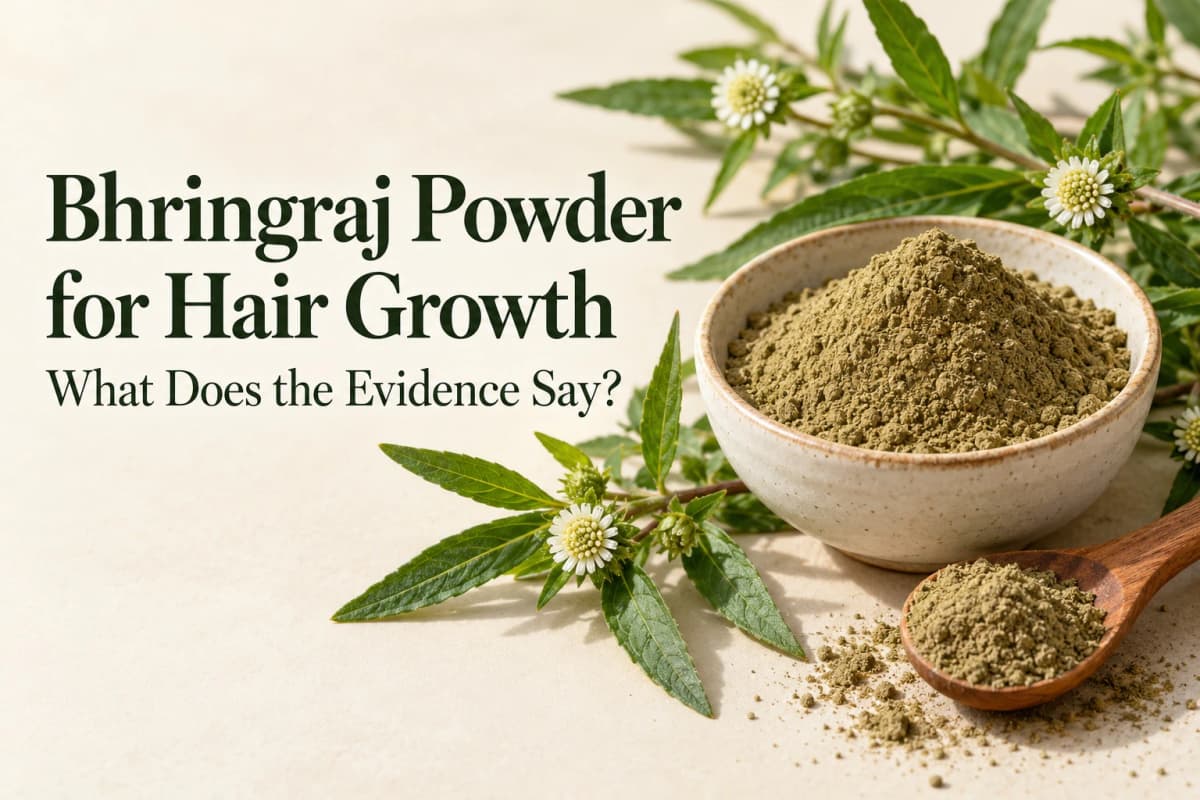
Finding more hair in your brush can change the way you look at every shampoo, supplement and home remedy. Suddenly, an ingredient you barely noticed becomes something you want to understand. Can it reduce shedding? Will it help your hair grow back? Is there actual research behind the promise?
Bhringraj powder often appears in these searches. It has a long history in traditional hair care, and researchers have investigated the plant for its effects on hair follicles. That gives it a more interesting story than a simple before-and-after advertisement.
But the details matter. Research on a concentrated plant extract does not automatically prove that a homemade powder mask works. Reduced shedding is not the same as new hair growth. And an ingredient being natural does not establish that it is safe to swallow.
This article examines bhringraj powder for hair, separates early findings from established benefits, and explains what to consider before buying or using it.
What Is Bhringraj Powder?
Bhringraj is commonly associated with the plant Eclipta prostrata, also called Eclipta alba in much of the research literature. It has a longstanding place in traditional medicine, including Ayurvedic hair-care practices. Studies have investigated preparations made from the plant, although those preparations vary considerably.
Commercial bhringraj powder is generally a dried, ground botanical product. Depending on the manufacturer, it may contain a specified plant part or material from the whole plant. Some products contain only bhringraj, while others combine it with additional herbs.
That distinction deserves attention. A packet labelled “herbal hair powder” may contain several ingredients, so its effects and tolerability cannot be attributed to bhringraj alone.
Before discussing bhringraj powder benefits, check what the product actually contains:
The botanical name.
The plant part used.
Whether it is plain powder or an extract.
Any added herbs, fragrances or other ingredients.
Whether it is intended for external application or oral use.
These details determine how closely a product resembles anything investigated in a study.
The Essential Answer: Promising Research, Limited Proof for Plain Powder
The research reviewed for this article provides reasons to investigate bhringraj further. Animal experiments have reported hair-growth activity with particular extracts, and a small human study reported reduced shedding with oral extract tablets. However, these findings do not establish that ordinary bhringraj powder mixed with water reliably regrows human hair.
This is the central distinction behind the entire topic.
A useful question is not simply, “Has bhringraj been studied?” It is:
Has this preparation, used in this way, been shown to improve this particular hair problem in people?
For a homemade mask, the answer remains uncertain. For oral supplementation, preliminary research exists, but it does not justify treating any retail powder as an equivalent treatment.
That uncertainty should shape expectations rather than end the discussion.
What the Published Studies Actually Found
1. A 2008 study investigated extracts in rats
Roy, Thakur and Dixit published a study in Archives of Dermatological Research examining petroleum ether and ethanol extracts of Eclipta alba in male albino rats. The researchers reported hair-growth-promoting activity in this experimental setting.
The relevant limitation is straightforward: the study involved rats and prepared extracts, rather than people applying ordinary bhringraj powder for hair. It supports further research, but it cannot establish the effectiveness of a consumer powder mask.
2. A 2009 study examined hair-cycle changes in mice
A study published in the Journal of Ethnopharmacology investigated a methanol extract of Eclipta alba in mice. Researchers reported dose-dependent activity and examined changes associated with the transition from the resting phase to the growing phase of the hair cycle.
This is evidence of biological activity in an animal model. It does not provide a validated mixing ratio, application time or treatment schedule for bhringraj powder on a human scalp.
3. Later research explored follicle-related mechanisms
Another study, published in the International Journal of Molecular Medicine, investigated Eclipta alba extracts and fractions in nude mice. It reported effects involving hair matrix keratinocyte proliferation and TGF-β1 expression.
These findings help researchers explore how an extract might affect follicle biology. They do not demonstrate that a household preparation produces the same effects in people.
4. A small human study reported reduced shedding
A paper in the December 2025 issue of the Journal of Ayurveda and Integrated Medical Sciences studied oral standardized bhringraj extract tablets for 24 weeks. Fifty-four adults enrolled, and 50 completed the study. Average counts in a 60-second comb test fell from 72.4 to 27.1 hairs, a reported reduction of 62.5%.
However, it was an open-label study without a placebo group. The manufacturer supplied the tablets and funded the research. The main outcomes concerned shedding, rather than demonstrating restored hair density. Mild gastrointestinal discomfort occurred in three participants.
This is preliminary human evidence, not confirmation that raw powder works. Its design cannot separate treatment effects from natural recovery or other influences.
Why Powder, Extract and Oil Are Not Interchangeable
Imagine three products sitting on a bathroom shelf: a packet of bhringraj powder, a bottle of bhringraj oil and a standardized extract tablet.
They share a plant name. That does not make them the same intervention.
A powder contains ground plant material. An extract is produced through a process that draws out selected constituents. An oil contains a carrier oil and a particular preparation of the herb, sometimes alongside other ingredients.
The concentration, composition and method of delivery can differ. Consequently, the animal-extract experiments described above cannot be translated directly into a household powder recipe. That is an interpretation of the study methods, rather than a finding that the researchers tested themselves.
This is why “scientifically studied ingredient” is an incomplete claim.
To make it useful, a manufacturer would need to explain which preparation was studied and whether the marketed product matches it.
When considering bhringraj powder benefits, look for evidence about the finished product wherever possible. Evidence about a different preparation is background information, not a guarantee.
Hair Growth, Hair Shedding and Hair Breakage Are Different Outcomes
The phrase “better hair” can hide several different experiences.
Someone might notice fewer strands in the shower. Another person might find that their hair feels smoother. A third might see a widening part become less visible. These observations concern different outcomes and require different explanations.
The American Academy of Dermatology distinguishes excessive shedding from hair loss and notes that some shedding follows events such as illness, childbirth or major stress. It can improve as the body readjusts. A dermatologist can help identify whether someone has shedding, hair loss or both.
This matters when evaluating bhringraj powder for hair.
Consider a hypothetical example. Someone begins using a herbal mask several months after an illness. Over the following months, shedding settles. They may reasonably feel that the mask helped, but that personal experience cannot show how much improvement would have happened without it.
Likewise, a photograph of shinier hair cannot demonstrate new follicle growth.
A trustworthy description of bhringraj powder benefits should say what changed, how it was measured and whether the ingredient caused that change.
Which Bhringraj Powder Benefits Are Supported, and Which Remain Uncertain?
The most useful way to assess claims is to separate research signals from promises that exceed the evidence.
Common claim
What readers should understand
Bhringraj stimulates hair growth
Particular extracts showed activity in animal experiments; this does not establish human powder-mask effectiveness.
Bhringraj reduces hair fall
Preliminary human evidence concerns an oral extract preparation and has substantial limitations.
Bhringraj powder reverses baldness
The studies discussed here do not establish this claim.
Bhringraj powder permanently restores grey hair
The evidence presented here does not establish permanent reversal in people.
Organic powder produces better regrowth
Organic status does not demonstrate clinical hair-growth effectiveness.
The research-related distinctions in this table follow from the preparations and outcomes used in the cited studies.
There is room for curiosity about bhringraj powder benefits without turning every possibility into a proven result.
An honest product description can acknowledge traditional use and emerging research. It should also acknowledge when direct evidence is missing.
Does Bhringraj Powder Treat the Cause of Hair Loss?
Hair loss can have different causes, including hereditary factors, thyroid disease, nutritional deficiencies, scalp infections and damaging hair-care practices. The American Academy of Dermatology lists these among the reasons hair may thin or fall out.
A single botanical ingredient should therefore not be expected to solve every situation.
For example, if a clinician identifies a deficiency, the question becomes how to correct that deficiency. If the problem involves a scalp infection, appropriate treatment matters. If a hairstyle repeatedly pulls on the hair, changing that practice becomes relevant.
Using bhringraj powder for hair does not remove the need to understand the cause.
A useful personal checklist is:
When did the change begin?
Is the problem mainly shedding, breakage or visible thinning?
Is it affecting the whole scalp or particular areas?
Have medications, illnesses, diet or hairstyles changed?
Is the scalp uncomfortable?
These observations can make a consultation more productive. They cannot diagnose the condition on their own, but they give the discussion a clearer starting point than choosing a remedy solely from a search result.
Bhringraj Powder for Hair: A Careful Approach to External Use
There is no validated human hair-growth recipe in the evidence discussed here that establishes how many spoonfuls of bhringraj powder to use, how long to leave it on or how frequently to apply it.
That makes precise promises such as “use twice weekly for guaranteed regrowth” difficult to justify.
If you choose an external-use product, treat it as a cosmetic experiment with uncertain growth benefits. Follow its labelled directions rather than inventing a stronger concentration.
Test the intended preparation first
The American Academy of Dermatology recommends testing new skin-care products on a small area twice daily for seven to ten days. For rinse-off products, it advises using the normal contact time. Applying this general precaution to an external bhringraj preparation is a cautious adaptation; it is not a bhringraj-specific clinical protocol. Stop if irritation develops.
A home test does not guarantee that a product will never cause a reaction.
Keep the experiment simple
Combining bhringraj powder for hair with five other ingredients makes it harder to interpret the result. If your scalp becomes uncomfortable, which ingredient caused it? If your hair looks better, which part of the routine helped?
Start with a clearly labelled product and avoid adding several unfamiliar ingredients at once.
Do not treat discomfort as evidence that it is working
Burning or worsening irritation should not be interpreted as follicles “waking up.” Discomfort is a reason to stop the experiment and assess what happened.
There is also little value in turning an optional hair-care practice into a demanding ritual. If preparation and washing become stressful, expensive or difficult, reconsider whether the uncertain benefit is worth the effort.
Bhringraj Powder for Eating: What Changes When You Swallow It?
Searches for bhringraj powder for eating require a separate discussion from searches about hair masks.
A product intended for external use should not be swallowed. Its label may reflect a different intended purpose, and the presence of a familiar herb does not make it suitable for consumption.
Even when a powder is marketed for oral use, important questions remain: What exactly is in it? How was its quality assessed? Is it appropriate for the person taking it?
The US National Center for Complementary and Integrative Health warns that some Ayurvedic preparations can contain harmful amounts of metals such as lead, mercury or arsenic. This is a concern about some products in the broader category, not proof that every bhringraj product is contaminated. It also advises discussing complementary products with health-care providers, particularly during pregnancy or nursing.
The oral-extract research described earlier cannot establish a safe household spoonful of bhringraj powder for eating. Extract tablets and raw powders are different preparations.
If you are considering bhringraj powder for eating, bring the actual product label to a qualified clinician or registered Ayurvedic practitioner. Discuss your medicines, existing conditions and reason for taking it.
“Food grade” may describe suitability for a particular use, but it does not prove that a powder regrows hair. Similarly, a traditional history of consumption does not establish an appropriate dose for every person.
Is Organic Bhringraj Powder Better?
The word “organic” can influence a buying decision before the ingredient list receives any attention.
Certified organic status concerns production under a defined agricultural standard. For example, the USDA describes organic as a labelling term connected to approved production methods. It is not a clinical claim about hair growth.
Choosing organic bhringraj powder may align with your preferences about farming and sourcing. That is a reasonable consideration. It should remain separate from questions about effectiveness.
An organic label cannot tell you whether a product:
Produces measurable regrowth.
Matches the extract used in a study.
Is suitable for your scalp.
Is appropriate for oral consumption.
Has been independently tested for relevant contaminants.
Food safety requirements also remain separate from organic labelling; the FDA explicitly notes that foods carrying organic claims must still meet applicable food-safety requirements.
When buying organic bhringraj powder, look for a verifiable certification rather than relying on a green package or the word “pure.”
The useful question is not merely whether the product is organic. It is whether the supplier can explain its identity, intended use and quality controls.
How to Judge a Bhringraj Product Before Buying
A trustworthy listing should make it easy to understand what you are purchasing.
Look for the botanical name, full ingredients, plant part, intended route of use, manufacturer details, batch information and clear storage instructions.
For organic bhringraj powder, ask which certification supports the claim. If testing is advertised, ask whether the report applies to the batch being sold.
A report is more informative when it explains what was tested, which laboratory performed the testing and what the results mean. A generic “lab tested” badge provides much less information.
Pay particular attention to the language around bhringraj powder benefits.
Claims such as “traditionally used in hair care” and “investigated in extract studies” can be accurately framed. Statements promising permanent regrowth, universal results or complete freedom from side effects deserve closer scrutiny.
Good information helps you decide. It does not pressure you to buy before you have understood the evidence.
How to Track Results Without Misleading Yourself
If you try bhringraj powder for hair, decide in advance what you hope to observe.
Is your goal a more comfortable routine? Less breakage? Reduced shedding? Improved density? Those goals should not be treated as interchangeable.
For photographs, keep lighting, camera distance, hair parting and wetness consistent. A brightly lit scalp can look different from one photographed in softer light. A changed hairstyle can conceal thinning without changing density.
A simple monthly note may be more useful than repeatedly inspecting individual strands. Record the product used, any discomfort and major changes to your routine.
Try to avoid starting several new products simultaneously. Otherwise, any improvement becomes difficult to interpret.
Most importantly, personal tracking cannot prove that bhringraj powder caused a change. It can help you notice tolerability and communicate observations to a clinician. It is not a substitute for a controlled study.
When Professional Assessment Matters More Than Another Remedy
Seek assessment if hair loss is sudden, patchy, visibly progressing or accompanied by persistent scalp symptoms. Do not use repeated home experiments to postpone understanding an ongoing problem.
The American Academy of Dermatology explains that diagnosis may involve history, examination and, when indicated, tests for underlying causes. Treatment depends on what is found. It also identifies minoxidil as an option that can help some forms of hair loss, while stressing that no single treatment works for everyone.
Discuss bhringraj powder for hair during that assessment if you use it. Bring the ingredient list rather than assuming that “herbal” provides enough information.
There is no need to choose between respecting traditional practices and asking for evidence. Both can belong in the same conversation.
Frequently Asked Questions
Does bhringraj powder really grow hair?
The available research provides promising findings for certain extracts, but it does not establish that plain bhringraj powder reliably regrows human hair. Product preparation and method of use matter.
What are the most credible bhringraj powder benefits?
The strongest credible discussion concerns traditional use and early research on extracts. Claims that bhringraj powder benefits include guaranteed baldness reversal or permanent restoration of grey hair go beyond the evidence reviewed here.
Can I use bhringraj powder every day?
There is no established evidence-based daily schedule for a homemade powder mask in the studies discussed. Follow the external-use product’s directions and stop if it causes discomfort rather than assuming more frequent use produces better results.
Is bhringraj powder for eating a good hair-growth remedy?
Bhringraj powder for eating should not be treated as a proven self-prescribed hair-growth treatment. Seek qualified advice about the exact product and your circumstances, especially if you take medicines or have a medical condition.
Does organic bhringraj powder work better?
Organic certification concerns production standards, not demonstrated regrowth. Organic bhringraj powder should be judged separately for identity, quality, suitability and clinical evidence.
Can I mix bhringraj powder with amla or other herbs?
A mixture makes it harder to identify which ingredient affects your hair or scalp. Do not assume that combining traditional ingredients creates a clinically proven treatment. Check the complete formulation and follow its intended-use instructions.
What the Evidence Means for Your Decision
Bhringraj powder deserves an informed discussion. Its traditional reputation and the research on extracts make it a reasonable subject for further investigation.
The evidence also has clear boundaries. Animal findings do not establish human results. An oral extract is not a powder mask. A reduction in shed hairs does not automatically demonstrate restored density.
If you choose bhringraj powder for hair, keep your expectations specific, check the product carefully and pay attention to tolerability. If you are considering bhringraj powder for eating, get advice about the actual preparation rather than borrowing a dose from an unrelated study.
Trust comes from knowing what an ingredient may offer and where the uncertainty remains. For bhringraj, the most accurate position is informed interest, with stronger claims waiting for stronger evidence.
Share this article: