
Synthetic Cells: What SpudCell Means for the Future of Biology (and Your Body)
2026-07-04 • 5 min read
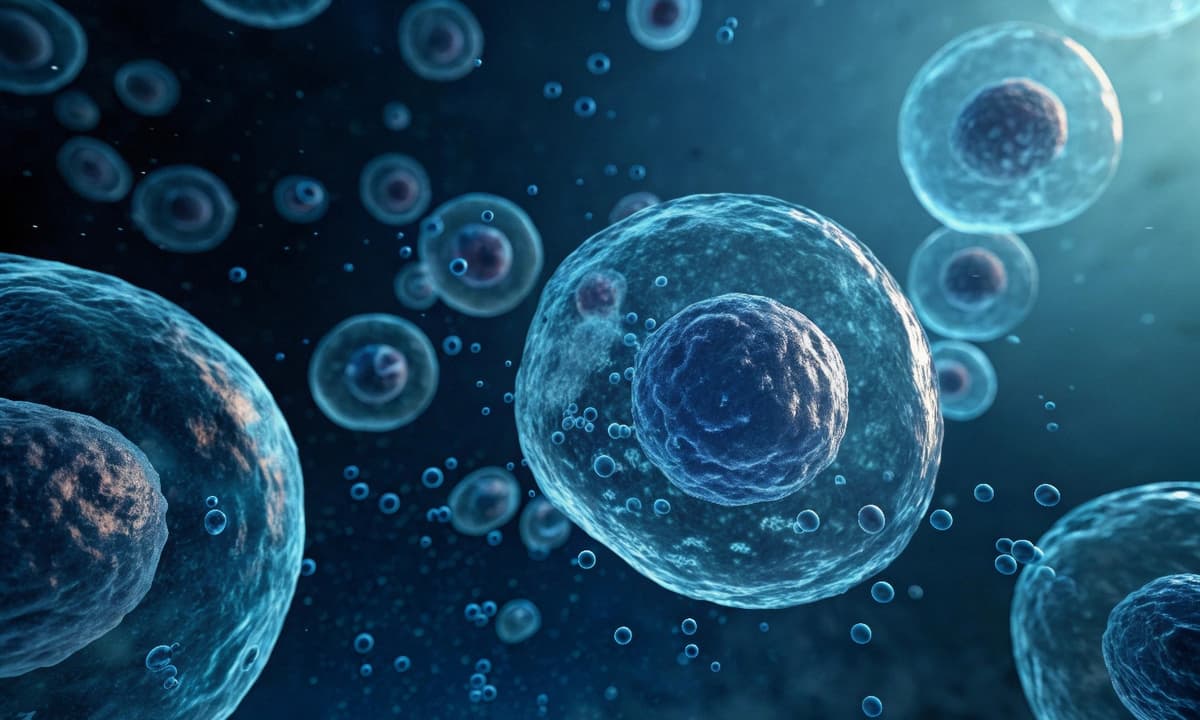
Synthetic cells just stopped being science fiction. On July 1, 2026, researchers at the University of Minnesota announced something biologists had chased for decades: a cell assembled entirely from non-living chemical parts that can feed, grow, copy its own DNA, and divide. The team calls it SpudCell, and it's already reshaping how scientists define the line between chemistry and life. At Reset, we spend our days thinking about cells too — just the billions already living and renewing inside you, no lab required. This piece unpacks what SpudCell actually did, why researchers are calling it a milestone, and, since most coverage stops at the headline, what it means for the very real cell-renewal system already running in your body right now.
What Are Synthetic Cells, Exactly?
A synthetic cell, sometimes called a protocell, is a lab-built structure designed to mimic the basic behaviors of a living cell — feeding, growing, replicating genetic material, and dividing — using components that were never alive to begin with. Earlier synthetic biology projects worked by editing existing organisms: taking a living bacterium and swapping in a custom-built genome. SpudCell is different. Its makers started with nothing biological at all — lipids, enzymes, and synthetic DNA — and built upward from there. It is not alive in the way a skin cell or a bacterium is alive; it cannot survive without a steady supply of nutrients and protein-making machinery delivered from outside. But it completed something no fully synthetic system had managed before: an entire cell cycle, from feeding to division.
Meet SpudCell — The Cell Built From Zero
SpudCell was developed by synthetic biologist Kate Adamala and colleagues at the University of Minnesota, working with a public-benefit research group called Biotic. Built from roughly 150 to 200 molecules and carrying a synthetic genome of about 90,000 base pairs, SpudCell managed to grow, replicate its DNA, and divide into daughter cells across several generations — even showing a basic version of natural selection when researchers introduced a growth-boosting genetic tweak. It is, by any measure, a fragile prototype. But it is also the clearest demonstration yet that the building blocks of life can be assembled, rather than merely borrowed, in a lab setting.
The Why — Building Life From Non-Life
The appeal of synthetic cells goes beyond novelty. Origin-of-life researchers have spent decades trying to understand how the first cells on Earth could have emerged from simple chemistry, long before enzymes, ribosomes, or DNA existed in their modern forms. Building a working cell from scratch, piece by piece, gives scientists a controlled way to test which ingredients are truly essential for something to behave like life — and which are just evolutionary add-ons. It's less about creating a rival to biology and more about finally being able to ask, and test, what life actually requires.
The How — Where This Could Eventually Show Up in Everyday Life
Applications are still early and experimental, but researchers see synthetic cell platforms as potential biological factories — systems that could one day be engineered to produce medicines, enzymes, or sustainable chemicals without relying on living organisms or petrochemical processes. None of this is available or in use today; SpudCell needs constant external support and cannot yet operate independently. It is best understood as a proof of concept and an open research platform, not a near-term product.
Meanwhile — What's Happening Inside Your Own Cells Right Now
While a research team spent years coaxing a handful of synthetic cells through a few generations, your body has already replaced millions of cells since you started reading this article. Skin cells turn over roughly every few weeks. Your gut lining renews itself even faster. And connective tissue — the collagen that holds your skin, joints, and cartilage together — is in a constant cycle of breakdown and rebuilding. Research indexed by the U.S. National Institutes of Health shows that this natural collagen renewal slows measurably with age, alongside a decline in skin elasticity and hydration, and that adequate raw materials — amino acids, vitamin C, and antioxidant support — measurably improve how well that renewal process keeps up.[1] No lab equipment required — just a system your body has been running since before you were born.
Supporting Your Body's Natural Cell Renewal — Starting Today
You don't need a biofoundry to support the cell-renewal system you already have. A few habits make a measurable difference:
●Prioritize protein and amino acids, the raw material your body uses to rebuild tissue, skin, and connective structures.
●Get enough vitamin C, which acts as an essential cofactor your body needs to actually synthesize new collagen — not just consume it.
●Support your antioxidant defenses through leafy greens and adequate sleep, since oxidative stress accelerates cellular wear.
●Stay consistently hydrated, since water plays a direct role in nutrient delivery to renewing tissue.
●Move daily; circulation is how nutrients and repair signals actually reach the cells that need them.
Key Takeaways
●SpudCell, unveiled July 1, 2026 by University of Minnesota researchers, is the first cell built entirely from non-living chemical parts to complete a full feed-grow-divide cycle.
●It is not alive by standard definitions and depends entirely on external nutrient and machinery supply to function.
●The breakthrough helps researchers study the origins of life and points toward future, still-experimental applications in biomanufacturing.
●Your own body performs large-scale cellular renewal every day — no lab required — but that process depends on adequate nutrition, sleep, and hydration.
●Vitamin C, amino acids from collagen, and antioxidant support give your body's natural renewal system the raw materials it needs to keep up.
FAQs
Is SpudCell alive?
Not by conventional definitions. It can grow, replicate DNA, and divide, but it cannot survive independently — it needs a continuous outside supply of nutrients and ribosomes to function.
What is SpudCell actually made of?
Roughly 150–200 molecules, including lipids for its membrane, enzymes, and a synthetic genome of about 90,000 base pairs — all chemically synthesized rather than taken from an existing organism.
Could synthetic cells be used in medicine one day?
Researchers are exploring long-term possibilities such as using engineered cell systems to produce medicines or chemicals more sustainably, but these applications remain experimental and are not in use today.
Is this the same as cloning or genetically modified organisms?
No. Cloning and GMOs start with an existing living cell and modify it. SpudCell was assembled from non-living components with no starting organism at all, which is what makes it scientifically distinct.
How does my body make new cells naturally?
Your cells divide through a natural cell cycle guided by your own DNA, using nutrients from food, oxygen, and hydration as raw materials — a process that runs continuously throughout your life, though its efficiency depends on diet, sleep, and overall health.
[1] Effects of Oral Collagen for Skin Anti-Aging: A Systematic Review and Meta-Analysis, PMC (National Institutes of Health), pmc.ncbi.nlm.nih.gov/articles/PMC10180699/
Share this article: