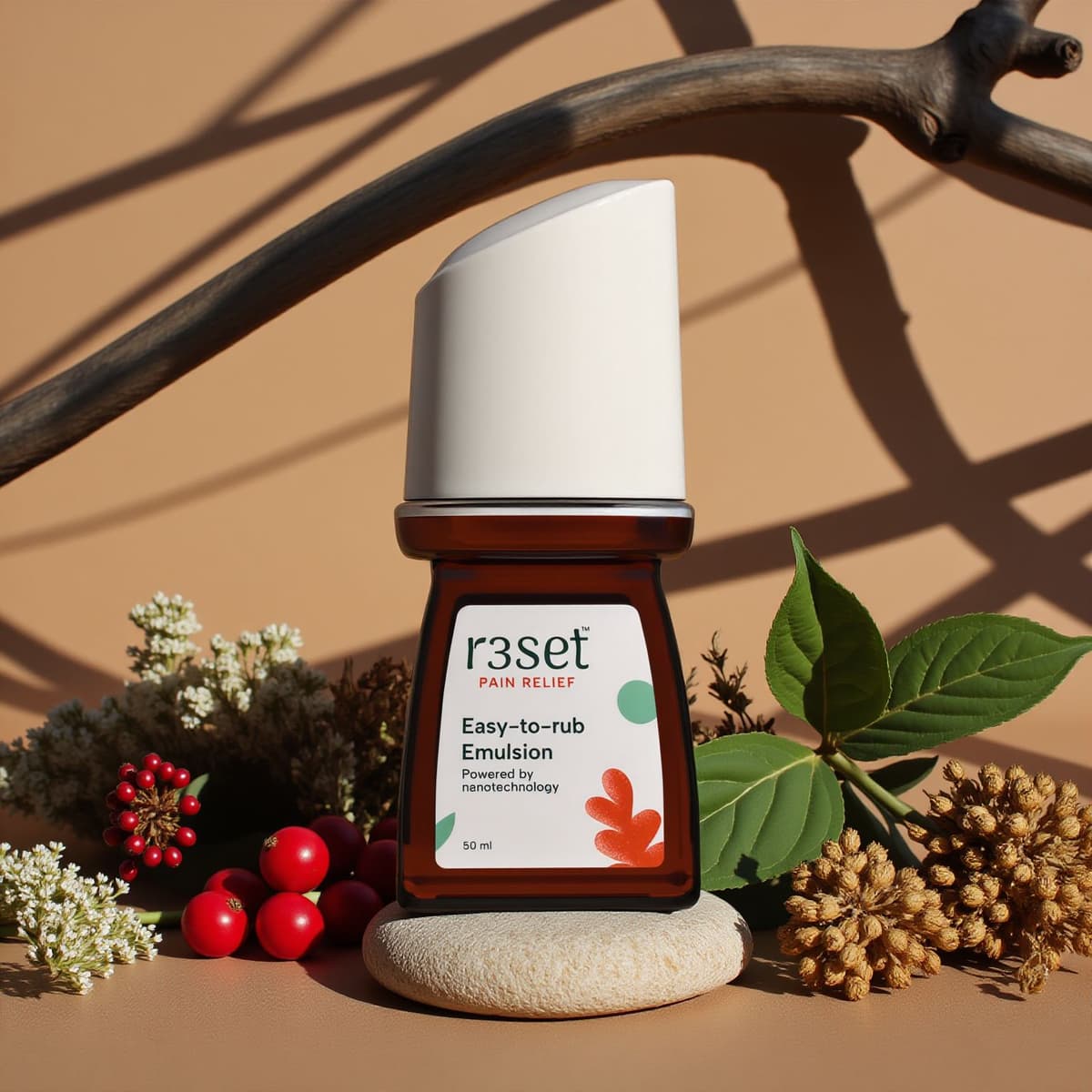
Emulsion Pain relief roll on
An easy to apply potent formula with roll-on massager

₹549.00
₹449.00
4.6

2026-02-27 • 5 min
The neck pain is real. The ointment tube is in your hand. But before you apply it — do you know what it actually does inside the tissue, why most ointments only scratch the surface of the problem, and what separates a product that works from one that merely feels like it does?
Neck pain ointment is the most instinctive topical response to cervical discomfort — and the global market for these products runs into billions of dollars for good reason. Used correctly, a well-formulated ointment or emulsion provides targeted, localised relief exactly where oral medications cannot reach with precision, without the systemic effects of pills, and with an immediacy that most other home treatments cannot match.
But not all neck pain ointments are equal — and the gap between them is not about brand name or price. It is about penetration depth. The cervical muscles and joints that generate most neck pain sit beneath the skin surface, beneath the superficial fat layer, and deep within the muscular tissue. An ointment that reaches only the skin and superficial subcutaneous layer is treating the wrapping, not the contents. This guide explains the science of topical penetration, the types of neck pain ointment available, how to use them for maximum effect, and the complete home care protocol that makes topical treatment work as part of a complete solution — not just a temporary cover.
The skin is simultaneously an entry point and a barrier. Topical ointments exploit its permeability to deliver active compounds to underlying tissue — but the skin is also designed to prevent foreign substances from crossing too deeply. This creates the fundamental challenge of all neck pain ointments: getting the active ingredient from the surface to the depth where the pain originates.
Most conventional ointments — including classic warming products, menthol-based gels, and even standard topical NSAIDs — produce their primary effect in the epidermis, dermis, and superficial subcutaneous fat. The warming or cooling sensation is real, the counter-irritant effect on superficial nerve endings is real, and for mild surface-level tension this is genuinely helpful. But the deeper cervical muscles — the levator scapulae, upper trapezius, semispinalis, and multifidus — sit centimetres below the skin surface. Standard topical formulations do not consistently reach them.
This is not a theoretical limitation. Clinical studies on topical analgesic penetration consistently show that conventional gel and ointment formulations achieve their highest active compound concentrations in the skin and superficial tissue, with rapidly declining levels at depth. The clinical implication is straightforward: for neck pain originating in deep muscle tissue and cervical joints, a standard ointment addresses the sensation of pain more than its source.
Advanced delivery technology — including nanotechnology-enhanced formulations — addresses this limitation by reducing active compound particle size to nano-scale, which dramatically increases skin permeability and allows delivery to the deeper tissue layers where cervical pain actually lives. Understanding this distinction is the most important thing you can know when choosing a neck pain ointment.
Localised muscle aching and tension across the back or sides of the neck — the most common presentation and the most responsive to topical treatment
Trigger point pain in the upper trapezius and levator scapulae — discrete tender spots that produce local and referred aching
Post-exercise or post-overuse cervical soreness — muscle microtrauma with localised inflammation
Morning stiffness from sleep position — the compressed, tight quality of overnight postural loading
Stress-driven neck and shoulder tension — elevated muscle tone from psychological load that accumulates as physical tightness
Post-traumatic soft tissue soreness in the subacute phase — from day 3 onward after the acute inflammatory peak
Topical ointment complements but does not replace professional or medical treatment for:
Cervical radiculopathy — radiating arm pain, tingling, or weakness from nerve root compression
Cervical disc herniation confirmed on imaging
Severe acute spasm that prevents all movement
Neck pain with swelling, fever, or systemic symptoms
Pain following significant trauma — always seek medical assessment first
Choosing and using a neck pain ointment intelligently begins with understanding which pathology you are treating. The same ointment, applied in the same way, has very different effects depending on what is generating the pain beneath it.
Trigger points — hyper-irritable, tightly contracted bands within the cervical muscles — are the primary pain generator in most common neck pain. They develop from sustained postural loading, repetitive movement, acute overload, or stress-driven muscle bracing. They generate both local aching and referred pain to the head and shoulder. Topical ointment applied with deliberate massage directly over a trigger point works through two mechanisms simultaneously: the active pharmaceutical or botanical compounds reduce local inflammation and modulate pain signalling, while the mechanical pressure of application begins to deactivate the trigger point itself. The combination is more effective than either in isolation.
The facet joints of the cervical spine are synovial joints with rich nerve supply that can become irritated from sustained loading, degeneration, or acute compressive stress. Facet joint pain presents as a localised, deep aching at the back of the neck that worsens with extension and rotation. Well-penetrating topical ointments can reach the periarticular tissue surrounding the cervical facet joints and reduce the inflammatory mediators contributing to joint irritation — making them a clinically useful adjunct to mobilisation and stretching for facet-mediated neck pain.
Whiplash, sudden jerking movements, sports impacts, and severe overuse strain the muscles, ligaments, and tendons of the cervical spine beyond their adaptive capacity. The resulting tissue micro-damage triggers the inflammatory cascade — producing prostaglandin-mediated pain and localised oedema. Topical ointments with anti-inflammatory active compounds address this inflammation directly at the tissue site, without the gastric exposure of oral NSAIDs. Their effectiveness is greatest in the subacute phase (day 3 onward), when the acute inflammatory peak has passed and tissue is entering the remodelling phase.
Chronic psychological stress sustains elevated sympathetic nervous system activation, which keeps the upper trapezius, levator scapulae, and suboccipital muscles in a persistently elevated resting tone. This tone produces the tight, heavy, dragging neck discomfort that almost everyone experiences during demanding periods. Topical ointments with warming active compounds stimulate local circulation and provide a counterirritant effect that temporarily interrupts the pain signalling from these tonically contracted muscles — offering meaningful symptomatic relief while the underlying stress drivers are addressed through other means.
Age-related wear of the cervical discs and facet joints generates a chronic, low-grade inflammatory environment in the cervical structures. This is not reversible, but it is manageable. Consistent topical anti-inflammatory treatment directly at the cervical level — applied twice daily rather than reactively during flares — reduces the persistent periarticular inflammation that drives the aching quality of spondylotic neck pain. For this presentation, ointment applied as a daily maintenance routine rather than an occasional rescue treatment produces the most meaningful benefit.
The most widely used category globally. These products work via the counter-irritant principle: the cooling sensation of menthol or the warming of camphor and methyl salicylate stimulates thermal and pain receptors in the skin, generating a competing sensory signal that temporarily overrides the perception of deep muscle pain. The relief is real — and fast — but it is primarily sensory rather than therapeutic. The underlying inflammation, trigger point, or joint irritation is not addressed; the pain signal is temporarily redirected. For mild, surface-level neck tension, this is sufficient and appropriate. For deeper muscular or joint pain, counter-irritant ointments provide comfort without resolution.
Topical NSAID formulations inhibit COX enzymes at the application site, reducing prostaglandin production and the local inflammatory response. This is a genuine anti-inflammatory effect — not merely sensory modulation — making topical NSAIDs appropriate for inflammatory neck pain from muscle strain, facet joint irritation, and post-traumatic tissue injury. Their limitation is penetration depth: standard topical NSAID formulations achieve therapeutic concentrations in superficial tissue but show declining levels at the depth of the deep cervical muscles and facet joints. They work best for near-surface pathology.
Botanical topical products use plant-derived compounds with established anti-inflammatory and analgesic properties — arnica for bruising and soft tissue injury, boswellic acids for joint inflammation, curcumin (turmeric) for inflammatory modulation. These compounds are well-tolerated, have minimal systemic absorption concerns, and are appropriate for regular daily use. Their effectiveness in conventional formulations is limited by the same penetration challenge as other topicals — the active botanical compounds are large molecules that do not easily cross the skin barrier to reach deep tissue.
Nanotechnology-enhanced topical products — including emulsions using nano-sized delivery particles — address the penetration limitation that constrains all other topical categories. By reducing active compound particle size to the nanometre scale, these formulations pass through the skin's lipid barrier significantly more effectively, achieving active compound concentrations in deep muscle and periarticular tissue that conventional formulations cannot reach. For neck pain originating in the deep cervical muscles and facet joints — the majority of clinically significant presentations — this penetration depth advantage translates directly into meaningfully superior therapeutic effect.
Most people apply neck pain ointment incorrectly — a brief smear and a quick rub — and then wonder why results are inconsistent. The application technique, timing, and integration with complementary approaches determines 50% of the outcome.
Warm tissue is receptive tissue. A 10-minute warm shower or heat pack before ointment application increases skin blood flow, elevates local tissue temperature, and temporarily increases the permeability of the skin's lipid barrier. Active compounds applied to warmed skin penetrate more deeply and distribute more evenly than those applied to cold, constricted tissue. This single preparation step is the most impactful technical improvement most people can make to their ointment routine.
The Reset Emulsion is not a standard ointment — it is a nanotechnology-enhanced botanical emulsion designed specifically to overcome the penetration limitation that constrains conventional neck pain products. Apply a generous amount to the back and sides of the neck, across the upper shoulders, and along any specific tender areas. Using the fingertips, massage in slow, firm circular motions for 2 full minutes — not a brief smear and wipe.
The 2-minute massage is not optional. It serves three simultaneous functions: it drives the nanotechnology-sized active particles deeper into the tissue through mechanical pressure; it applies direct trigger point pressure to the most pain-generating cervical muscle areas; and it stimulates local circulation through the massage effect itself. The combination of nanotechnology penetration and deliberate massage technique produces the deepest, most therapeutically effective topical application available for home neck pain management.
Reset tip: Apply Reset Emulsion using a specific directional sequence — base of skull outward to the shoulders, then upward strokes along the lateral neck, then circular work over the most tender trigger points. This sequence follows the anatomical map of the most common cervical pain structures and ensures the most pain-relevant tissue receives the most application attention.
Post-stretch application takes advantage of a temporary elevation in local tissue permeability following movement. Stretching increases local circulation, opens the muscle fascial compartments, and temporarily elevates tissue temperature — all of which enhance topical compound penetration. Applying the ointment after your daily neck stretching session delivers active compounds into tissue that is maximally receptive, amplifying both the ointment's anti-inflammatory effect and the stretch's mobility benefit.
Morning and evening application as a consistent daily habit — before and after your stretching routine — produces the most durable and progressive reduction in neck pain over time. The tissue health improvements from consistent topical anti-inflammatory delivery compound across weeks, creating a progressively more resilient cervical environment.
No ointment resolves neck pain in isolation. Topical treatment is the most effective and most immediately satisfying component of a complete protocol — but it must sit alongside the other layers:
Daily cervical stretching: chin tucks, upper trapezius stretch, levator scapulae stretch, and neck rotation — five minutes every day
Ergonomic correction: screen at eye level, pillow setup matched to sleep position, movement breaks every 45–60 minutes
Heat therapy before movement and ointment application
Stress management: 5 minutes of diaphragmatic breathing daily to reduce the sympathetic-driven cervical hypertonicity that perpetuates tension-driven neck pain
For acute neck pain that flares mid-day, after a poor sleeping position, or during a stressful period — the Reset Emulsion provides the fastest topical relief available for home management. Apply directly to the epicentre of pain with firm fingertip pressure and massage for 90 seconds. The nanotechnology delivery system begins reaching the deep cervical muscle tissue within minutes — reducing inflammation and spasm at the source, not masking it at the surface.
Unlike conventional ointments where the primary experience is surface warming or cooling, the Reset Emulsion's active botanical compounds work progressively deeper as the minutes pass — with maximum effect at the target tissue depth reached within 10–15 minutes of application. For most common neck pain presentations, this is the fastest, most anatomically targeted topical relief achievable without prescription medication.
Keep Reset Emulsion at your desk, in your bag, and on your bedside table. The three moments of highest neck pain impact — mid-afternoon work buildup, first thing on waking, and pre-sleep — all benefit from having targeted relief immediately accessible.
Never apply any topical ointment to broken, irritated, or infected skin — this applies to all formulations including botanical products
Wash hands thoroughly after applying menthol or capsaicin-based ointments — accidental eye contact produces significant discomfort
Avoid heat pads directly over a freshly applied ointment — the combination of chemical and thermal skin stimulation can produce burns in sensitive individuals; apply heat first, then the ointment
Patch test any new formulation on a small area before full application, particularly if you have known skin sensitivities or allergies
Do not apply topical ointments over the spine directly — focus on the para-spinal muscles and not the vertebral column itself
During pregnancy, confirm suitability of any topical product with your midwife or doctor before use — including botanical and natural formulations
Children under 12 should not use adult-formulated topical analgesics without paediatric medical guidance
The most important variable in neck pain ointment effectiveness is penetration depth — and most conventional ointments work primarily at the skin surface, not at the depth of the deep cervical muscles where most neck pain originates.
Nanotechnology-enhanced formulations like Reset Emulsion address this limitation by delivering active botanical compounds to deep muscle and joint tissue — where conventional products do not consistently reach.
Heat applied before ointment, and movement before the second application, both significantly increase topical penetration and therapeutic effect.
Two-minute deliberate massage during application serves three functions simultaneously: mechanical delivery, trigger point pressure, and circulation stimulation.
Counter-irritant ointments provide sensory relief. Topical NSAIDs provide surface-level anti-inflammatory effect. Nanotechnology botanical emulsions provide deep-tissue therapeutic action — each suited to different presentations and depths of pain.
Ointment works best as the topical layer of a complete protocol — not as a standalone solution. Daily stretching, posture correction, and ergonomic adjustment address the cause; topical treatment addresses the tissue state.
Consistent twice-daily application produces progressively better outcomes than reactive use during pain peaks — tissue health improves cumulatively.
Nanotechnology-enhanced formulations achieve the greatest penetration depth of any topical delivery system currently available for home use. By reducing active compound particles to the nano scale, they pass through the skin's lipid barrier more effectively than conventional gel or ointment formulations — reaching the deep cervical muscle tissue and periarticular joint structures that standard products work at the surface of. For neck pain originating in the deep muscular and joint layers — the majority of clinically significant presentations — this depth advantage is the most meaningful differentiating factor in product selection.
Warming ointments — using camphor, methyl salicylate, or capsaicin — are generally more appropriate for chronic tension-driven neck pain and for use before movement and stretching. They stimulate circulation and reduce the viscosity of tight fascial tissue. Cooling ointments — using menthol — provide faster immediate relief and are more appropriate for acute, sharp pain or the subacute phase of a muscle strain. For most common everyday neck pain, warming is the better default. In the first 48 hours of an acute injury or flare, cooling is preferable. For deep-tissue anti-inflammatory effect across all presentations, a nanotechnology botanical formulation provides a third, more therapeutically substantive category.
For most home management purposes, twice daily — morning and evening — provides the most consistent therapeutic benefit. Morning application before heat and stretching prepares the tissue for the day's physical demands. Evening application after the day's postural loading supports overnight tissue recovery. For acute pain management, some formulations can be applied up to 3–4 times daily — always check the specific product instructions. The most important principle is consistency over frequency: twice daily every day outperforms four times daily for three days and then nothing.
Yes — and the combination produces better outcomes than either alone. Topical ointment applied before physiotherapy or stretching reduces the pain and muscle guarding that limits how fully the therapeutic movement can be performed. Applied after treatment, it supports the tissue recovery that physical therapy initiates. A physiotherapist may also apply prescription-strength topical products during manual therapy sessions. There is no contraindication between topical ointment and physiotherapy, massage, heat therapy, or any of the home care approaches in this guide — they are complementary and synergistic.
Standard ointments and gels — whether counter-irritant, topical NSAID, or botanical — work within the skin and superficial tissue layers. Their active compounds are formulated at conventional particle sizes that limit transdermal penetration. The Reset Emulsion uses nanotechnology to reduce its active botanical anti-inflammatory and analgesic compounds to nano-scale particles, enabling significantly deeper penetration through the skin barrier and into the deep cervical muscle tissue and periarticular structures. The practical result is that Reset Emulsion addresses the inflammation and spasm at the depth where neck pain originates — not at the surface where it is felt. Applied twice daily with deliberate massage technique, it provides a qualitatively different therapeutic effect from conventional topical products: deeper, more sustained, and more directly targeted to the anatomical source of most cervical pain.
A neck pain ointment is only as good as what it can reach. The difference between temporary surface relief and genuine tissue recovery comes down to one thing: whether the active compounds get to where the pain actually lives. For most neck pain, that place is deep — in the muscle belly, at the trigger point, at the periarticular joint tissue — and it requires a formulation built to get there.
The technique matters too. Heat first. Two minutes of deliberate massage. Morning and evening, every day. Integrated with the stretching, posture correction, and movement that treat the cause while the ointment treats the tissue.
Make the Reset Emulsion the topical foundation of your neck pain protocol — nanotechnology-powered botanical relief that reaches where conventional ointments do not. Twice daily. Every day. Because a pain-free neck does not come from the surface. It comes from the reset.
Share this article:
An easy to apply potent formula with roll-on massager
₹549.00
₹449.00
dose of radiance for skin and hair

₹439.00
A dose of immunity and goodness with a tangy twist

₹439.00
₹419.00
An optimal choice for safe and natural pain relief.

₹349.00
₹249.00
A herbal dose of complete wellness

₹439.00
Enhance the quality of sleep and focus with a flavourful dose

₹489.00