It's Time to Rethink the Box: Sustainable Packaging on World Environment Day
2026-06-02 • 5 min read
Every year on June 5th, World Environment Day nudges humanity toward a hard look in the mirror. In 2025, the message feels more urgent than ever. The products filling our shelves — including health and wellness essentials we rely on daily — arrive wrapped in layers of plastic, foam, and materials that will still be sitting in a landfill long after the people who discarded them are gone. Sustainable packaging isn't a fringe conversation anymore. It's one of the defining challenges of our time — and one of the most immediate opportunities for brands and consumers to lead meaningful change.
Reset was built around a core belief: that what you put on your body should reflect the same respect for nature that Ayurveda has honoured for thousands of years. Seven powerful herbs. No unnecessary fillers. Products that work without adding burden to the planet. That philosophy cannot stop at the formula itself — it must extend to how those products reach you. This World Environment Day, we want to talk about the box, the jar, the sachet, and the pouch. We want to talk about what eco friendly packaging actually means, what sustainable packaging materials are worth knowing about, and how every choice — yours and ours — adds up.
The Problem Nobody's Talking About Loudly Enough
Before we get into solutions, it's worth sitting with the numbers for a moment — because they have a way of shaking loose comfortable assumptions.
According to the United Nations Environment Programme (UNEP), the world generates over 400 million tonnes of plastic waste each year. Of that, approximately 36% is single-use packaging — bags, wrappers, bottles, sachets that briefly house a product and then become a problem that lasts centuries. The Central Pollution Control Board (CPCB) of India reported that the country generated around 4.4 million metric tonnes of plastic waste in 2022–23 alone, much of it concentrated in urban centres.
What makes this particularly difficult to sit with is the timeline. A single-use plastic wrapper takes anywhere from 450 to 1,000 years to degrade in a landfill environment, according to research cited by India's Ministry of Environment, Forest and Climate Change (MoEFCC). The product it contained was probably used within weeks. This mismatch — between product lifespan and packaging lifespan — is at the heart of why the push for sustainable packaging materials is not just an aesthetic preference. It is an ecological emergency response.
The good news, and there is genuine good news here, is that the sustainable packaging market has been responding at scale. Global market valuations have climbed into the hundreds of billions, and the fastest-growing search trends of 2025 confirm that consumers, not just regulators, are driving the demand.
Table 1: Global Packaging Waste — By the Numbers
What Makes Packaging Truly Sustainable?
This is where many brands and consumers come unstuck. The word "sustainable" has been stretched so thin across marketing copy that it has, in some cases, lost its shape entirely. Calling something "eco friendly packaging" because it's green-coloured or printed with a leaf doesn't make it so. Genuine sustainability in packaging rests on four verifiable criteria.
The first is resource origin — was the material sourced renewably, without destroying ecosystems or depleting finite resources? The second is production impact — how much energy, water, and carbon did manufacturing it require? The third is functional efficiency — does the packaging use only as much material as is genuinely necessary to protect the product? The fourth, and often the most neglected, is end-of-life integrity — what actually happens to this material after the consumer is done with it?
Three terms come up constantly in this space, often used interchangeably but meaningfully different. Biodegradable, compostable, and recyclable describe three distinct pathways — and confusing them can lead to well-intentioned waste ending up in the wrong stream, which is sometimes worse than informed disposal. The table below breaks these down clearly.
Table 2: Biodegradable vs. Compostable vs. Recyclable — Key Differences
The Most Promising Sustainable Packaging Materials Right Now
Google Trends data through 2025 tells a clear story: "biodegradable packaging" is the single most searched sustainable packaging term, with search volume reaching a peak score of 96 in late 2025. Consumers aren't just vaguely curious — they're actively seeking alternatives. Here is what the landscape currently looks like.
Kraft and Recycled Paper
Paper remains the most accessible and widely understood sustainable packaging material. When sourced from FSC-certified forests and manufactured with recycled content, kraft paper is genuinely low-impact. It degrades in weeks in natural conditions, can be home composted, and doesn't require special infrastructure. Its primary limitation is moisture resistance — though innovations in barrier coatings are closing that gap.
Bamboo
Bamboo grows at remarkable speed, requires no pesticides, and regenerates without replanting. As a packaging material it's rigid, aesthetically clean, and biodegrades within months. It is particularly well suited to rigid containers, trays, and structural elements. Indian brands are beginning to adopt bamboo-based packaging at scale, which also benefits the bamboo farming economy in the northeast.
Mushroom Packaging — The Most Exciting Material You Haven't Heard Of
Mushroom packaging, technically called mycelium-based packaging, is grown rather than manufactured. The process starts with agricultural by-products — hemp husks, corn stalks, sawdust — that are inoculated with fungal spores. Over five to seven days, the mycelium root network grows through and binds this waste into a solid, lightweight composite. Once dried and heat-treated to stop biological activity, the result is a shock-absorbing, thermally insulating material comparable in performance to polystyrene foam.
The critical difference is what happens at end-of-life. Mushroom packaging decomposes in 30 to 90 days in home compost or soil. It leaves no microplastics. It requires no fossil fuels to produce. Major global companies including Dell and IKEA have already trialled it as a replacement for EPS foam inserts. Analysts project the global mycelium packaging market will nearly double from approximately USD 68 million in 2024 to USD 142 million by 2034.
Bioplastics
Plant-derived plastics made from corn starch or sugarcane, known as PLA bioplastics, offer a more familiar form factor while reducing dependence on fossil fuels. The nuance is important here: most bioplastics require industrial composting facilities to break down properly — they don't degrade meaningfully in a home compost or landfill. This is why bioplastic should not be treated as a straightforward win, but rather as one tool in a broader transition strategy, particularly where flexible film packaging is currently unavoidable.
Refill and Concentrate Formats
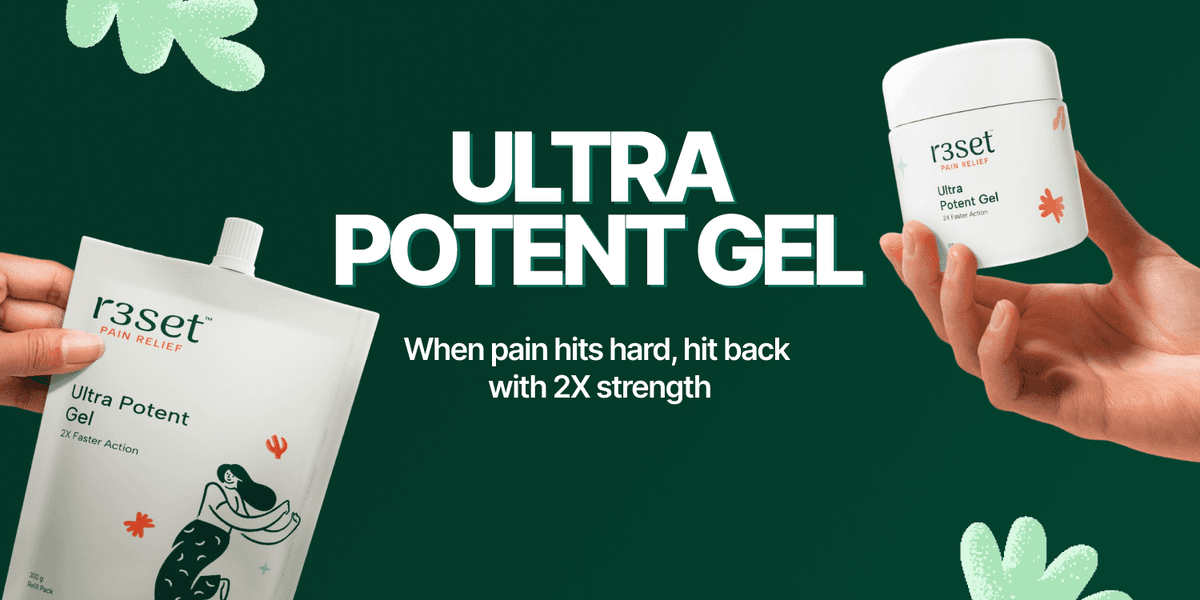
Perhaps the most underrated sustainable packaging innovation is the refill model. By separating the long-lasting primary container from the single-use delivery mechanism, refill formats dramatically reduce the total amount of packaging material consumed per product use. This is the thinking behind the Ultra Potent Gel Refill Pack from Reset — more product, less waste, same efficacy. It's a model that the beauty, personal care, and wellness industries are increasingly embracing as part of responsible product design.
Table 3: Sustainable Packaging Materials — Quick Comparison
What Reset Is Doing Differently
Reset's products are built on a philosophy that natural should mean something. Every formula starts with Ayurvedic wisdom — ingredients that have demonstrated efficacy across centuries. The Ultra Potent Gel, for instance, combines seven botanicals: Wintergreen, Menthol, Eucalyptus (Neelgiri), Nirgundi, Camphor, Boswellia (Shallaki), and Ajmoda. No synthetic fillers. No petroleum derivatives. Just the intelligence of plants, concentrated.
That same principle is being applied to how we package. The Ultra Potent Gel Refill Pack offers three times the quantity of a standard jar while using significantly less packaging per gram of product — a direct reduction in the material footprint of your wellness routine. It's not a gimmick; it's the natural extension of a brand philosophy that respects what goes into a product and what comes out of its lifecycle.
If you haven't already, explore the Ultra Potent Gel — formulated with the same seven-herb Ayurvedic blend, and increasingly part of a packaging story we're actively working to make more responsible with each iteration.
How You Can Take Action Today
Knowing the theory is useful. Changing behaviour is what actually moves the needle. Here's a practical framework for consumers who want to make this World Environment Day count.
•Choose refill when it's available.
•A refill pouch or concentrate format almost always has a lower packaging footprint than a new primary container. Many health and wellness brands now offer this.
•Learn to read labels properly.
•"Biodegradable" is not the same as compostable. Look for certification marks — BPI (Biodegradable Products Institute), FSC, or TÜV Austria home compostable certification — rather than vague eco-friendly claims.
•Reduce packaging volume through purchasing decisions.
•Buying a larger format or a multi-use product typically generates less packaging waste per use than buying several small single-use versions.
•Rinse and sort before recycling.
•Contamination is one of the biggest reasons recyclable packaging doesn't actually get recycled. A quick rinse makes a real difference.
•Ask brands questions publicly.
•Social media comments and brand community forums are powerful. When consumers ask about packaging sustainability, it signals to product teams that these decisions are visible.
The table below helps cut through greenwashing — one of the most common traps consumers and even well-meaning brands fall into.
Table 4: Greenwashing vs. Genuine Sustainability — How to Tell the Difference
The Future Is Already Here
The regulatory tide has turned decisively. The European Union's Packaging and Packaging Waste Regulation (PPWR), which came into force in February 2025, sets legally binding recyclability standards and reuse targets that will have global ripple effects — including on Indian export brands and multinationals operating across markets. Extended Producer Responsibility (EPR) frameworks are expanding across the United States state by state, and India's own Plastic Waste Management Rules continue to tighten.
Beyond regulation, the innovation pipeline is genuinely exciting. Smart packaging with QR codes now carries recycling instructions, material composition data, and even carbon footprint information directly to consumers. Reusable packaging systems are scaling through new logistics models. Seaweed-based films and other marine-derived packaging materials are moving from lab to pilot production. Refill stations in physical retail are making a return.
The packaging conversation is no longer about finding a slightly less bad option. It's about fundamentally redesigning how products move from maker to user — in a way that respects the finite resources of the planet both the maker and the user share. World Environment Day 2025 isn't a date on the calendar. It's a starting point.
Key Takeaways
•Sustainable packaging refers to materials and systems designed to minimise environmental impact across sourcing, production, use, and end-of-life.
•The terms biodegradable, compostable, and recyclable describe three distinct and non-interchangeable pathways — understanding the difference is essential to making good disposal decisions.
•The most promising sustainable packaging materials in 2025 include kraft/recycled paper, bamboo, mycelium (mushroom) packaging, bioplastics, and refill-based formats.
•Mushroom packaging — grown from agricultural waste and mycelium — decomposes in 30 to 90 days and produces no microplastics. It's being adopted by major global brands as a polystyrene alternative.
•Refill formats like the Reset Ultra Potent Gel Refill Pack reduce the total packaging material consumed per product use — a direct, measurable way to lower your personal footprint.
•Greenwashing remains widespread. Certifications (FSC, BPI, TÜV Austria), material specificity, and end-of-life guidance are the hallmarks of genuinely sustainable packaging.
•Global regulation is tightening — the EU PPWR, EPR laws across the US, and India's Plastic Waste Management Rules are all applying pressure that will accelerate the transition.
•Consumer choices — choosing refill, asking brands questions, sorting waste correctly — are consequential and visible to product development teams.
Frequently Asked Questions
What is sustainable packaging?
Sustainable packaging refers to packaging solutions designed to minimise environmental impact at every stage — from sourcing the raw material through production, use, and end-of-life disposal or reuse. It prioritises renewable or recycled inputs, efficient use of material, and clear, viable end-of-life pathways such as recycling, composting, or reuse.
Why does it matter on World Environment Day?
World Environment Day, observed every June 5th, serves as a global moment of collective focus on the planet's most pressing ecological challenges. Packaging waste — particularly single-use plastic — is one of the most visible and solvable contributors to pollution, ocean contamination, and landfill overflow. Using this day to commit to packaging-related changes, whether as a consumer or brand, creates real, measurable impact.
What are the most common sustainable packaging materials?
The most widely used sustainable packaging materials include FSC-certified kraft and recycled paper, bamboo, glass, aluminium (highly recyclable), bioplastics derived from plant starches, and mycelium-based (mushroom) packaging. Refill formats that eliminate the need for repeated primary containers are also gaining significant traction in health, beauty, and wellness categories.
What is the difference between biodegradable and compostable packaging?
Biodegradable means a material will eventually break down through biological processes — but the timeframe can range from weeks to centuries depending on the material and conditions. Compostable is a more specific standard: the material breaks down into nutrient-rich biomass within a defined period (typically 90–180 days) under controlled conditions. Home-compostable packaging does this in your garden; industrial-compostable packaging requires a commercial composting facility.
Is bioplastic truly eco-friendly?
It depends on the full lifecycle. Bioplastics made from renewable plant sources do reduce dependence on fossil fuels in production. However, most commercially available bioplastics — particularly PLA — require industrial composting infrastructure to break down properly. Without it, they can persist in landfill much like conventional plastic. They are a step in the right direction, but not a complete solution on their own.
What is mushroom packaging and how does it work?
Mushroom packaging — technically called mycelium-based packaging — is grown using the root network of fungi combined with agricultural by-products such as hemp husks, corn stalks, or sawdust. Fungal spores are introduced into a mould containing this agricultural waste and allowed to grow for five to seven days, binding the material into a solid composite. The packaging is then heat-dried to halt biological activity. The result is a lightweight, shock-absorbing material comparable to polystyrene foam that decomposes fully in 30 to 90 days in home compost or soil.
Is sustainable packaging more expensive for businesses?
In most cases, sustainable packaging carries a higher upfront material cost compared to conventional plastics. However, this gap is narrowing as production scales. Brands that move early often benefit from regulatory compliance advantages, stronger consumer loyalty, and reduced liability as EPR (Extended Producer Responsibility) frameworks expand. Refill models, in particular, can reduce long-term costs by decreasing the volume of primary packaging produced per unit sold.
How can consumers identify genuinely sustainable packaging?
Look for specific, verifiable markers rather than vague claims. Trustworthy signals include FSC certification for paper-based packaging, BPI or TÜV Austria compostability certification for compostable formats, and clear disposal instructions on the pack itself. Brands that disclose packaging composition, material sourcing, and end-of-life guidance — rather than simply labelling packaging 'eco' — are more likely to be walking their talk.
How does sustainable packaging help reduce carbon emissions?
Conventional plastic production is energy-intensive and derived from fossil fuels, contributing directly to carbon emissions. Sustainable alternatives made from renewable, rapidly regenerating sources (bamboo, agricultural waste, sustainably harvested paper) have a significantly lower embodied carbon footprint. Refill formats reduce the number of containers produced per consumer use, compounding savings across a product's commercial life. Some materials, like mycelium packaging, require minimal processing energy and sequester agricultural carbon in their raw inputs.
What are the future trends in sustainable packaging?
The most significant trends shaping 2025 and beyond include the expansion of reusable packaging systems with return logistics, smart packaging with QR-based lifecycle tracking, advanced mycelium and seaweed-based material innovation, bioplastic development targeted at industrial compost streams, and legislation-driven design for recyclability under frameworks like the EU PPWR. India's own regulatory landscape under the Plastic Waste Management Rules is also accelerating brand-level packaging reform.
How can I take action this World Environment Day?
Start with what you buy and how you dispose of it. Choose refill formats where available. Learn to distinguish compostable from biodegradable from recyclable on your packaging. Rinse containers before recycling. Ask the brands you use publicly about their packaging commitments. Support companies whose packaging philosophy aligns with their product philosophy — and whose actions match their marketing. The smallest consistent choices, at scale, shape what the market does next.
You May Also Find These Helpful
Explore more on the Reset blog: The Goodness Blog — for articles on Ayurvedic ingredients, pain relief science, and living more sustainably with your wellness routine.
Disclaimer
This article is intended for general informational purposes only. The information presented regarding packaging materials, environmental data, and regulatory frameworks is based on publicly available sources and is accurate to the best of our knowledge at the time of publication. Reset products are Ayurvedic wellness topicals; this content does not constitute medical advice. For specific health or product concerns, please consult a qualified healthcare professional.
Share this article: