
Pain Relief
Spain National Football Team vs France National Football Team Timeline
2026-07-13
5 min read

2026-07-13 • 5 min read
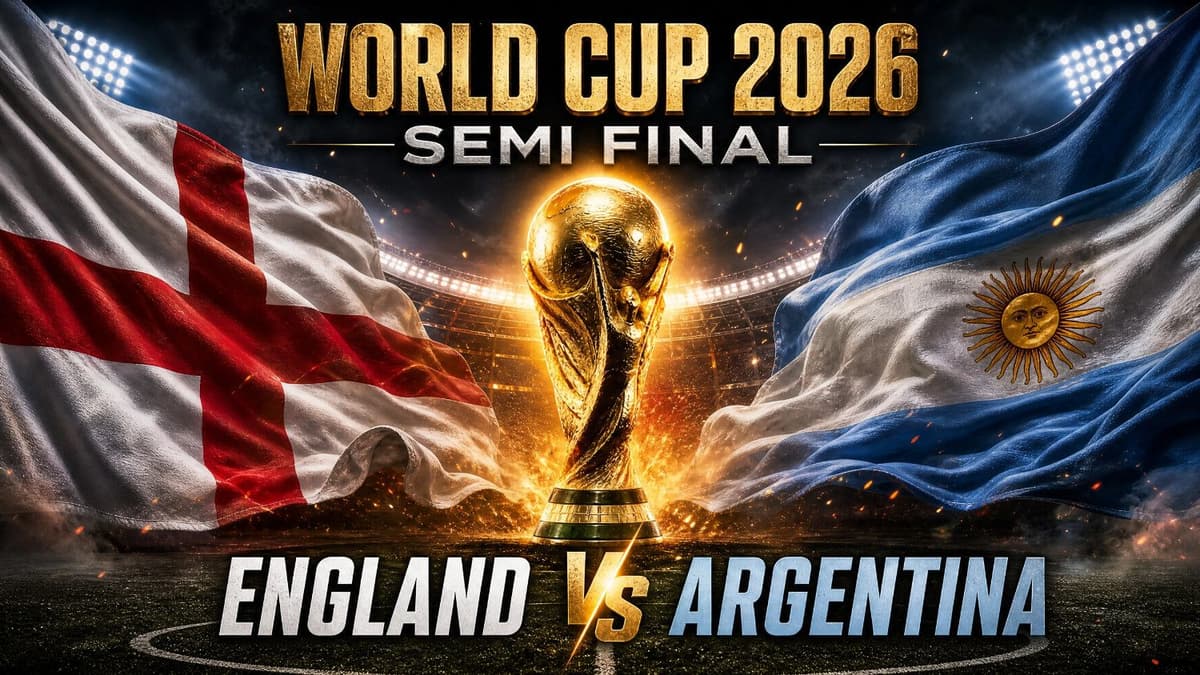
Some football rivalries are built on geography. Others are built on history far bigger than the pitch itself. Argentina vs England in the worldcup semifinal 2026 belongs to the second category — and it is about to explode across 90 minutes (or more) in the sticky Atlanta heat on Wednesday night. Two former world champions, two squads that have clawed through extra-time dramas to survive the knockout rounds, and two narratives that could not be more different: a 39-year-old legend chasing the perfect farewell versus a 23-year-old force of nature who refuses to let his country lose.
England vs Argentina carries a weight that most semi-finals simply cannot match. The Hand of God. Beckham's red card. The Falklands War shadow that still darkens every encounter between these nations. And yet, here is the most remarkable detail heading into Wednesday — Lionel Messi, the man who has done everything in football, has never once played against England. Not in a World Cup. Not in a friendly. Not ever. That changes in Atlanta, at a stadium that will host just over 71,000 people and a television audience of hundreds of millions, with a place in the World Cup final on the line.
In this detailed preview and timeline, we cover how both squads battled their way to Georgia, the full head-to-head history between these nations, the Messi-vs-Bellingham subplot that makes this semi-final feel generational, complete squad lists, predicted lineups, where Indian fans can watch at 12:30 AM IST on July 16, and a few words on why recovery matters just as much for late-night viewers as it does for the players on the field.
Argentina arrived in North America as defending champions and have played like it — mostly. Lionel Scaloni's squad swept through their group with three comfortable victories over Algeria, Austria, and Jordan, scoring eight goals and conceding just one. But the knockout rounds have been an entirely different story. Cape Verde pushed them to extra time in the round of 32 before a 111th-minute own goal spared Argentine blushes. Egypt ran them desperately close in the round of 16, with Argentina scraping through 3-2 after Messi missed a penalty and then scored the equaliser that kept their tournament alive. The quarter-final against Switzerland was another grind — Alexis Mac Allister headed in Messi's early corner, but Dan Ndoye levelled in the second half, and it took a sensational long-range curler from Julián Álvarez in the 112th minute to finally break Swiss resistance. Lautaro Martínez added a third in stoppage time of extra time. Argentina have now played three consecutive knockout matches that required extra time or last-gasp drama. The tank is not empty yet, but it is running low.
England's journey has been equally uncomfortable and equally successful. Thomas Tuchel's side announced themselves with a thrilling 4-2 win over Croatia in Dallas — Harry Kane and Jude Bellingham doing most of the damage — before stumbling to a goalless draw against Ghana and labouring past Panama 2-0. The round of 32 produced a nervy 2-1 comeback win over DR Congo in Atlanta, and then came the fireworks: a 3-2 defeat of Mexico in the Estadio Azteca, where Bellingham's brace in the space of two minutes turned the match on its head. The quarter-final against Norway in Miami was yet another white-knuckle ride. Andreas Schjelderup put the Norwegians ahead, Bellingham equalised with a mesmeric dribble just before half-time, and then the Real Madrid man struck again early in extra time, tapping in after Morgan Rogers's shot was parried. England have not won a knockout match by more than a single goal at this tournament. It does not matter. They keep advancing.
Table 1: Tournament Journey — Argentina vs England at World Cup 2026
Source: FIFA.com match reports
Few international football rivalries carry the emotional and political charge that Argentina and England do. The roots stretch far beyond the pitch — the 1982 Falklands War between the two nations cast a long shadow over every subsequent sporting encounter, transforming football matches into proxy battles that carried the weight of national pride and lingering resentment. It is impossible to tell the story of this fixture without telling the story of the countries themselves.
On the pitch, these two have met five times at World Cups, and England hold the edge with three victories to Argentina's one, plus a draw that was decided by penalties. The first meeting came at Chile 1962, where England cruised to a 3-1 group-stage win. Four years later, on home soil at Wembley in 1966, Alf Ramsey's side ground out a 1-0 quarter-final victory in a match so hostile that the Argentine captain Antonio Rattín was sent off — and Ramsey infamously refused to let his players swap jerseys afterwards, calling the Argentines 'animals' in a post-match press conference.
Then came 1986, and the match that defined the rivalry for a generation. In the quarter-final at Mexico City's Estadio Azteca, Diego Maradona produced two of the most famous goals in football history within four minutes of each other — the 'Hand of God,' a blatant handball that the Tunisian referee allowed, and immediately afterwards the 'Goal of the Century,' a solo run that started in his own half and left five English defenders in his wake. England pulled one back through Gary Lineker but could not find an equaliser. Maradona later admitted he relished the handball specifically because of the Falklands, writing in his autobiography that it felt like stealing England's wallet.
The 1998 World Cup brought another iconic chapter. In Saint-Étienne, Michael Owen scored a wonder goal for England before David Beckham was sent off for a retaliatory kick at Diego Simeone — who admitted years later that he had dived. The match finished 2-2 and Argentina won 4-3 on penalties. Beckham's redemption arrived four years later at the 2002 World Cup in Sapporo, where his penalty gave England a 1-0 group-stage victory. That remains the last time these two nations met at a World Cup — until Wednesday.
Table 2: Argentina vs England — World Cup Head-to-Head Results
Source: FIFA.com, Wikipedia — Argentina-England football rivalry
There is a poetic symmetry to this semi-final that football writers could not have scripted better. On one side stands Lionel Messi, 39 years old, playing what everyone acknowledges will be one of his final World Cup matches. On the other stands Jude Bellingham, 23, a player whose tournament trajectory increasingly mirrors the Maradona comparisons that used to be reserved for Messi himself. Bellingham is the first player since Maradona in 1986 to score two or more goals in consecutive World Cup knockout matches at the same tournament — a stat that feels almost too fitting given the history between these nations.
Messi's numbers at this World Cup are staggering. Eight goals — tied with Kylian Mbappé for the Golden Boot lead — and two assists, meaning he has directly contributed to ten of Argentina's seventeen tournament goals. He has scored in nine consecutive World Cup matches, an all-time record, and has surpassed every career milestone the tournament has to offer: most goals, most assists, most appearances. At 39, playing for Inter Miami in MLS rather than at the peak of European club football, many doubted whether Messi had enough left. He has answered those doubts with the kind of savage, clinical finishing that defined his Barcelona peak. The only thing missing is a goal against England — a team he has remarkably never faced in his entire career, not even in a friendly.
Bellingham, meanwhile, has been England's lifeline. His brace against Mexico in the round of 16 — two goals in two minutes — is the kind of moment that turns a good player into a tournament icon. Against Norway, he produced a solo dribble that carved through three defenders to equalise, then followed it with the extra-time winner. He now has six goals in the tournament, trailing only Messi, Mbappé, and Erling Haaland in the Golden Boot standings. Where Messi creates through vision, patience, and geometrically perfect passes, Bellingham creates through relentless forward running, physical dominance, and a goalscoring instinct that belies his midfield position.
And then there is Harry Kane, quietly assembling one of the great World Cup striker campaigns. Kane broke Wayne Rooney's all-time England World Cup scoring record during the group stage and has continued to deliver when it matters most — including a penalty against Mexico that kept England alive at 2-2 before Bellingham's late heroics. Together, Kane and Bellingham have combined for the majority of England's goals, forming a partnership that Tuchel has built his entire system around.
Table 3: Key Player Stats at World Cup 2026 (Pre Semi-Final)
Source: FIFA.com tournament statistics, FOX Sports, ESPN
Both managers have largely full-strength squads available, though a few notable absences and fitness doubts add intrigue to team selection. Here is the complete breakdown of both 26-man rosters, according to FIFA's official tournament registrations and squad updates from ESPN and The FA.
Table 4: Full Squad Lists — Argentina & England (World Cup 2026)
Source: FIFA.com squad registrations, ESPN, The FA. Note: Jordan Henderson is ruled out (broken wrist); Ezri Konsa is a suspension doubt.
England have a handful of concerns heading into this semi-final. Jordan Henderson broke his wrist during celebrations after the Mexico win and is out of the tournament entirely. Ezri Konsa, who has been a regular in the back line, is a doubt — some reports suggest he suffered cramp against Norway, while others indicate a possible suspension. Jarell Quansah served a two-match ban following his red card against Mexico and is now available again. The biggest question mark hangs over Declan Rice, who was substituted at half-time against Norway. Thomas Tuchel has said Rice was in significant discomfort but is expected to be fit for Wednesday. If Rice cannot go, Kobbie Mainoo would step into the holding role.
Argentina's concerns are fewer but not insignificant. Messi took an accidental knock to the face from Granit Xhaka during the Switzerland match, drawing blood around his right eye. He played the full 120 minutes regardless and is expected to be fully fit. Cristian Romero, however, was replaced at half-time of extra time against the Swiss, and Facundo Medina may get the nod alongside Lisandro Martínez in central defence. Full-backs Nahuel Molina and Nicolás Tagliafico were both substituted before 90 minutes and should be fresh enough to start.
England predicted XI (4-2-3-1): Pickford; Konsa (or Quansah), Stones, Guéhi, Burn; Rice, Mainoo; Saka, Bellingham, Gordon; Kane.
Argentina predicted XI (4-1-2-1-2): E. Martínez; Molina, Medina, L. Martínez, Tagliafico; Paredes; De Paul, Mac Allister; Enzo Fernández; Álvarez, Messi.
Tactically, this promises to be a chess match between two deeply pragmatic coaches. Tuchel builds everything around defensive compactness and quick transitions — England absorb pressure, win the ball back, and release Bellingham and Saka into space at devastating speed. Scaloni, on the other hand, trusts his midfield trio of Enzo Fernández, Mac Allister, and De Paul to control possession and find Messi in pockets between the lines where he is almost impossible to mark. The key battle will be Rice versus Messi — if England's holding midfielder can cut off the supply line, Argentina lose their most dangerous creative outlet. If Messi finds space, it could be a long night for the English back four.
The match takes place at Atlanta Stadium — the FIFA tournament name for Mercedes-Benz Stadium in Atlanta, Georgia — on Wednesday, July 15, at 3:00 PM ET. For Indian viewers, that translates to Thursday, July 16, at 12:30 AM IST. The stadium has a capacity of approximately 71,000 for this tournament and will be hosting its second knockout-stage match after England's round-of-32 win over DR Congo was played at the same venue. In India, the match will be broadcast live on Unite8 Sports (formerly Zee Sports) and streamed on Zee5. DD Sports will also carry free-to-air coverage for select matches, including the semi-finals.
For Argentine fans, this semi-final carries an additional layer of emotion — it could be Lionel Messi's final World Cup match if Argentina lose. Every touch, every pass, every dribble will be watched through the lens of finality. For English fans, this is a chance to reach only the second World Cup final in the nation's history, 60 years after Bobby Moore lifted the trophy at Wembley in 1966. The narrative pressure on both sides is immense.
Here is a fact that gets lost in the drama of goals and saves: both Argentina and England played 120 minutes of football in their quarter-finals, not 90. That means each squad has accumulated at least 660 minutes of competitive action across six matches in roughly four weeks — with two of those matches extending deep into extra time. Research published in the British Journal of Sports Medicine confirms that muscle damage from high-intensity sprinting and direction changes peaks 48 to 72 hours after a match. By the semi-final, players are performing on tissue that has never fully repaired itself since the round of 32.
Professional recovery protocols involve cold-water immersion, compression therapy, nutrition timing, sleep optimisation, and — crucially — topical analgesics that deliver localised relief to fatigued muscle groups. The topical approach is favoured because it minimises the systemic load associated with oral medications, getting active ingredients directly to the source of discomfort without stressing the digestive system.
This is exactly the philosophy that underpins Reset Ultra Potent Gel (reset.in/products/ultra-potent-gel), a topical Ayurvedic formulation containing seven time-tested herbs: Wintergreen, Menthol, Eucalyptus (Neelgiri), Nirgundi, Camphor, Boswellia Serrata, and Ajmoda. These ingredients have been trusted for centuries in traditional Indian wellness systems for their cooling, soothing, and comfort-supporting properties. The gel is designed as a daily recovery companion — not a medical treatment — for anyone who wants targeted topical comfort after physical strain, whether you are a professional athlete, a weekend cricketer, or simply someone who has been sitting in the same position for three hours watching football at half past midnight.
You do not need a World Cup physio budget to take better care of your body. If you are planning to stay up for the 12:30 AM IST kickoff — and with a match this loaded, of course you are — here are some practical habits that will help you feel better the morning after.
Start with movement. Sitting rigid on a sofa for two or three hours is a recipe for neck stiffness, lower-back tightness, and sluggish circulation. Get up during half-time and the drinks break. Do a few gentle stretches — neck rolls, shoulder shrugs, standing hamstring stretches. Even two minutes of movement between halves makes a measurable difference.
Hydrate consistently. Late-night screen time, air conditioning, and the general stress of watching a penalty shoot-out all contribute to dehydration. Keep a bottle of water within arm's reach throughout the match. If you are watching with snacks, balance the salt with extra fluids.
Apply a quality topical formulation to any areas of discomfort. A product like Reset Ultra Potent Gel — with its blend of Wintergreen, Menthol, and Boswellia Serrata — can be massaged gently into a stiff neck or lower back for a cooling, soothing sensation that supports day-to-day comfort. It is the same principle professional squads use, adapted for anyone who needs localised relief.
Finally, protect your sleep. After the match, avoid scrolling through highlight reels and Twitter arguments for another hour. Dim the lights, skip the caffeine, and aim for at least seven hours. Recovery happens during deep sleep, when growth hormone secretion peaks and tissue repair accelerates. Your body will thank you on Thursday morning.
●Argentina vs England is the second World Cup 2026 semi-final, taking place at Atlanta Stadium on Wednesday, July 15, at 3:00 PM ET — which is 12:30 AM IST on Thursday, July 16 for Indian viewers.
●This is the sixth World Cup meeting between these nations. England lead the all-time WC head-to-head 3-1-1, but Argentina's lone victory in 1986 — featuring the Hand of God — remains the most famous of all.
●Lionel Messi has never played against England in any match. Wednesday will be the first time, and likely the last, that he faces the Three Lions.
●Messi leads the Golden Boot race with 8 goals and 2 assists. Jude Bellingham has 6 goals and is the first player since Maradona in 1986 to score braces in consecutive World Cup knockout games.
●Both teams played extra time in their quarter-finals. Recovery and fatigue management will be a decisive factor in a match expected to be tight and tactical.
●Indian fans can watch live on Zee5, Unite8 Sports, and DD Sports (free-to-air). Recovery after the late-night viewing marathon starts with movement, hydration, and a quality topical formulation like Reset Ultra Potent Gel.
Q: When is Argentina vs England in the 2026 World Cup?
The semi-final takes place on Wednesday, July 15, 2026, at 3:00 PM ET. For Indian viewers, kickoff is at 12:30 AM IST on Thursday, July 16.
Q: Where is the England vs Argentina semi-final being played?
The match is at Atlanta Stadium (Mercedes-Benz Stadium) in Atlanta, Georgia, USA. The stadium has a World Cup capacity of approximately 71,000.
Q: What channel is Argentina vs England on in India?
Indian fans can watch the match live on Unite8 Sports (formerly Zee Sports) and stream it on Zee5. DD Sports will also provide free-to-air coverage.
Q: Has Messi ever played against England?
No. Despite a 20-year international career, Lionel Messi has never faced England in any competitive match or friendly. The 2026 World Cup semi-final will be their first-ever meeting.
Q: What is the Argentina vs England head-to-head record at World Cups?
In five previous World Cup meetings, England lead with three wins (1962, 1966, 2002) to Argentina's one (1986). The 1998 encounter ended 2-2 and was decided on penalties, with Argentina advancing.
Q: How many goals has Jude Bellingham scored at World Cup 2026?
Bellingham has scored six goals through six matches. He is the first player since Diego Maradona in 1986 to score two or more goals in consecutive World Cup knockout matches at the same tournament.
Q: Who has scored the most goals at the 2026 World Cup?
As of the quarter-final stage, Kylian Mbappé (France) and Lionel Messi (Argentina) are tied on eight goals each. Erling Haaland (Norway) has seven, and Jude Bellingham (England) has six.
Q: Is Declan Rice fit for the semi-final?
Rice was substituted at half-time during the quarter-final against Norway due to discomfort. Thomas Tuchel has indicated he expects Rice to be available for selection against Argentina, though his match fitness will be monitored.
Q: How can I manage body stiffness from watching late-night football?
Move during breaks, stay hydrated, and apply a topical Ayurvedic formulation like Reset Ultra Potent Gel — containing Wintergreen, Menthol, Eucalyptus, Nirgundi, Camphor, Boswellia Serrata, and Ajmoda — to stiff areas for targeted comfort and soothing relief.
Table 5: Argentina vs England — Semi-Final at a Glance
Source: FIFA.com, ESPN, FOX Sports, Olympics.com
Share this article:
An easy to apply potent formula with roll-on massager

₹549.00
₹449.00
A 2X more powerful formula for enhanced relief.

₹799.00
₹649.00
Rejuvenating blend of herbal ingredients for your liver detox.

₹559.00
₹449.00
An optimal choice for safe and natural pain relief.

₹349.00
₹249.00
| Round | Argentina Result | England Result |
|---|---|---|
| Group Match 1 | Argentina 3-0 Algeria | England 4-2 Croatia |
| Group Match 2 | Argentina 2-0 Austria | England 0-0 Ghana |
| Group Match 3 | Argentina 3-1 Jordan | England 2-0 Panama |
| Round of 32 | Argentina 3-2 Cape Verde (AET) | England 2-1 DR Congo |
| Round of 16 | Argentina 3-2 Egypt | England 3-2 Mexico |
| Quarter-Final | Argentina 3-1 Switzerland (AET) | England 2-1 Norway (AET) |
| Year | Stage | Result | Key Moment |
|---|---|---|---|
| 1962 | Group Stage | England 3-1 Argentina | England dominate in Chile |
| 1966 | Quarter-Final | England 1-0 Argentina | Rattín sent off at Wembley |
| 1986 | Quarter-Final | Argentina 2-1 England | Hand of God + Goal of the Century |
| 1998 | Round of 16 | Argentina 2-2 England (4-3 pen) | Beckham red card, Owen wonder goal |
| 2002 | Group Stage | England 1-0 Argentina | Beckham's penalty redemption |
| Player | Team | Goals | Assists | Minutes |
|---|---|---|---|---|
| Lionel Messi | Argentina | 8 | 2 | 660+ |
| Julián Álvarez | Argentina | 2 | 1 | 520 |
| Alexis Mac Allister | Argentina | 2 | 1 | 540 |
| Lautaro Martínez | Argentina | 2 | 0 | 280 |
| Jude Bellingham | England | 6 | 1 | 580 |
| Harry Kane | England | 5 | 2 | 540 |
| Bukayo Saka | England | 1 | 2 | 500 |
| Anthony Gordon | England | 1 | 1 | 420 |
| Argentina | England |
|---|---|
| Emiliano Martínez (GK) | Jordan Pickford (GK) |
| Franco Armani (GK) | Dean Henderson (GK) |
| Gerónimo Rulli (GK) | James Trafford (GK) |
| Nahuel Molina | Reece James |
| Cristian Romero | John Stones |
| Lisandro Martínez | Marc Guéhi |
| Facundo Medina | Ezri Konsa |
| Nicolás Tagliafico | Jarell Quansah |
| Gonzalo Montiel | Dan Burn |
| Nehuén Pérez | Djed Spence |
| Marcos Acuña | Nico O'Reilly |
| Enzo Fernández | Declan Rice |
| Leandro Paredes | Jude Bellingham |
| Rodrigo De Paul | Kobbie Mainoo |
| Alexis Mac Allister | Jordan Henderson |
| Giovani Lo Celso | Elliot Anderson |
| Exequiel Palacios | Morgan Rogers |
| Thiago Almada | Eberechi Eze |
| Lionel Messi (C) | Harry Kane (C) |
| Julián Álvarez | Bukayo Saka |
| Lautaro Martínez | Marcus Rashford |
| Paulo Dybala | Noni Madueke |
| Nicolás González | Anthony Gordon |
| Ángel Correa | Ivan Toney |
| Alejandro Garnacho | Ollie Watkins |
| Valentín Castellanos | Phil Foden |
| Detail | Argentina | England |
|---|---|---|
| FIFA Ranking | 2nd | 4th |
| Coach | Lionel Scaloni | Thomas Tuchel |
| WC 2026 Record | W5 D0 L0 (2 AET) | W5 D1 L0 (1 AET) |
| Goals Scored | 17 | 13 |
| Goals Conceded | 7 | 6 |
| Top Scorer | Messi (8) | Bellingham (6) |
| Key Player to Watch | Enzo Fernández | Declan Rice |
| Kickoff (IST) | 12:30 AM, July 16 | 12:30 AM, July 16 |
| Venue | Atlanta Stadium, Georgia | Atlanta Stadium, Georgia |
| Broadcast (India) | Zee5 / Unite8 Sports | Zee5 / Unite8 Sports |

